


Last Update:
Mar 4, 2026
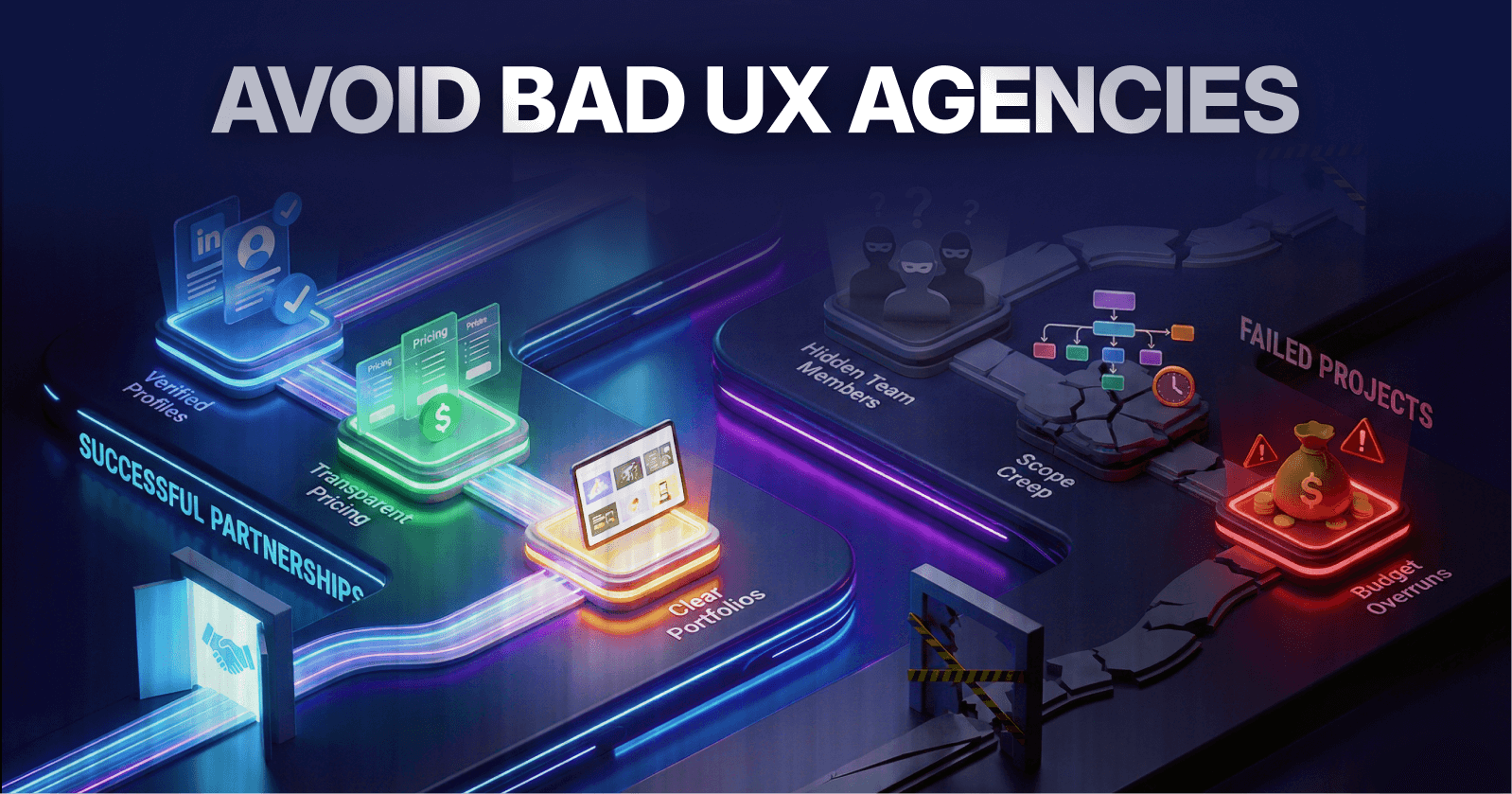
Table of Contents
No headings found in Blog Content.
Share

Risk of Cheap UX Agencies:
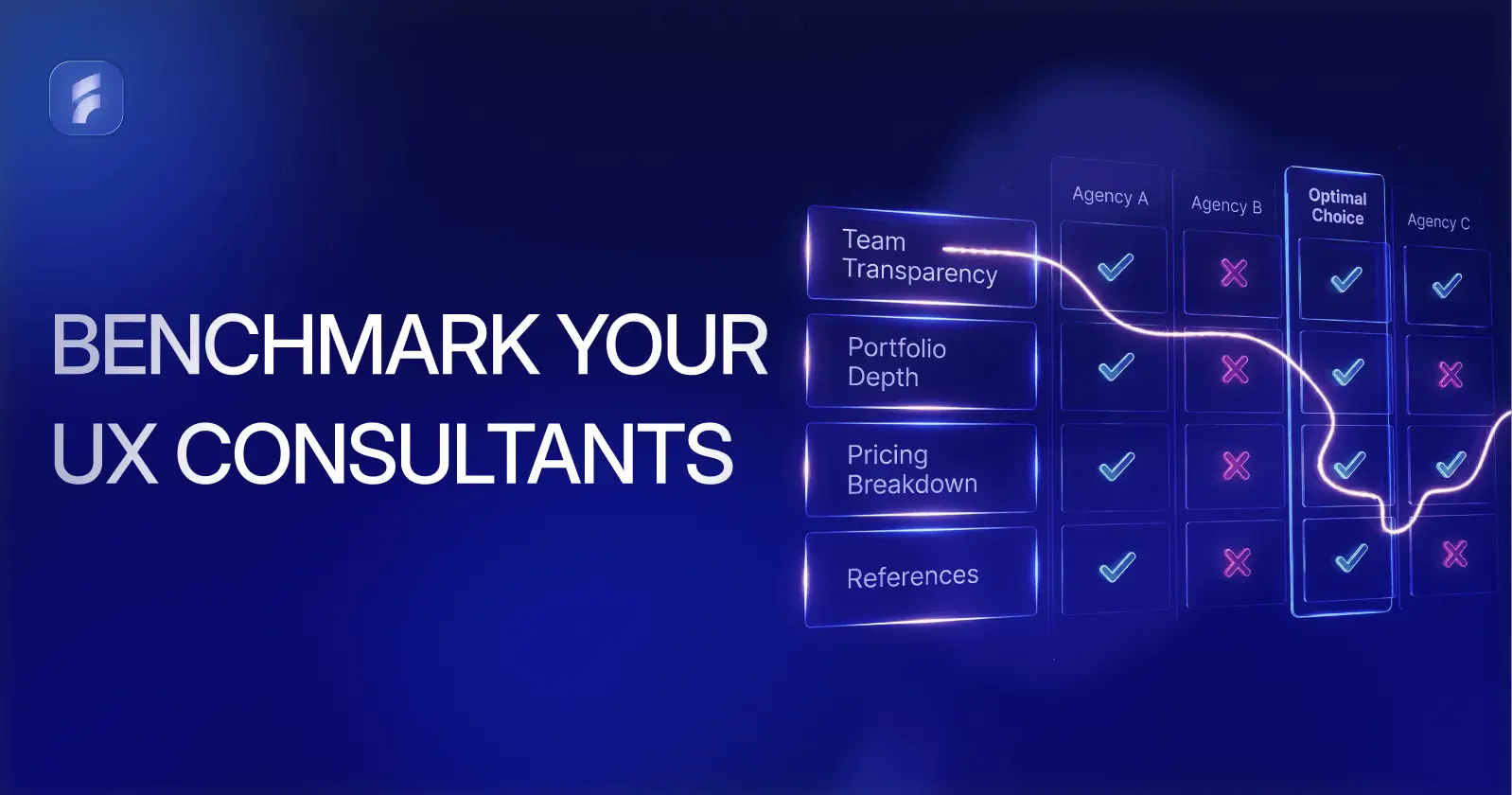
Hiring cheap agencies can lead to poor results and wasted time. They often lack experience and fail to align design with business goals.Team Transparency:
Always meet the actual team working on your project. Be wary of agencies with stock photos or vague team bios.Portfolio Integrity:
Request editable files (Figma/Sketch) to see real work, including iterations and data-backed design decisions.Independent Reference Checking:
Don't rely only on provided references—research past clients for honest feedback.Real-Time Collaboration:
Ensure access to live design workspaces (e.g., Figma) for transparency and timely updates.Clear Pricing:
Avoid agencies with vague pricing or hidden costs. Transparent agencies provide itemized breakdowns.Cultural Fit & Communication:
Effective communication is crucial, especially for offshore agencies. Make sure there’s a consistent process and transparency.
You're about to write a check for $20K-$50K to a UX agency. But here's the reality: 40% of SaaS founders regret their agency hire due to hidden inexperience, dishonest scoping, or templated work that kills MRR growth.
The cost isn't just financial. It's 3 to 6 months of delayed product launches, confused users abandoning your onboarding, and competitors gaining ground while you're stuck in redesign hell.
This guide gives you the exact framework to separate legitimate agencies from polished facades, especially crucial when evaluating offshore partners where 2 to 3x cost savings ($15K vs $50K) can accelerate your runway.
Why This Matters Right Now
Before we dive into red flags, understand what's at stake:
The Hidden Cost of Bad Hires:
Wasted spend: $50K+ in failed redesigns
Timeline delays: 4 to 6 months of lost momentum
Opportunity cost: Delayed feature launches = stalled MRR
Team burnout: Your engineers rebuilding what should have worked
The Offshore Opportunity: Eastern European and South Asian agencies deliver identical quality at 40 to 60% lower rates, but only when properly vetted.
The difference between a transformative partnership and a catastrophic mistake comes down to asking the right questions before you sign, and maintaining vigilant honesty checks during the engagement.
Part 1: Pre-Hire Vetting - The 7 Critical Tests
Test 1: The Team Transparency Challenge
What to do: Ask for a 15 minute video call with the actual team members who'll work on your project, today.
What you're testing: Real agencies have nothing to hide. Fake ones use stock photos, generic bios, or offshore juniors they're uncomfortable showing.
Red flag example: Agency lists "Sarah Chen, Senior UX Lead, 10+ years SaaS experience" but her photo matches a Shutterstock model. LinkedIn search yields zero results. When you ask to connect, they say "privacy policy prevents it."
Green flag example: Within 2 hours, you're on Zoom with Ana (Research Lead, 50+ SaaS audits, LinkedIn verified 2019 to present) and Tom (Prototyping Specialist, ex-Intercom). Their profiles match the website 100%.
Action: Request LinkedIn profiles for all named team members. Message 2 directly: "Can you confirm your role on [your company] project?" Silence or denial exposes the fraud.
Test 2: The Portfolio Deep Dive
What to do: Ask to see the actual Figma/Sketch file from their best SaaS dashboard case study, not screenshots.
What you're testing: Real work shows messy iterations, user testing notes, and data-driven pivots. Fake portfolios are polished Dribbble shots with zero substance.
Red flag example: They send a static PDF of a beautiful dashboard. When you ask "walk me through your iterations live for 5 minutes," they ramble without mentioning user data, A/B tests, or metrics.
Green flag example: They share an editable Figma link with 15+ versions showing evolution. Comments reveal real decisions: "V2 reduced task completion time 28% based on session recordings" or "Killed this feature—users ignored it in 12/12 tests."
The follow-up question: "Show me something that failed and how you fixed it." Honest agencies admit mistakes. Fake ones claim perfection.
Test 3: The Reference Blitz
What to do: Don't just call their provided references. Search independently for clients mentioning them on LinkedIn, Twitter, or industry forums.
What you're testing: Curated references always give glowing reviews. Independent research reveals the truth.
How to execute:
Google "[Agency Name] + SaaS" or "[Agency Name] + fintech"
Search LinkedIn posts mentioning them
Find 2-3 past clients on their portfolio
Cold email them: "I'm evaluating [Agency]. What risks did they flag upfront that others missed?"
The golden question: "Did they share failures honestly during the project?"
Real partners admit when they pivoted, missed timelines, or discovered their initial hypothesis was wrong. Fake ones claim flawless execution.
Green flag benchmark: 3+ clients praising process over pixels. Comments like "transparent about blockers" or "admitted when our scope was unrealistic—saved us $15K."
Test 4: The Live Skill Test
What to do: Send them an anonymized screen recording from your product (Hotjar, FullStory) showing a real user struggling. Give them 24 hours to diagnose it.
What you're testing: Pattern recognition, data fluency, and whether they can deliver value before the contract.
Red flag response: Generic advice with zero specificity: "Add better animations" or "Improve the flow" with no mention of metrics or past comparable work.
Green flag response: "Users drop at step 3 because there's no progress indicator creating anxiety. Based on our work with [Client Z], adding micro-onboarding with a 5-step bar increased activation 32%. For your case, I'd expect a 20-25% lift. Here's a quick Figma mockup of the fix."
Why it works: This separates agencies who understand SaaS growth mechanics from pixel-pushers who make things pretty but don't move metrics.
Test 5: The LinkedIn Cross-Check
What to do: Audit every team member's LinkedIn profile for tenure, connections, and endorsements.
What you're testing: Real SaaS expertise vs. fabricated credentials.
Red flag profile:
"UX Researcher, 8 years SaaS experience"
Profile shows 2 years total experience at a cookie-cutter agency
100 connections, zero endorsements
No SaaS companies mentioned in work history
Green flag profile:
500+ connections in SaaS/tech
Specific project mentions: "Led retention redesign for [recognizable SaaS]"
Endorsements from former clients or colleagues
Tenure at agency matches their claims (2019 to present, not started 2023)
The verification step: Message 2 team members directly asking them to confirm their role. Real professionals respond within 48 hours. Ghosting equals fraud.
Test 6: The Pricing Breakdown Challenge
What to do: When they quote you, demand a detailed breakdown: "Of this $25K, what % is research vs. prototyping vs. testing?"
What you're testing: Whether they understand project economics or are winging it with inflated estimates.
Red flag example: "We need to do a full audit first with custom quote after." Then $15K ballpark becomes $45K due to "unforeseen complexities" (classic scope creep setup).
Green flag example: "$25K breaks down: 20% discovery/research ($5K), 40% prototyping ($10K), 25% user testing ($6.25K), 15% handoff/documentation ($3.75K). If you already have user research, we cut the first 20% and start at $20K."
Why this matters: Vague pricing means they're either inexperienced or planning to bleed you with change orders.
Test 7: The Cultural Honesty Filter
What to do: For offshore agencies, test communication quality and timezone alignment during vetting—not after signing.
What you're testing: Whether their "US timezone overlap" claim is real, and if language barriers will derail your project.
Red flag example: Agency claims "daily standups during your business hours" but emails arrive at 3 AM your time. Video call requests get "technical difficulties" excuses for 2 weeks. When you finally connect, accents create 40% comprehension gaps.
Green flag example: First call happens within 24 hours during your 9 AM to 12 PM window. They proactively share: "Our core team works 2 PM to 10 PM your time for 6 hour overlap. English proficiency tested quarterly. Here's our Slack response SLA: 4 hours max, 90 minute average."
The honesty test: Ask, "What's the biggest communication challenge you've had with US clients and how did you fix it?"
Real answer: "One client needed faster Slack replies. We added a dedicated AM responder in their timezone."
Fake answer: "We've never had issues" (impossible).
Part 2: During Engagement - Maintaining Honesty Through Active Partnership
Vetting finds honest agencies. Ongoing communication rituals and contract enforcement keep them honest throughout delivery.
The Weekly Transparency Framework
Once engaged, honesty becomes a daily practice, not a one-time vetting result. Here's how to structure ongoing accountability.
Mandatory Weekly Rituals:
1. The Named Attendee Call (30 minutes, video required)
Real agencies send the same people every week. Rotating faces signal they're juggling too many clients or hiding junior execution.
What to enforce:
Same core team members each call (UX lead, designer, researcher)
Video mandatory, no camera-off exceptions
Prepared agenda sent 24 hours prior
Live Figma/work-in-progress walkthrough, not slide decks
Red flag during engagement: Week 3 call has three new faces you've never met. When you ask "Where's Ana who presented Weeks 1 and 2?" they say "She's on another project now."
Honest response: "Ana's leading research, Tom's executing designs. Same team, every week. Here's our project Slack channel where you'll see daily updates from both."
Consequence clause: No-shows or unapproved substitutions trigger 5% fee deduction from that milestone payment.
2. The Shared Workspace Honesty Test
Honest agencies work transparently. Dishonest ones hide mess until deadline day.
What to demand:
Live Figma/Notion workspace access from Day 1
Daily updates visible in real-time (not "we'll show you Friday")
Comment history preserved (proves iteration, not last-minute scrambles)
Version control with timestamps
How to spot honesty gaps: Check Figma edit history. If 90% of work happens 24 hours before your weekly call, they're not actually working steadily. They're cramming.
Green flag pattern: Daily micro-updates: "Tuesday 2pm: Tested navigation with 5 users, 3 struggled with Settings placement. Wednesday 10am: Moved Settings to top nav, retest Thursday."
Dishonest pattern: Radio silence Monday through Thursday. Friday 11pm: 40 screens suddenly appear before your Saturday call.
3. The Blocker Transparency Ritual
This separates ethical partners from those hiding problems until they explode.
Weekly question to ask: "What's blocked or at risk this week, and what help do you need from us?"
Honest agency response: "Your API docs are unclear on the permissions model. We're designing blind. Can your dev lead do a 15 minute call Tuesday to clarify? This could delay prototyping 3 days if unresolved."
Dishonest agency response: "Everything's great! On track!" (Then Week 8: "Surprise! We need to redesign the entire permissions flow because we misunderstood your API. That's an extra $8K and 3 weeks.")
Why this matters: Agencies that hide blockers are protecting their ego, not your timeline. Demand vulnerability.
4. The Data Honesty Check-In
Every design decision should be defensible with user data, not designer preference.
What to ask bi-weekly: "Show me the data behind your last 3 design decisions."
Honest agency shows:
Session recordings: "Users clicked Settings icon 47 times but it did nothing, frustration evident"
A/B test results: "Version B increased trial signups 23%, here's the Optimizely report"
Support ticket analysis: "18 tickets about 'can't find export' in 2 weeks, so we elevated it"
Dishonest agency says: "Our expert designers know what works. Trust the process."
Translation: "We're guessing and hoping you don't ask for proof."
5. The Honest Pivot Protocol
Ethical agencies admit when initial assumptions were wrong. Dishonest ones double down to avoid looking incompetent.
What to establish upfront: "If user testing invalidates our direction, we pivot immediately even if it means scrapping work. Honesty over ego."
Real example of honesty: Week 4: "Our dashboard concept tested poorly. 7 out of 10 users couldn't complete basic tasks. We're proposing a simplified version that cuts 40% of features but increases usability. This doesn't cost you extra, we'll absorb the rework."
Dishonest alternative: Week 4: "Testing went great! Users loved it!" (Proceeds with doomed design because admitting failure feels risky.)
How to verify: Attend user testing sessions yourself via Zoom. Don't let them filter feedback.
Milestone-Based Payments (Never 100% Upfront)
Structure:
25% on signed SOW
30% after research deliverable (personas, user flows, benchmarks)
30% after tested prototypes with your real users
15% on final handoff with documentation
Why: If they disappear or underdeliver, you haven't lost everything. Include: "Non-delivery within agreed timeline = full refund + 10% penalty."
Weekly Transparency Rituals
What to enforce:
30 minute video call with named attendees (not rotating stand ins)
Shared Figma/Notion workspace updated daily
Mandatory attendance: no shows trigger 5% fee deduction
For offshore teams: Alternate call times. Week 1 at your 9 AM, Week 2 at your 6 PM. Fair burden sharing builds trust.
Async tools: Slack #daily-wins channel + Loom video updates for non-urgent items.
Escalation Clauses (Define Disputes Upfront)
Progressive enforcement:
Week 1 delay: written warning
Week 2 delay: 10% payment reduction + third party mediator
Week 3 delay: contract termination, IP returned, refund issued
Offshore-specific: Specify English fluency minimum ("90% mutual comprehension in verbal calls") and 4-hour response SLAs during overlap windows.
Independent Audit Rights
What to include: "All deliverables must achieve 75%+ approval rating in client-run user testing. Failures require free rework until threshold met."
How to execute: Run prototypes through UserTesting.com or Maze with your actual user segment. Data driven agencies welcome this. It proves their work.
The moral anchor clause: "Agency prioritizes client MRR growth over billable hours. Misalignment justifies early termination."
Part 3: Green Flags That Signal Real Partners
Once you've eliminated the fakes, look for these positive signals:
1. Proactive Risk Flagging
What it looks like: Before signing, they tell you: "Your proposed scope skips retention testing. Without it, you risk 20% churn rebound post-launch. Here's a free 2-week addition or we de-prioritize feature X."
Why it matters: They're optimizing for your success, not their invoice.
2. Process-First Discovery
What it looks like: "Week 1: Free UX audit of your current product + roadmap. If we're not the right fit after seeing your data, we walk away with no charge."
Why it matters: Forced fit agencies push contracts. Great ones prioritize mutual success.
3. Long-Term Client Retention
What to ask: "How many clients have you worked with for 12+ months?"
Green flag answer: "47% of our revenue comes from retainer clients we've had 18+ months. Here are three. Call them."
What it proves: They deliver ongoing value, not one-time projects that fall apart post-launch.
4. Data Over Decoration
What it looks like: Case studies filled with metrics, not hero shots. "Dashboard V1: 18% activation. V6 (after session analysis): 42% activation. Raw data attached."
Red flag alternative: Dribbble-style portfolios with zero numbers, no mention of business impact, just pretty pixels.
5. Candid Failure Stories
What to ask: "Tell me about a project that went sideways and what you learned."
Green flag answer: "We designed a complex flow for [Client] that bombed in testing. Users abandoned 80% through. We pivoted to a 3 click MVP based on support ticket analysis and hit 65% completion. Learned to validate assumptions before building."
Why it matters: Honesty about failures predicts honesty during your project.
The Offshore Advantage (When Done Right)
Cost reality:
US agency redesign: $40K to $80K
Vetted offshore agency: $15K to $30K
Quality difference when properly vetted: Zero
Where to find gems:
Eastern Europe (Ukraine, Poland): Strong technical UX, English fluency
India: Massive talent pool, 12 hour timezone offset (plan async workflows)
Latin America: Timezone alignment with US, cultural similarities
The vetting multiplier: Offshore savings are meaningless if you hire the wrong team. Use every test in this guide 2x as rigorously for international partners.
The Bottom Line
The stakes: Your next agency hire either accelerates your path to $1M ARR or sets you back 6 months and $50K.
The honest partnership framework: Pre hire vetting identifies agencies with integrity. During engagement communication rituals maintain that honesty daily.
The green light criteria:
✓ Real team with verifiable LinkedIn profiles
✓ Portfolio showing messy iterations + data
✓ Independent references praising honesty over perfection
✓ Live skill test proves competence before contract
✓ Transparent pricing with detailed breakdowns
✓ Proactive risk flagging during discovery
✓ Long term client relationships (12+ months)
✓ Weekly transparency calls with named, consistent attendees
✓ Real time workspace access showing daily progress
✓ Blocker honesty every single week
✓ Willingness to pivot when data proves them wrong
The offshore reality: When vetted properly, international agencies deliver identical quality at 40 to 60% cost savings. When vetted poorly, they're your most expensive mistake.
Your decision framework: If an agency fails even ONE test in this guide or refuses any transparency ritual during engagement, walk away. Ethical partners exist. Demand them.
The best UX agencies don't just redesign your interface. They become morally invested partners in your revenue growth, flagging risks you didn't see, admitting failures before they compound, and celebrating MRR milestones like they're their own.
That's the integrity standard. Accept nothing less.