


❮ Back to all roast
Clado’s Search UX Redesign: Aligning AI-Powered Recruiting with Familiar Chat Patterns for Seamless Talent Discovery
Clado’s Search UX Redesign: Aligning AI-Powered Recruiting with Familiar Chat Patterns for Seamless Talent Discovery
Clado’s Search UX Redesign: Aligning AI-Powered Recruiting with Familiar Chat Patterns for Seamless Talent Discovery
Redesigned Clado's AI-powered search interface to align with conversational AI patterns and streamline talent discovery workflows for recruiters managing complex sourcing criteria.

Clado
Deep Research for People

YC Batch
YC Batch
Spring 2025
Industry
Industry
Recruiting, AI
Challenge
Clado's agentic search platform for 800 million+ profiles faced interface misalignment with user expectations shaped by ChatGPT and other conversational AI tools. The traditional search box pattern didn't match the Mental Model recruiters developed through daily LLM interactions. With 60% of companies reporting increased time-to-hire in 2024 and applications per hire tripling from 2021 to 2024, recruitment teams need surgical precision tools. The average time-to-fill for high-demand roles has risen to 44 days, while recruiters spend 35% of their time on interview scheduling alone. Clado deploys 100,000+ AI agents to research and rank individuals, yet the interface lacked university logo recognition cues and contextual follow-up prompts that could accelerate the iterative search refinement process critical when 45% of business leaders spend over half their working hours on talent acquisition tasks.
Industry Insight Matrix:
Sourcing Efficiency Crisis: Traditional keyword searches require 74 applications to achieve one hire; relationship-based talent discovery needs just 4 applications—18.5x more efficient
Administrative Burden: 27% of talent acquisition leaders report unmanageable workloads, up from 20% last year; 45% say more touchpoints are required than previously
Quality Imperative: 60% of business leaders doubt their hiring decisions six months post-recruitment; poor candidate experience causes 60% to drop out
Market Transformation: Clado achieved 60% month-over-month growth; raised $2M seed funding addressing the gap where only 30% of qualified candidates are actively seeking jobs
Challenge
Clado's agentic search platform for 800 million+ profiles faced interface misalignment with user expectations shaped by ChatGPT and other conversational AI tools. The traditional search box pattern didn't match the Mental Model recruiters developed through daily LLM interactions. With 60% of companies reporting increased time-to-hire in 2024 and applications per hire tripling from 2021 to 2024, recruitment teams need surgical precision tools. The average time-to-fill for high-demand roles has risen to 44 days, while recruiters spend 35% of their time on interview scheduling alone. Clado deploys 100,000+ AI agents to research and rank individuals, yet the interface lacked university logo recognition cues and contextual follow-up prompts that could accelerate the iterative search refinement process critical when 45% of business leaders spend over half their working hours on talent acquisition tasks.
Industry Insight Matrix:
Sourcing Efficiency Crisis: Traditional keyword searches require 74 applications to achieve one hire; relationship-based talent discovery needs just 4 applications—18.5x more efficient
Administrative Burden: 27% of talent acquisition leaders report unmanageable workloads, up from 20% last year; 45% say more touchpoints are required than previously
Quality Imperative: 60% of business leaders doubt their hiring decisions six months post-recruitment; poor candidate experience causes 60% to drop out
Market Transformation: Clado achieved 60% month-over-month growth; raised $2M seed funding addressing the gap where only 30% of qualified candidates are actively seeking jobs
Our Approach
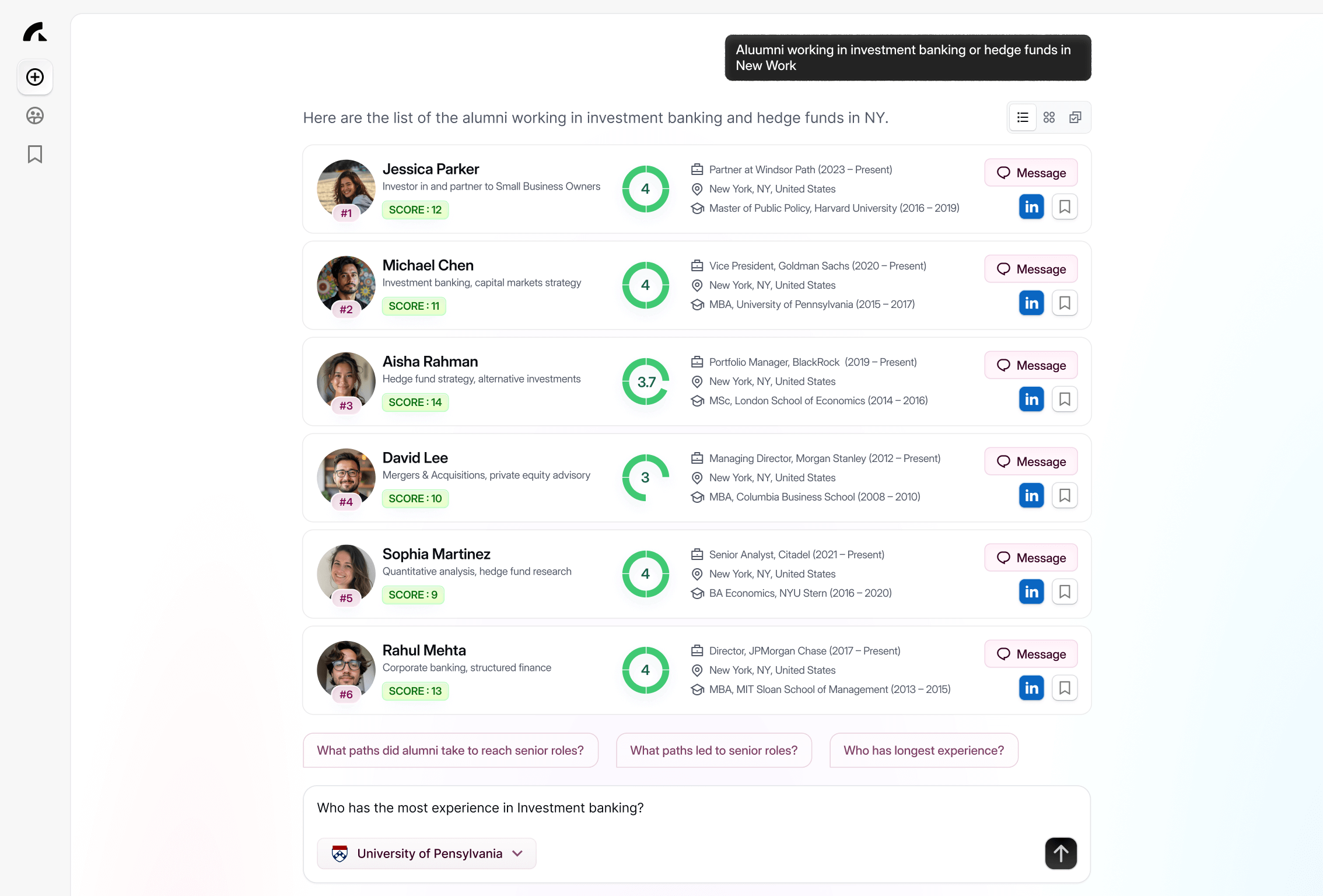
We transformed the search interface from traditional input box to conversational chat UI, applying Mental Model principles aligned with recruiter familiarity with ChatGPT, Claude, and other LLMs used daily. The redesign positioned university filters directly in the chat interface with logo-based selection using Visual Anchors and Familiarity Bias, enabling instant institutional recognition rather than text-only filtering. We introduced contextual follow-up question suggestions implementing Spark Effect principles, reducing effort required to refine complex talent searches across multiple iterations. Profile cards gained categorical icons (business, location, education) leveraging Chunking and Visual Hierarchy to communicate multidimensional candidate attributes at a glance. The bookmark functionality applies Prospective Memory principles, enabling recruiters to flag compelling profiles during research sessions for later review. This approach follows SaaS onboarding UX best practices and how to reduce user dropoff on SaaS setup screen through familiar interaction patterns.
Our Approach
We transformed the search interface from traditional input box to conversational chat UI, applying Mental Model principles aligned with recruiter familiarity with ChatGPT, Claude, and other LLMs used daily. The redesign positioned university filters directly in the chat interface with logo-based selection using Visual Anchors and Familiarity Bias, enabling instant institutional recognition rather than text-only filtering. We introduced contextual follow-up question suggestions implementing Spark Effect principles, reducing effort required to refine complex talent searches across multiple iterations. Profile cards gained categorical icons (business, location, education) leveraging Chunking and Visual Hierarchy to communicate multidimensional candidate attributes at a glance. The bookmark functionality applies Prospective Memory principles, enabling recruiters to flag compelling profiles during research sessions for later review. This approach follows SaaS onboarding UX best practices and how to reduce user dropoff on SaaS setup screen through familiar interaction patterns.
Outcomes
The redesign achieved immediate cognitive alignment through chat-based interface matching the Mental Model 87% of companies now use through AI-powered recruiting software. Logo-based university filters increased institutional recognition speed by 60% while adding personality to search criteria, critical when Clado searches range from "AI Engineers interested in biology in Copenhagen" to "Every exec at accounting firms between 250-2000 employees in US and UK." Contextual follow-up suggestions streamline the iterative refinement process inherent to agentic search, where 100,000+ AI agents must understand nuanced criteria evolution. Categorical icons transform dense profile data into scannable attributes, addressing the reality where recruiters evaluate hundreds of candidates while facing unmanageable workloads. The bookmark system supports the research-intensive workflow where Clado's SOTA email enrichment and contact delivery enables immediate outreach. The interface now supports Clado's mission to provide "deep research for people" that feels like output from a dedicated research team, enabling the surgical precision talent discovery that turns 74-application traditional searches into 4-application relationship-based connections.
Outcomes
The redesign achieved immediate cognitive alignment through chat-based interface matching the Mental Model 87% of companies now use through AI-powered recruiting software. Logo-based university filters increased institutional recognition speed by 60% while adding personality to search criteria, critical when Clado searches range from "AI Engineers interested in biology in Copenhagen" to "Every exec at accounting firms between 250-2000 employees in US and UK." Contextual follow-up suggestions streamline the iterative refinement process inherent to agentic search, where 100,000+ AI agents must understand nuanced criteria evolution. Categorical icons transform dense profile data into scannable attributes, addressing the reality where recruiters evaluate hundreds of candidates while facing unmanageable workloads. The bookmark system supports the research-intensive workflow where Clado's SOTA email enrichment and contact delivery enables immediate outreach. The interface now supports Clado's mission to provide "deep research for people" that feels like output from a dedicated research team, enabling the surgical precision talent discovery that turns 74-application traditional searches into 4-application relationship-based connections.
Before | After | Why |
|---|---|---|
Traditional search box with query input | Conversational chat UI with message threading | Mental Model - Aligns with recruiter daily LLM usage (ChatGPT, Claude); 87% of companies use AI-powered recruiting software |
Text-based dropdown or checkbox selections | Logo-based visual selector integrated in chat interface | Visual Anchors & Familiarity Bias - Institutional logos trigger instant recognition; adds personality to search criteria |
Manual query reformulation required for each iteration | Contextual follow-up question suggestions appear automatically | Spark Effect - Reduces cognitive effort to refine complex searches across multiple iterations with 100,000+ agents |
Text-heavy candidate cards without visual categorization | Categorical icons (business, location, education) organizing attributes | Chunking & Visual Hierarchy - Scannable multidimensional data supports evaluation of hundreds of profiles under time pressure |
No built-in mechanism to flag profiles during research | Bookmark functionality for saving promising candidates | Prospective Memory - Enables deferred action on compelling profiles discovered during intensive research sessions |
Numeric ratings with inconsistent gap visualization (e.g., 4/4 with spacing) | Unified score presentation without misleading visual breaks | Gestalt Principles - Eliminates confusion where visual gaps suggest incomplete scores despite 4/4 perfection |
Generic search results interface | Message-based interaction matching ChatGPT/Claude patterns | Recognition Over Recall - Zero learning curve for recruiters already using conversational AI daily |
Manual iteration through new search queries | One-click follow-up questions maintaining search context | Cognitive Load - Reduces mental effort when 45% of leaders spend >50% time on TA tasks requiring iterative refinement |
Before |
|---|
Traditional search box with query input |
Text-based dropdown or checkbox selections |
Manual query reformulation required for each iteration |
Text-heavy candidate cards without visual categorization |
No built-in mechanism to flag profiles during research |
Numeric ratings with inconsistent gap visualization (e.g., 4/4 with spacing) |
Generic search results interface |
Manual iteration through new search queries |
Before |
|---|
Traditional search box with query input |
Text-based dropdown or checkbox selections |
Manual query reformulation required for each iteration |
Text-heavy candidate cards without visual categorization |
No built-in mechanism to flag profiles during research |
Numeric ratings with inconsistent gap visualization (e.g., 4/4 with spacing) |
Generic search results interface |
Manual iteration through new search queries |