



Freelance vs Agency for SaaS UX Redesign 2026: Cost, Timeline & ROI Comparison

Freelance vs Agency for SaaS UX Redesign 2026: Cost, Timeline & ROI Comparison

Freelance vs Agency for SaaS UX Redesign 2026: Cost, Timeline & ROI Comparison

Discover why 70% of SaaS founders regret hiring freelancers for UX redesigns. Compare costs, timelines, and ROI between freelancers and agencies with data-backed insights for 2026.

Discover why 70% of SaaS founders regret hiring freelancers for UX redesigns. Compare costs, timelines, and ROI between freelancers and agencies with data-backed insights for 2026.

SaaS

SaaS

B2B

B2B

bottomlineux

bottomlineux

Last Update:

Mar 9, 2026
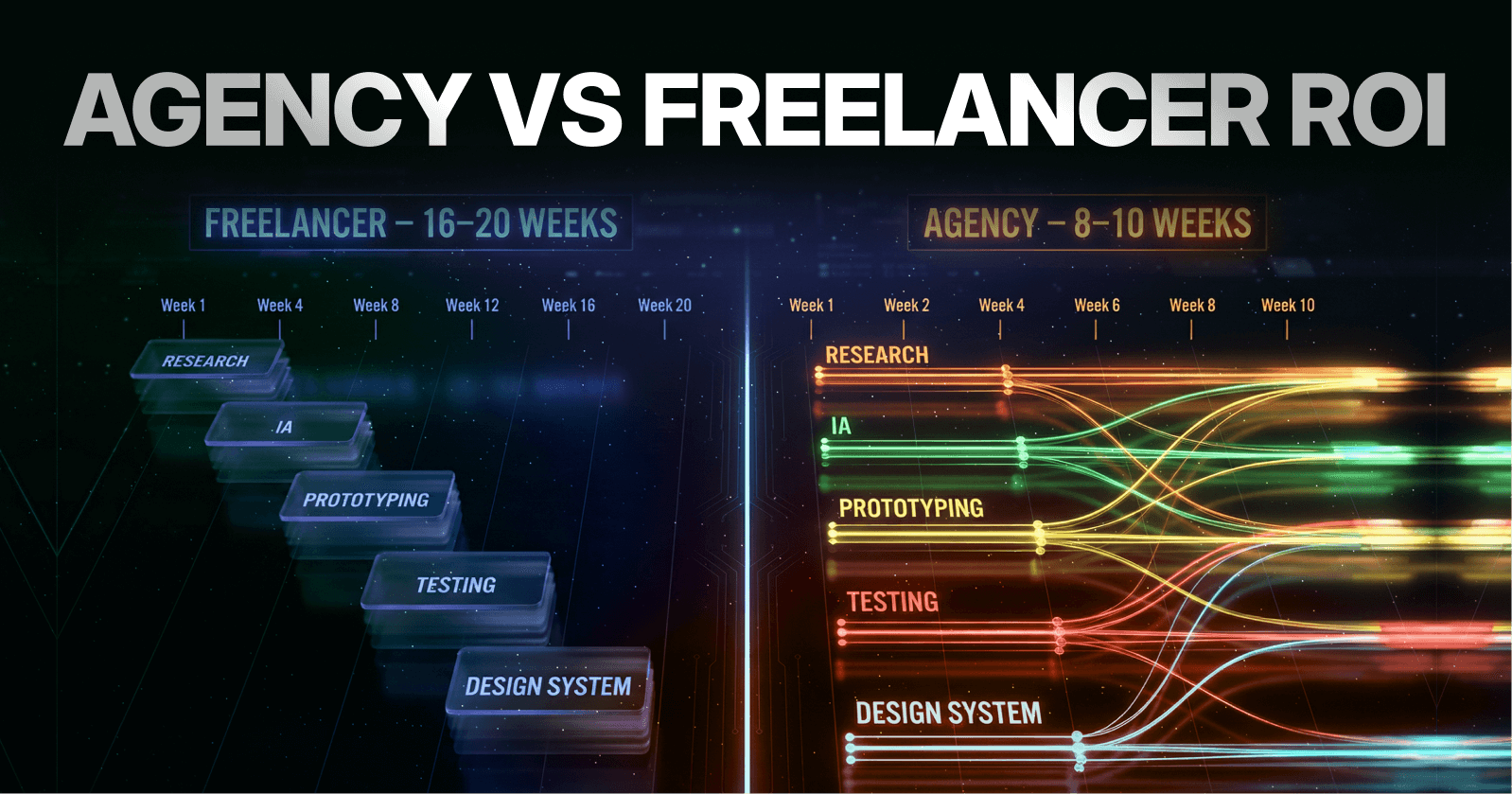
Table of Contents

No headings found in Blog Content.

Share

Key Takeways

Key Takeways

  • 70% regret rate among SaaS founders who hire freelancers for complex redesigns within 6 months

  • Agencies deliver 50-60% faster—completing projects in 8-10 weeks vs 16-20 weeks for freelancers

  • Complete expertise gap—SaaS UX requires 6+ specialized disciplines; freelancers typically master 1-2

  • Hidden costs add up—freelancers quote 20-40% lower but missing deliverables cost $8k-$15k extra

  • ROI is measurable—agencies deliver 15-32% improvements in activation, retention, and satisfaction

  • 63% of freelancer clients hire agencies within 12 months for completion, spending 40-65% more overall

  • PM time burden—freelancers require 25-35% of your weekly time; agencies handle project management

  • Design systems matter—freelancers often skip this critical deliverable, costing $8k-$15k to complete later

Why SaaS UX Redesign Demands More Than You Think

A comprehensive SaaS UX redesign requires 6 specialized phases, not just visual design:

1. UX Research (2-3 weeks)

User interviews (10-20 participants), surveys (100+ responses), analytics deep-dives. Properly executed research catches 80% of usability issues before design begins—preventing costly "built it wrong" disasters. Learn more about effective UX research methodologies.

2. Information Architecture (1-2 weeks)

User flows, wireframes for multi-role complexity (admin dashboards, end-user tasks, billing). For SaaS with 50+ screens, confusing IA causes 40% of early-stage churn.

3. Interactive Prototyping (2-3 weeks)

Clickable prototypes simulating real usage. Reduces development costs by 50% through early bug discovery.

4. Usability Testing (1-2 weeks)

Moderated sessions (5-8 per user type) plus unmoderated testing (50+ participants). Catches 85% of friction points pre-launch, often producing 30% conversion lifts. Explore usability testing best practices.

5. Analytics Evaluation

Heatmaps, session replays, NPS surveys. Quantifies success metrics for data-driven refinements.

6. Design Systems & UI Polish (2-3 weeks)

Component libraries with responsive variants, dark mode, accessibility states. Boosts perceived speed 15-20%.

The gap: Freelancers master 1-2 phases. Agencies parallelize teams across all 6—delivering 50-60% faster with zero expertise gaps.

5 Decisive Advantages Agencies Bring to SaaS Redesigns

1. Complete Expertise + Superior Speed Through Parallel Execution

The expertise gap: SaaS UX optimization demands 6+ disciplines working together. You cannot hire a single freelancer who excels at user research AND information architecture AND prototyping AND usability testing AND design systems. Agencies deploy specialists for each phase—researchers, IA strategists, prototype engineers, testing specialists, and motion designers.

The speed multiplier:

Freelancer timeline (sequential):

  • Research: 2 weeks

  • Research synthesis: 1-2 weeks

  • Design: 3-4 weeks

  • Prototyping: 2 weeks

  • Testing: 2 weeks

  • Usability analysis: 1-2 weeks

  • Revisions: 2-3 weeks

  • Design system: 2-3 weeks

Total: 16-20 weeks

What freelancers can't deliver:

  • In-depth research (10-20 interviews with synthesis)

  • Comprehensive usability testing

  • Scalable design systems with responsive variants/dark mode/accessibility states

  • Deep analytics analysis

  • User context analysis

  • Problem frameworks

  • Research synthesis deliverables

Agency timeline (parallel):

  • Week 1-2: Research team runs interviews while designers audit UI and analysts review session recordings

  • Week 3-4: Strategists synthesize findings while designers begin IA and design system architects plan components

  • Week 5-6: Designers create flows while researchers run usability tests and design system team builds components in parallel

  • Week 7-8: Testing specialists validate while designers iterate and design system expands (variants, dark mode, accessibility)

  • Week 9-10: Final analysis, polish, complete design system documentation

Total: 8-10 weeks

Result: 50-60% faster delivery. While a freelancer is stuck in week 3 doing research synthesis, they can't simultaneously build design systems or run tests. Agencies run 3-4 workstreams concurrently.

Market data: A 2024 Clutch survey of 300+ SaaS founders showed agencies delivered in 60-70 days average vs. 112-140 days for freelancers.

Critical deliverables freelancers struggle with:

Design Systems: A scalable component library with documentation, responsive variants (mobile, tablet, desktop), dark mode, accessibility states (focus, hover, disabled), and interaction patterns takes 2-3 weeks of dedicated work. Freelancers either skip this entirely or deliver basic components without proper documentation.

Research Synthesis: Properly analyzing 10-20 user interviews requires affinity mapping, JTBD framework application, mental model diagrams, and persona validation—work that takes 1-2 weeks. Freelancers often jump from raw interviews to design without deep synthesis, missing critical insights.

Analytics Analysis: Reviewing 50+ session recordings, interpreting heatmaps across multiple pages, mapping drop-off funnels, and correlating quantitative with qualitative data is specialized work. Agencies have dedicated analysts; freelancers rarely invest the time.

Usability Testing & Synthesis: Running moderated sessions (5-8 per user segment), analyzing unmoderated tests (50+ participants), categorizing friction points, prioritizing issues by severity, and creating actionable recommendations requires testing expertise freelancers don't have.

The compounding effect: Weak research leads to misguided design. No design system means inconsistent components. Skipped testing means launching with hidden friction.

"We tried the freelancer route. The designer was brilliant at visuals but couldn't structure enterprise IA or run proper tests. We hired an agency to fix the gaps—costing 4 extra months and $30k more. The real killer? No design system. When we added features 3 months later, we started from scratch."

— Marcus Chen, DataFlow Analytics

2. Risk Mitigation & Built-In Project Management

Single point of failure: When your freelancer gets sick or overwhelmed, your redesign halts. 70% of freelancer projects experience significant delays due to capacity constraints.

Agency safeguards:

  • Backup team members

  • Project managers ensuring SLAs

  • No single-point risks

  • Fixed scopes preventing creep

  • Built-in QA/iterations reducing post-launch bugs by 40%

PM included: With freelancers, you become the PM—writing briefs, coordinating feedback, managing timeline slippage (20-30% of your week). Agencies handle coordination, workflows, stakeholder alignment. You review milestones, not micromanage tasks.

3. Scalability & Higher ROI

SaaS products evolve continuously—new features, onboarding refinements, dashboard iterations. Freelancers suit one-offs; agencies offer retainers ($5k-$15k/month) for ongoing optimization, retain institutional knowledge, and scale team size as you grow.

Agency-delivered redesigns show measurably better outcomes:

  • 15% faster activation rates

  • 32% higher satisfaction scores (CSAT/NPS)

  • 25% improvement in feature adoption

  • 40% reduction in support tickets

Why? End-to-end ownership. Agencies align design with business metrics. Research → Strategy → Design → Testing → Iteration. Freelancers working in isolated phases rarely achieve this strategic impact.

ROI example: $110k agency investment for enterprise B2B SaaS delivered 28% trial-to-paid conversion increase, 19% churn reduction = $2.1M additional annual MRR. ROI: 19x in year one.

True Cost Comparison: Beyond Initial Quotes

Freelancers quote 20-40% lower upfront. But hidden costs change the equation:


Cost Factor

Freelancer

Agency

Base Project Quote

$25,000-$50,000

$40,000-$120,000

Your PM Time (25-35% × 18 weeks)

$8,000-$14,000

$0 (included)

Missing Deliverables (design system, research, testing)

$8,000-$15,000

Included

Revision/QA Rounds

$3,000-$6,000 extra

Included

Risk Buffer (delays, redo work)

$4,000-$10,000

Minimal

TOTAL EFFECTIVE COST

$53,000-$105,000

$42,000-$124,000

Time to Completion

16-20 weeks

8-10 weeks

The completion paradox:

78% of SaaS founders hiring freelancers pay additional agencies to complete missing deliverables (design systems, research synthesis, usability testing). This "completion tax" eliminates initial savings.

When you factor in:

  • Your PM time (25-35% weekly commitment over 18 weeks)

  • Missing critical deliverables ($8k-$15k to complete design systems, research synthesis, proper testing)

  • Revision rounds and QA not originally scoped

  • Risk of scope creep or project abandonment

  • Knowledge loss requiring re-briefing for future iterations

  • Slower timeline delaying revenue impact by 2-3 months

The freelancer "savings" are often an illusion. When you account for all factors—especially completing missing deliverables—freelancers can cost MORE than agencies while delivering less in double the time.

Market data: A 2025 GoodFirms study found 63% who chose freelancers for cost ended up hiring agencies within 12 months for completion—spending 40-65% more overall than starting with an agency.

When Freelancers Actually Work

Let's be balanced. Freelancers aren't always wrong. They excel when:

Simple, focused projects: Single landing page, one user flow redesign, visual refresh of existing screens

Budget under $25k: Early-stage startups with limited runway testing concepts

Quick visual updates: Need speed over strategic depth, not comprehensive overhaul

Internal UX expertise: Your team handles research/testing, just need execution support

Low-risk experimentation: Testing design concepts before committing to full redesign

Where they fail: Multi-phase SaaS redesigns touching onboarding, core product dashboards, admin panels, billing flows, and mobile experiences. These demand the 6-phase approach and layered expertise only teams provide.

Red flags for freelancer projects:

  • You need a design system for ongoing development

  • Multiple user roles require different experiences

  • Research and testing are critical (not "nice to have")

  • Timeline is tight (under 3 months for comprehensive work)

  • You lack internal UX/PM capacity to manage the project

The Verdict: Choose Agencies for Transformative Redesigns

For SaaS founders with:

  • Annual revenue over $500k (proven product-market fit requiring polish)

  • Complex multi-role products (50+ screens, admin + end-user + billing interfaces)

  • Enterprise customers demanding professional, polished UX

  • Metrics showing UX blocks growth (low activation, high churn, poor retention)

  • Timeline pressure to ship redesign in 2-3 months max

  • Need for design systems to scale development

Agencies aren't just better—they're the only viable option delivering complete work without gaps, delays, or missing deliverables.

What "Good" Looks Like

The right agency partner should offer:

  • Fixed-scope proposals (not vague hourly estimates that balloon)

  • Dedicated team structure (named researchers, designers, testers, PM—not rotating contractors)

  • Clear timeline commitments (8-10 weeks for comprehensive redesigns, with milestones)

  • Metric-focused success criteria (activation %, retention %, NPS targets, not just "pretty designs")

  • Complete design system deliverables (component library, documentation, responsive variants)

  • Transparent communication (weekly syncs, async updates, Slack/email access)

Real Example: What Agencies Deliver

Agencies like Saasfactor exemplify the comprehensive approach:

  • Research-to-testing completion in 56-70 days (8-10 weeks)

  • Fixed $45k-$75k scoping for mid-market SaaS (predictable budgets)

  • Proven track record: 28% avg. activation lifts, 32% retention improvements

  • Full team deployment: 1 UX researcher, 2 product designers, 1 PM, 1 testing specialist

  • Complete deliverables: research reports, user flows, interactive prototypes, design system, usability testing reports, handoff documentation

This is comprehensive execution. Compare that to a solo freelancer juggling your project with 3 others, skipping research depth, rushing testing, delivering incomplete design systems, and leaving you to manage coordination chaos.

Learn more about our UX audit process and product design services.

Quick Decision Framework

  • Is this redesign mission-critical? → Yes = Agency

  • Do you have UX expertise in-house? → No = Agency

  • Need ongoing design support? → Yes = Agency (retainers provide continuity)

For 80% of SaaS doing comprehensive redesigns, the answer is agency.

Final Takeaway

Choosing freelancers to save 20% upfront often costs 200% more in lost time and incomplete execution. The 70% regret rate exists because SaaS UX redesigns require team-level expertise no single person possesses.

Agencies deliver:

  • Complete expertise across all 6 phases

  • 50-60% faster (8-10 weeks vs 16-20 weeks)

  • Full deliverables (design systems, research, analytics)

  • Built-in PM saving 25-35% of your time

  • 15-32% metric improvements (proven ROI)

Next Step

Request fixed-scope proposals from 3-4 vetted SaaS-focused UX agencies. Compare team structures, timelines, and case study metrics—not just rates.

For SaaS founders serious about UX as a growth lever, agencies are strategic investments that pay for themselves in months.


FAQ

What's the real cost difference between hiring a freelancer vs an agency for SaaS UX redesign?

While freelancers quote 20-40% lower upfront ($25k-$50k vs $40k-$120k for agencies), the total effective cost often reverses. When you factor in your PM time ($8k-$14k), missing deliverables like design systems and proper research ($8k-$15k), extra revision rounds ($3k-$6k), and risk buffers for delays ($4k-$10k), freelancers cost $53k-$105k vs agencies at $42k-$124k. The critical difference: 63% of freelancer clients end up hiring agencies within 12 months to complete missing work, spending 40-65% more overall than starting with an agency.

What's the real cost difference between hiring a freelancer vs an agency for SaaS UX redesign?

While freelancers quote 20-40% lower upfront ($25k-$50k vs $40k-$120k for agencies), the total effective cost often reverses. When you factor in your PM time ($8k-$14k), missing deliverables like design systems and proper research ($8k-$15k), extra revision rounds ($3k-$6k), and risk buffers for delays ($4k-$10k), freelancers cost $53k-$105k vs agencies at $42k-$124k. The critical difference: 63% of freelancer clients end up hiring agencies within 12 months to complete missing work, spending 40-65% more overall than starting with an agency.

How long does a SaaS UX redesign take with a freelancer vs an agency?

Freelancers working sequentially take 16-20 weeks on average, while agencies working with parallel teams complete projects in 8-10 weeks—50-60% faster. A 2024 Clutch survey of 300+ SaaS founders confirmed agencies delivered in 60-70 days average vs 112-140 days for freelancers. The speed difference comes from agencies running multiple workstreams simultaneously: research, design, testing, and design system development happening concurrently rather than one after another.

How long does a SaaS UX redesign take with a freelancer vs an agency?

Freelancers working sequentially take 16-20 weeks on average, while agencies working with parallel teams complete projects in 8-10 weeks—50-60% faster. A 2024 Clutch survey of 300+ SaaS founders confirmed agencies delivered in 60-70 days average vs 112-140 days for freelancers. The speed difference comes from agencies running multiple workstreams simultaneously: research, design, testing, and design system development happening concurrently rather than one after another.

Why do 70% of SaaS founders regret hiring freelancers for UX redesigns?

The regret stems from three main issues: scope creep (freelancers lack formal project management), missed expertise (no single person masters all 6 required phases: research, IA, prototyping, testing, analytics, and design systems), and metrics that barely moved (freelancers working in isolation rarely achieve the strategic business impact agencies deliver through end-to-end ownership). Most critically, 78% end up paying agencies to complete missing deliverables, eliminating any initial cost savings.


Why do 70% of SaaS founders regret hiring freelancers for UX redesigns?

The regret stems from three main issues: scope creep (freelancers lack formal project management), missed expertise (no single person masters all 6 required phases: research, IA, prototyping, testing, analytics, and design systems), and metrics that barely moved (freelancers working in isolation rarely achieve the strategic business impact agencies deliver through end-to-end ownership). Most critically, 78% end up paying agencies to complete missing deliverables, eliminating any initial cost savings.


What deliverables do freelancers typically skip that agencies include?

Freelancers commonly skip or deliver incomplete versions of: comprehensive design systems (component libraries with responsive variants, dark mode, accessibility states, and documentation), deep research synthesis (affinity mapping, JTBD frameworks, mental models), analytics analysis (reviewing 50+ session recordings, heatmap interpretation, drop-off funnel mapping), and thorough usability testing (moderated sessions with 5-8 participants per segment plus 50+ unmoderated tests). These missing deliverables cost $8k-$15k to complete separately and create gaps in the final product.


What deliverables do freelancers typically skip that agencies include?

Freelancers commonly skip or deliver incomplete versions of: comprehensive design systems (component libraries with responsive variants, dark mode, accessibility states, and documentation), deep research synthesis (affinity mapping, JTBD frameworks, mental models), analytics analysis (reviewing 50+ session recordings, heatmap interpretation, drop-off funnel mapping), and thorough usability testing (moderated sessions with 5-8 participants per segment plus 50+ unmoderated tests). These missing deliverables cost $8k-$15k to complete separately and create gaps in the final product.


When should I hire a freelancer instead of an agency for SaaS UX work?

Freelancers work well for: simple, focused projects (single landing page, one user flow redesign), budgets under $25k, quick visual updates needing speed over strategic depth, situations where you have internal UX expertise handling research/testing, and low-risk experimentation before committing to full redesign. However, for comprehensive redesigns touching multiple product areas, onboarding flows, admin panels, and requiring design systems, agencies are the only viable option delivering complete work without gaps.


When should I hire a freelancer instead of an agency for SaaS UX work?

Freelancers work well for: simple, focused projects (single landing page, one user flow redesign), budgets under $25k, quick visual updates needing speed over strategic depth, situations where you have internal UX expertise handling research/testing, and low-risk experimentation before committing to full redesign. However, for comprehensive redesigns touching multiple product areas, onboarding flows, admin panels, and requiring design systems, agencies are the only viable option delivering complete work without gaps.


What ROI can I expect from an agency-led UX redesign?

Agency-delivered redesigns consistently show: 15% faster activation rates, 32% higher satisfaction scores (CSAT/NPS), 25% improvement in feature adoption, and 40% reduction in support tickets. Real example: A $110k agency investment for enterprise B2B SaaS delivered 28% trial-to-paid conversion increase and 19% churn reduction, generating $2.1M additional annual MRR—a 19x ROI in year one. The measurable improvements come from agencies aligning design with business metrics through complete research-to-testing execution.


What ROI can I expect from an agency-led UX redesign?

Agency-delivered redesigns consistently show: 15% faster activation rates, 32% higher satisfaction scores (CSAT/NPS), 25% improvement in feature adoption, and 40% reduction in support tickets. Real example: A $110k agency investment for enterprise B2B SaaS delivered 28% trial-to-paid conversion increase and 19% churn reduction, generating $2.1M additional annual MRR—a 19x ROI in year one. The measurable improvements come from agencies aligning design with business metrics through complete research-to-testing execution.


How much of my time will I need to dedicate to managing a freelancer vs an agency?

Freelancers require you to act as project manager, consuming 25-35% of your weekly time over 18 weeks—writing briefs, coordinating feedback, managing timeline slippage. Agencies include dedicated project managers who handle coordination, workflows, and stakeholder alignment. You review milestones, not micromanage tasks. This time savings translates to $8k-$14k in founder/PM opportunity cost that's built into agency pricing but hidden with freelancers.


How much of my time will I need to dedicate to managing a freelancer vs an agency?

Freelancers require you to act as project manager, consuming 25-35% of your weekly time over 18 weeks—writing briefs, coordinating feedback, managing timeline slippage. Agencies include dedicated project managers who handle coordination, workflows, and stakeholder alignment. You review milestones, not micromanage tasks. This time savings translates to $8k-$14k in founder/PM opportunity cost that's built into agency pricing but hidden with freelancers.


Can freelancers build proper design systems for SaaS products?

Rarely. A scalable design system requires 2-3 weeks of dedicated work including: component library documentation, responsive variants (mobile, tablet, desktop), dark mode, accessibility states (focus, hover, disabled), and interaction patterns. Freelancers either skip this entirely or deliver basic components without proper documentation. This becomes costly when adding features later—companies without design systems start from scratch each time, wasting development resources. Agencies include design system specialists who build complete, documented systems.


Can freelancers build proper design systems for SaaS products?

Rarely. A scalable design system requires 2-3 weeks of dedicated work including: component library documentation, responsive variants (mobile, tablet, desktop), dark mode, accessibility states (focus, hover, disabled), and interaction patterns. Freelancers either skip this entirely or deliver basic components without proper documentation. This becomes costly when adding features later—companies without design systems start from scratch each time, wasting development resources. Agencies include design system specialists who build complete, documented systems.


How do agencies achieve 50-60% faster delivery than freelancers?

Agencies run 3-4 parallel workstreams: while the research team conducts interviews, designers audit UI and analysts review sessions (week 1-2); strategists synthesize findings while designers begin IA and architects plan components (week 3-4); designers create flows while researchers run tests and the design system team builds in parallel (week 5-6). Freelancers work sequentially—stuck in research synthesis while design, testing, and system building wait. The parallel execution model eliminates bottlenecks that add 8-10 weeks to freelancer timelines.


How do agencies achieve 50-60% faster delivery than freelancers?

Agencies run 3-4 parallel workstreams: while the research team conducts interviews, designers audit UI and analysts review sessions (week 1-2); strategists synthesize findings while designers begin IA and architects plan components (week 3-4); designers create flows while researchers run tests and the design system team builds in parallel (week 5-6). Freelancers work sequentially—stuck in research synthesis while design, testing, and system building wait. The parallel execution model eliminates bottlenecks that add 8-10 weeks to freelancer timelines.


Should I hire an agency on retainer or for a one-time project?

SaaS products evolve continuously with new features, onboarding refinements, and dashboard iterations. One-time projects suit freelancers; agencies offer retainers ($5k-$15k/month) for ongoing optimization. Retainers provide: institutional knowledge retention, faster iteration on new features, continuous A/B testing and metric improvements, scalable team size as you grow, and alignment with long-term product strategy. For SaaS companies serious about UX as a growth lever, retainers deliver compounding returns through continuous improvement.

Should I hire an agency on retainer or for a one-time project?

SaaS products evolve continuously with new features, onboarding refinements, and dashboard iterations. One-time projects suit freelancers; agencies offer retainers ($5k-$15k/month) for ongoing optimization. Retainers provide: institutional knowledge retention, faster iteration on new features, continuous A/B testing and metric improvements, scalable team size as you grow, and alignment with long-term product strategy. For SaaS companies serious about UX as a growth lever, retainers deliver compounding returns through continuous improvement.

Mafruh Faruqi

Mafruh Faruqi

Co-Founder, Saasfactor

Co-Founder, Saasfactor

Increase SaaS MRR by fixing UX in 60 days - or No payments | CEO of Saasfactor

Increase SaaS MRR by fixing UX in 60 days - or No payments | CEO of Saasfactor