



Last Update:
Mar 9, 2026
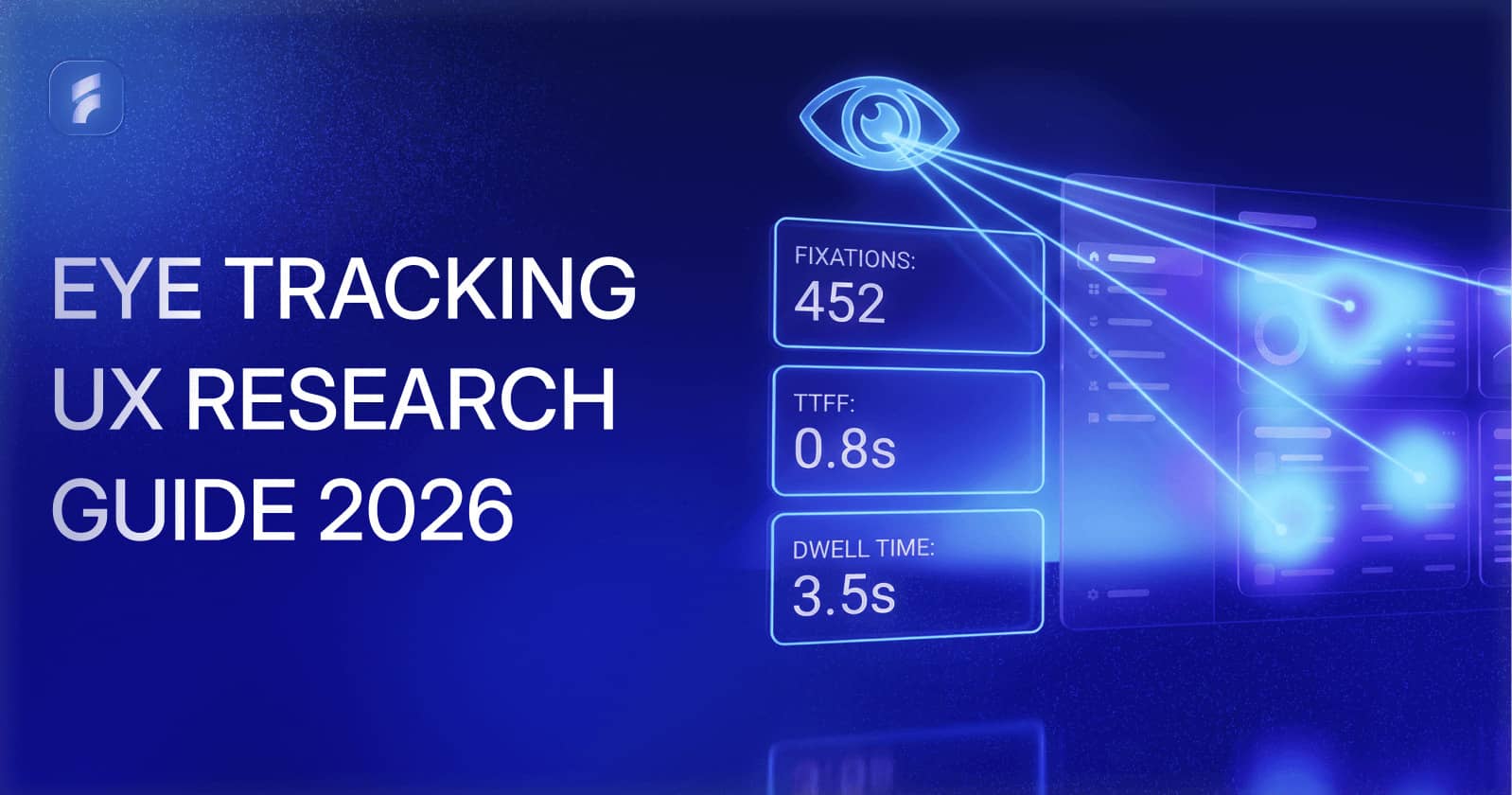
Table of Contents
No headings found in Blog Content.
Share

Eye tracking is one of the most powerful UX research methods available, revealing exactly where users look, what they ignore, and how they navigate digital interfaces in real time.
Unlike surveys or interviews, eye tracking captures subconscious visual behaviour and gives designers objective data that users themselves cannot self-report.
Key eye tracking metrics including fixations, heatmaps, saccades, and time to first fixation provide actionable insights for improving visual hierarchy, CTA placement, and conversion rates.
Eye tracking is used across SaaS, ecommerce, mobile app design, healthcare, and advertising to reduce cognitive load, eliminate content blindness, and optimise user flows.
Modern eye tracking tools range from high-precision lab-grade hardware such as Tobii and iMotions to accessible webcam-based and AI-powered platforms such as Hotjar and EyeQuant.
SaaS and product design agencies are increasingly packaging eye tracking into premium UX audit services, using it as both a research tool and a positioning differentiator.
The six-step eye tracking research process covers objective setting, participant selection, tool configuration, usability testing, data analysis, and design implementation.
Eye tracking complements rather than replaces other UX research methods such as usability testing and A/B testing, and delivers the strongest results when used alongside them.
Limitations including cost, small sample sizes, and the expertise required for accurate data interpretation should be factored into research planning before committing to this method.
This guide covers everything you need to know: how eye tracking works, the metrics that matter, the research process, top tools, and how to apply it to your SaaS product or agency offering.
Eye tracking in UX research measures and records where a person looks while interacting with a digital product, using specialized hardware or software to capture the precise position of a user's gaze multiple times per second. This practice generates a rich stream of data about visual attention, reading patterns, and interface comprehension. In digital design, this data is transformative because it reveals what users actually do—where their eyes land first, what they linger on, what they skip, and where their attention breaks down—bypassing the limitations of traditional methods that rely on conscious recall. This is critical because human visual behaviour is largely subconscious and instantaneous, with users forming impressions and making decisions in milliseconds based on cues they cannot consciously describe.
Eye tracking directly improves both usability and conversion rates by exposing the gap between design intent and user reality. When gaze data shows users are ignoring a key call-to-action button or fixating on a decorative image instead of the core value proposition headline, the necessary design fixes become clear and evidence-based. For conversion rate optimisation, it is particularly powerful in identifying friction points in checkout flows, revealing elements that capture attention before abandonment, and helping to prioritise redesign efforts on areas that most influence user behaviour. Organisations that integrate this research make faster, more targeted, and impactful design improvements.
The application of eye tracking spans a wide range of industries. In SaaS, product teams use it to evaluate onboarding flows, dashboard layouts, and feature discoverability. E-commerce retailers leverage gaze data to optimise product page layouts, imagery, and pricing presentation. Mobile app designers use it to understand navigation on smaller screens, while its use extends to advertising for measuring ad visibility and recall, healthcare for accessibility research, automotive for driver attention studies, and education for understanding engagement with learning materials.
This comprehensive guide covers everything necessary for effective eye tracking UX research in 2026, from the fundamentals of the technology and the specific metrics that matter, to the research process you should follow, and the available tools at different price points. Furthermore, it details how SaaS companies and product design agencies can leverage eye tracking as a premium research and positioning tool. Whether you are a UX researcher, a product designer, UX benchmarking consultants or a business leader, this guide provides the knowledge needed to successfully implement eye tracking for product improvement.
What is Eye Tracking Technology?
Eye tracking is a technology that measures eye position and eye movement in order to determine where a person is looking at any given moment, known as the point of gaze. In UX research, this means recording exactly which parts of a digital interface a user's eyes land on, how long they look at each element, and in what order they process visual information on a page or screen. The result is a precise, objective, and time-stamped record of visual attention that can be analysed, visualised, and used to inform design decisions.
How Does Eye Tracking Work?
Most modern eye tracking systems work using a process called corneal reflection. An infrared light source, either built into a monitor, a handheld device, or wearable glasses, emits light that reflects off the user's cornea and pupil. A camera captures these reflections at high speed, and sophisticated algorithms calculate the direction and point of gaze based on the geometry of the reflection patterns. High-end systems capture gaze data at 60 to 1200 samples per second, producing extraordinarily detailed records of visual behaviour over the course of a session.
Webcam-based eye tracking systems, which have become increasingly accessible and common, use the front-facing camera of a standard laptop or desktop monitor combined with machine learning models trained on large datasets of eye movement patterns. While less precise than dedicated hardware, these systems are accurate enough for many UX research applications and dramatically reduce the cost and logistical complexity of conducting eye tracking studies.
Key Components for Eye Tracking in UX Research
A functional eye tracking setup for UX research requires several components working together. The eye tracker itself, whether hardware-based or webcam-based, is the data capture device. Calibration software ensures the system accurately maps the user's gaze to specific coordinates on the screen by asking participants to follow a series of on-screen targets before the session begins. A stimulus presentation system displays the interface or prototype being tested, while recording software logs the gaze data in real time. Finally, analysis software, often included with commercial eye tracking platforms, processes the raw gaze data into visualisations and metrics such as heatmaps, fixation maps, and scanpath recordings that researchers can interpret and act on.
Difference Between Eye Tracking and Other UX Research Methods
The defining difference between eye tracking and most other UX research methods is objectivity. Methods like user interviews, surveys, and think-aloud testing depend on self-report, on users' ability and willingness to accurately describe their experience. Eye tracking measures behaviour directly, without relying on the user to verbalise or remember what happened. This makes it uniquely suited to capturing fast, subconscious, and pre-attentive visual processing that users cannot introspect on.
Compared to clickstream analytics, which tells you where users clicked but not where they looked before clicking or before leaving without clicking, eye tracking provides a far richer picture of the attentional journey that precedes action. It is best understood not as a replacement for other methods, but as a powerful complement that adds a behavioural layer of evidence to qualitative and quantitative research.
Types of Eye Tracking in UX Research
Eye tracking technology comes in several distinct forms, each suited to different research environments, budgets, and levels of precision. From high-accuracy lab-based screen trackers to wearable glasses for real-world studies and accessible webcam-based solutions for remote research, the right type depends on what you need to measure and where. Understanding the differences between these approaches is essential for selecting the method that will generate the most useful data for your specific UX research objectives.
Screen-Based Eye Tracking
Screen-based eye tracking is the most widely used form in UX research. A dedicated eye tracking device, typically a thin bar mounted below or integrated into a monitor, uses infrared sensors to track the user's gaze as they interact with a website, app, or prototype displayed on screen. Screen-based trackers offer high accuracy and sampling rates, making them ideal for detailed usability studies in controlled lab environments. They are non-intrusive and require no head-mounted equipment, allowing participants to behave naturally during sessions. Leading platforms like Tobii Pro provide screen-based trackers that are widely used in academic and commercial UX research settings.
Mobile Eye Tracking
Mobile eye tracking involves tracking gaze while a participant interacts with a smartphone or tablet. This can be achieved using dedicated hardware attachments that clip onto the device, or through the device's front-facing camera combined with gaze estimation software. Mobile eye tracking is particularly valuable for understanding how users navigate smaller screens, where thumb reach zones intersect with visual attention, and how the physical act of holding a device influences where users look. As mobile usage now dominates digital interaction for most consumer products, mobile eye tracking has become an essential tool for app UX research.
Wearable Eye Tracking Glasses
Eye tracking glasses are wearable devices that allow researchers to study gaze in real-world environments, in physical retail stores, during product unboxing, while navigating a physical space, or during any task that extends beyond a fixed screen. The glasses contain miniature cameras and infrared sensors that track the wearer's gaze relative to their field of view, recording both what they look at and a video of the environment from their perspective. In UX research, wearable eye tracking is particularly useful for studying how users interact with hardware interfaces, kiosks, or multi-screen environments, and for retail and packaging research where the physical context shapes user behaviour.
Webcam-Based Eye Tracking
Webcam-based eye tracking uses the standard camera on a participant's computer, with no specialist hardware required, combined with AI-powered gaze estimation software to track where they are looking on screen. The accuracy is lower than dedicated hardware, typically within 1 to 2 degrees of visual angle rather than fractions of a degree, but for many UX research applications this is entirely sufficient. The transformative advantage of webcam-based tracking is accessibility. It enables remote and unmoderated eye tracking studies with large, geographically distributed participant pools at a fraction of the cost of lab-based research. Platforms like Realeye and VisualEyes have made this approach increasingly mainstream.
Remote vs. In-Lab Eye Tracking Testing
In-lab eye tracking takes place in a controlled research environment where the participant comes to a fixed location. This setting offers the highest data quality, the ability for researchers to observe participants in real time, and control over environmental variables like lighting and screen distance. Remote eye tracking, whether conducted via webcam-based tools or by sending portable hardware to participants, trades some precision for dramatically greater scale, speed, and participant diversity. The right choice depends on the research question. For detailed and high-stakes usability studies where precision matters, in-lab testing is preferable. For broad pattern-detection studies across diverse user populations, remote testing is often more practical and cost-effective.
Key Eye Tracking Metrics Explained
Eye tracking generates several distinct types of data, each revealing a different dimension of how users visually engage with an interface. From raw gaze points and fixations to heatmaps, scanpaths, and dwell time, these metrics work together to build a complete picture of visual attention and behaviour. Knowing what each metric measures and how to interpret it correctly is essential for drawing valid, actionable conclusions from any eye-tracking study.
Gaze Points
Gaze points are the individual raw data samples captured by an eye tracker, each representing the exact screen coordinate where the participant's eye was directed at a specific moment in time. A typical eye tracking session generates thousands of gaze points per minute. On their own, raw gaze points are too granular to interpret directly, but they form the foundation from which all higher-level metrics including fixations, saccades, and heatmaps are derived through algorithmic processing.
Fixations
A fixation occurs when the eye pauses on a specific point for long enough to process the information at that location, typically defined as a cluster of gaze points within a small spatial radius sustained for approximately 100 to 300 milliseconds. Fixations are the primary unit of analysis in eye tracking research because they indicate genuine visual attention and cognitive processing. A high fixation count on a particular interface element, such as a headline, a button, or an image, suggests that element is drawing and holding user attention. The duration of fixations also carries meaning. Longer fixations can indicate either deep engagement or difficulty in processing information.
Saccades
Saccades are the rapid and ballistic eye movements that occur between fixations, the jumps the eye makes as it moves from one point of interest to another. During a saccade, the eye moves so fast that it captures no useful visual information and perception effectively shuts off. Analysing saccade patterns reveals how users scan an interface, whether they follow a logical and linear reading path or jump unpredictably between elements. Large and irregular saccades can indicate confusion or a disorganised visual hierarchy. Short and efficient saccades suggest a well-structured layout that guides the eye naturally through the content.
Heatmaps
Heatmaps are the most recognisable visualisation produced by eye tracking research. They aggregate fixation data across multiple participants and render it as a colour-coded overlay on the interface being studied, with warm colours such as red, orange, and yellow indicating areas of high visual attention and cool colours such as blue and green indicating low attention. Heatmaps make it immediately and intuitively clear which parts of a design capture user attention and which are ignored. They are particularly useful for evaluating the visual hierarchy of landing pages, product pages, navigation menus, and dashboards, and for communicating findings to stakeholders who may not be familiar with raw gaze data.
Scanpaths
A scanpath is a visualisation of the sequence and path of an individual user's fixations, typically rendered as a series of numbered circles representing fixations connected by lines representing saccades. Scanpath analysis reveals the order in which a user visually processes elements on a page, and whether that order aligns with the designer's intended reading flow. Comparing scanpaths across multiple participants can reveal consistent patterns, for example if most users fixate on a secondary element before the primary headline, that point to structural issues in the layout's visual hierarchy.
Time to First Fixation (TTFF)
Time to First Fixation measures how long it takes, from the moment a page or screen is displayed, for a user's gaze to first land on a specific element of interest such as a CTA button, a value proposition headline, a product image, or a navigation item. TTFF is a critical metric for evaluating the discoverability and visual prominence of key interface elements. A long TTFF on a primary CTA suggests the button is not prominent enough in the visual hierarchy and is likely being missed by a significant proportion of users, directly impacting conversion rates.
Areas of Interest (AOI)
Areas of Interest are defined regions of an interface that researchers designate for targeted analysis, for example a navigation bar, a pricing section, a product image, or a form field. By defining these areas before analysis, researchers can generate specific metrics for each region: how many participants fixated on it, for how long, in what order relative to other regions, and how these figures vary across different user segments or design variants. AOI analysis transforms broad gaze data into precise and actionable insight about specific interface components.
Dwell Time
Dwell time measures the total amount of time a user's gaze spends within a defined area, the sum of all fixation durations within that zone during the session. Unlike individual fixation duration, dwell time captures the cumulative attention a user gives to an element across repeated looks. High dwell time on a product description suggests the user is reading carefully and engaging deeply. High dwell time on a navigation menu, on the other hand, may suggest the user is struggling to find what they are looking for. Context is essential when interpreting dwell time. It is a signal of engagement, but whether that engagement is positive such as deep interest or negative such as confusion depends entirely on the nature of the element being examined.
Why Eye Tracking is Important in UX Design
Eye tracking is essential in UX design because it provides objective, behavioural evidence of how users actually experience an interface, without relying on what they say or remember. By analysing gaze patterns, fixations, and visual attention data, designers can identify usability issues, optimise visual hierarchy, and understand what captures or loses user attention in real time. These insights enable more targeted and confident design decisions that reduce friction, improve engagement, and increase conversion rates in ways that subjective feedback alone cannot achieve.
Improves Visual Hierarchy
Visual hierarchy, the arrangement of design elements in order of their importance, is one of the most fundamental principles of effective UX design. Eye tracking provides direct and objective evidence of whether a design's intended hierarchy matches the hierarchy users actually experience. When gaze data reveals that users fixate first on a decorative image rather than the primary headline, or spend more time on secondary navigation than on the core value proposition, designers can restructure the layout with confidence. Without eye tracking, visual hierarchy is evaluated through subjective judgment. With it, every structural decision can be grounded in behavioural evidence.
Optimises Call-to-Action Placement
The placement, size, colour, and surrounding whitespace of call-to-action elements are among the most impactful variables in conversion rate optimisation. Eye tracking reveals whether users are actually seeing CTAs before they decide to leave a page and if not, exactly why. A CTA that falls below the visual fold in a user's natural gaze pattern, or that is visually overwhelmed by surrounding content, will generate a poor time to first fixation score and low fixation counts regardless of how persuasive its copy is. Eye tracking data makes these placement failures visible and quantifiable, enabling designers to reposition and redesign CTAs based on where users naturally look.
Identifies Content Blindness
Content blindness, also known as banner blindness in advertising contexts, refers to the phenomenon where users habitually ignore certain regions or types of content on a page, often because those regions are associated with advertisements, repetitive navigation, or low-value information from prior experience. Eye tracking is the most reliable method for identifying content blindness because it reveals exactly which elements receive zero or near-zero fixations across a participant pool. Once identified, content blindness zones can be redesigned by repositioning important content away from ignored areas, or by restructuring the visual treatment of key elements so they break through habitual inattention.
Enhances Conversion Rate Optimisation
Eye tracking enhances conversion rate optimisation by connecting visual attention data directly to conversion behaviour. Traditional approaches rely on A/B testing to determine which design variant performs better, but A/B testing alone cannot explain why one variant outperforms another. Eye tracking fills that explanatory gap, revealing that the winning variant had a shorter time to first fixation on the primary CTA, or that the losing variant suffered from content blindness in the pricing section. This diagnostic capability allows teams to make more targeted and hypothesis-driven changes rather than running blind experiments, dramatically improving the efficiency of the optimisation process.
Reduces Cognitive Load
Cognitive load in UX refers to the mental effort required to process and interact with an interface. High cognitive load leads to frustration, errors, and abandonment. Eye tracking reveals cognitive load through gaze behaviour: long fixation durations on simple elements suggest the user is struggling to process them; large and irregular saccade patterns indicate disorientation; and repeated revisiting of the same interface region suggests the user cannot hold information in working memory long enough to complete a task. By identifying these signatures of cognitive overload, designers can simplify layouts, improve information architecture, and reduce the mental burden of using their product.
Improves Mobile UX
Mobile interfaces present unique UX challenges including smaller screens, different interaction patterns, and highly variable usage contexts such as being on the move or using the product with one hand. Eye tracking on mobile reveals how these constraints shape visual attention: how far down users scroll before losing interest, which thumb zones receive the most fixations, whether important information above the fold is actually being seen, and how users navigate between screens. These insights are particularly valuable for SaaS products with mobile components, where feature discoverability and onboarding efficiency on small screens can make a significant difference to activation and retention rates.
Eye Tracking Research Methods and Process
Conducting effective eye tracking research requires a structured approach that moves from clear objective-setting through to measurable design improvements. Each step in the process builds on the last, ensuring that the gaze data collected is relevant, reliable, and directly tied to the research questions that matter most. Following this six-step framework gives teams the methodological rigour needed to turn raw visual attention data into confident, evidence-based design decisions.
Step 1: Define Research Objectives
Every effective eye tracking study begins with clearly defined research objectives. Before selecting a tool, recruiting participants, or designing stimuli, the research team must identify the specific questions they need to answer. Are you trying to understand whether users notice a new feature in your dashboard? Are you evaluating the effectiveness of a redesigned onboarding screen? Are you investigating why conversion rates on a pricing page are lower than expected? The research objective determines every subsequent decision, including the type of eye tracking used, the tasks participants are asked to complete, the areas of interest defined for analysis, and the metrics used to evaluate success. Vague objectives lead to unfocused data. Precise objectives lead to actionable insights.
Step 2: Select Participants
Eye tracking studies require carefully recruited participants who represent the actual or intended users of the product being tested. Demographic factors, technical proficiency, and domain knowledge all influence how users visually engage with an interface. A first-time user will have a very different scanpath from an experienced power user, and both are valid subjects depending on the research question. Most eye tracking studies work with relatively small participant samples, with 5 to 30 being common for qualitative insight studies, which makes participant quality and representativeness especially important. For webcam-based remote studies, larger samples are feasible, enabling more statistically robust quantitative comparisons.
Step 3: Choose Eye Tracking Tool
Tool selection should follow directly from the research objectives, participant context, and available budget. High-precision in-lab studies require dedicated hardware like Tobii Pro or SMI eye trackers, which offer sampling rates of 60 to 1200 Hz and sub-degree gaze accuracy. Studies that prioritise scale and accessibility over precision may opt for webcam-based platforms. Studies involving physical environments or hardware products require wearable eye tracking glasses. For SaaS and digital product teams working within typical research budgets, AI-powered attention prediction tools like EyeQuant or Hotjar's heatmap features offer a practical entry point that, while not technically eye tracking, can provide directionally useful attention data for common research questions.
Step 4: Run Usability Test
With objectives defined, participants recruited, and tools configured, the eye tracking session itself can be conducted. Sessions typically begin with a calibration phase where the participant is asked to follow an on-screen target through several positions, allowing the system to map their unique gaze pattern to screen coordinates. Participants then complete a series of tasks, realistic scenarios that simulate how they would actually use the product, while the eye tracker records their gaze data. Good session design minimises artificiality. Tasks should be grounded in real user goals, and facilitators should avoid leading participants or drawing attention to specific interface elements. Think-aloud protocols can be combined with eye tracking, though they may slightly alter natural gaze behaviour.
Step 5: Analyze Data
Eye tracking data analysis involves processing the raw gaze data into interpretable visualisations and metrics. Heatmaps and fixation maps provide an immediate visual overview of attention distribution across the interface. AOI analysis generates quantitative metrics including fixation counts, time to first fixation, and dwell time for each defined region of interest. Scanpath analysis reveals the sequential structure of gaze behaviour for individual participants or groups. Statistical comparison across conditions, variants, or participant segments enables researchers to identify patterns that are consistent and meaningful rather than idiosyncratic. Effective analysis always connects gaze data back to the original research objectives. The goal is not to describe eye movements but to answer the questions the study was designed to address.
Step 6: Apply Design Improvements
The ultimate value of eye tracking research is realised only when findings are translated into concrete design changes. This final step involves synthesising the data analysis into a set of prioritised and evidence-based design recommendations, identifying which interface elements need to be repositioned, resized, removed, or restructured based on the gaze patterns observed. Recommendations should be specific and actionable, tied directly to the metrics and visualisations from the study. Changes should then be implemented in the design, validated through follow-up testing which may include further eye tracking, and monitored for impact on the relevant business metrics including conversion rates, task completion rates, session duration, and onboarding completion.
Eye Tracking vs Other UX Research Methods
Eye tracking is a powerful research method, but it delivers the greatest value when understood in relation to the other tools available to UX researchers. Compared to click heatmaps, usability testing, and A/B testing, eye tracking offers a uniquely direct window into visual attention and subconscious behaviour. Rather than replacing these methods, it complements and strengthens them, adding a behavioural layer of evidence that makes findings more precise, more defensible, and more actionable.
Eye Tracking vs Heatmaps
Click-based heatmaps, generated by tools like Hotjar or Crazy Egg, record where users click, tap, or scroll on a page, producing visualisations that superficially resemble eye tracking heatmaps. However, the two measure fundamentally different behaviours. Click heatmaps reveal where users act, while eye tracking heatmaps reveal where users look, including all the looking that happens before, after, and instead of clicking. A user may fixate intensely on a CTA button before deciding not to click it. A click heatmap records nothing while an eye tracking heatmap reveals a high-attention failure point. Eye tracking gaze heatmaps are therefore significantly more informative for diagnosing conversion issues, since they capture the full visual engagement story rather than only its final action outcome.
Eye Tracking vs Usability Testing
Traditional usability testing, where a participant completes tasks while a researcher observes and takes notes often with a think-aloud protocol, is one of the most established and effective UX research methods. It excels at uncovering why users struggle with an interface through verbal articulation and observable behaviour. Eye tracking complements usability testing by adding precise and objective gaze data to the qualitative observations, revealing attentional patterns that users cannot verbalise and that researchers cannot observe through behaviour alone. The two methods are most powerful in combination. Usability testing provides the narrative context, and eye tracking provides the behavioural evidence.
Eye Tracking vs A/B Testing
A/B testing is a quantitative method that compares the performance of two design variants across a large user population, measuring outcomes like conversion rates, click-through rates, or time on page. It is excellent at determining which design variant performs better at scale. Eye tracking, by contrast, is a smaller-scale diagnostic tool that explains why one design elicits different behaviour than another. Together they form a powerful research pairing. A/B testing identifies performance differences while eye tracking explains the visual mechanisms behind them. Running eye tracking studies to understand why a losing A/B variant underperformed allows designers to make more informed decisions about the next round of testing, compressing the optimisation cycle.
Benefits of Eye Tracking UX Research
Eye tracking delivers objective, real-time data on where users look, for how long, and in what order, capturing subconscious visual behaviours that surveys and interviews consistently miss. The benefits extend across the entire design and optimisation process: from identifying usability bottlenecks and validating visual hierarchy through heatmaps and fixation data, to building a culture of evidence-based design that reduces guesswork and accelerates alignment. For product teams and agencies alike, eye tracking is one of the highest-return research investments available.
Data-Driven Design Decisions
Eye tracking removes subjectivity from some of the most contentious design decisions. Questions like whether a CTA is prominent enough, whether users will notice a feature, or whether a layout communicates the right hierarchy have always been answered through designer intuition, stakeholder opinion, or proxy metrics. Eye tracking provides direct and behavioural evidence, eliminating guesswork, reducing the influence of the highest paid person's opinion, and building a culture of evidence-based design within product teams. When design decisions are grounded in objective gaze data, they are easier to defend, faster to align around, and more likely to produce the intended outcomes.
Higher Engagement
By revealing exactly which interface elements capture and hold user attention and which are ignored, eye tracking enables designers to restructure content and visual hierarchy to maximise engagement. Elements that users skip can be redesigned to be more visually prominent. Elements that hold attention longer than intended can be simplified to reduce cognitive load. The result is a more engaging and efficient interface that aligns with natural visual processing patterns rather than fighting against them. Higher engagement translates directly into longer session times, higher feature adoption rates, and stronger user retention, all of which are critical growth metrics for SaaS and digital products.
Improved Accessibility
Eye tracking contributes to accessibility research by revealing how users with different visual abilities, reading patterns, or cognitive styles engage with an interface. For users with dyslexia, gaze data may reveal atypical reading patterns that are not accommodated by standard text layouts. For users with low vision, eye tracking can reveal whether content is being processed in unexpected ways that suggest the need for larger text, higher contrast, or different spatial organisation. This behavioural data is a valuable complement to conventional accessibility audits, which typically evaluate compliance with guidelines rather than measuring actual user behaviour.
Better Ad Performance
In digital advertising and content marketing contexts, eye tracking is used to evaluate the visibility and impact of ad placements, sponsored content, and display units. Advertisers use gaze data to understand which ad positions are actually seen by users as opposed to technically rendered on screen, how long users fixate on creative elements, and which visual treatments generate the strongest attentional response. For SaaS companies investing in display advertising or content promotion, eye tracking research can significantly improve the return on investment of ad spend by ensuring that creative assets are designed to capture attention in the contexts where they are displayed.
Increased Conversions
The cumulative impact of eye tracking-informed design improvements including better CTA placement, optimised visual hierarchy, elimination of content blindness, and reduced cognitive load is measurably higher conversion rates. When users see the right elements in the right order, understand the value proposition quickly, and find the path to action without friction, they convert at higher rates. Eye tracking provides the diagnostic precision to identify and fix the specific attentional barriers standing between a user and a conversion, making it one of the highest return on investment research methods available to product and marketing teams.
What Are the Limitations of Eye Tracking?
While eye tracking is a powerful research method, it comes with practical constraints that teams should factor into their research planning. The cost of professional hardware, the expertise required to design and interpret studies correctly, and the challenges of working with small sample sizes all influence what is realistically achievable. Understanding these limitations upfront helps teams set appropriate expectations, choose the right tools for their context, and avoid drawing overconfident conclusions from the data.
Cost
Professional eye tracking hardware such as Tobii Pro or SMI systems represents a significant capital investment, with high-end research-grade trackers costing several thousand to tens of thousands of dollars. Beyond hardware, the cost of running in-lab studies includes facility costs, participant recruitment and incentives, and the time of trained researchers to design, conduct, and analyse studies. For many startups and small product teams, this cost profile puts traditional eye tracking out of reach. Webcam-based and AI-powered alternatives have dramatically reduced the cost barrier, but they come with trade-offs in accuracy and the depth of data they can produce.
Small Sample Sizes
Most eye tracking studies, particularly in-lab studies, are conducted with relatively small participant samples, typically between 5 and 30 participants. While small samples are sufficient for identifying the most significant usability issues and gaze patterns, they limit the statistical power of quantitative comparisons and make it difficult to detect subtle differences or to generalise findings to highly diverse user populations. Remote and webcam-based studies can achieve larger sample sizes, but the data quality trade-offs mean the additional scale does not fully compensate for the reduced precision. Researchers must be transparent about sample size limitations when reporting findings and avoid overstating the generalisability of results.
Requires Expertise
Designing, conducting, and analysing a valid eye tracking study requires a level of expertise that goes beyond general UX research skills. Researchers need to understand the technical specifications and limitations of the equipment, the principles of eye tracking study design including task construction and calibration, the algorithms used to process raw gaze data into fixations and saccades, and the interpretive frameworks for making sense of heatmaps, scanpaths, and area of interest metrics. Without this expertise, eye tracking studies can generate misleading data. For example, poor calibration can produce systematically inaccurate gaze data that looks plausible but is unreliable. Building this expertise within an organisation takes time and investment.
Data Interpretation Challenges
Eye tracking data is rich and detailed, but that richness creates interpretation challenges. High fixation counts on an element can indicate either strong positive engagement or confusion. Long dwell time can suggest either deep interest or difficulty. A first fixation on an unexpected element can indicate either a design problem or a legitimate user priority. Context, task design, and triangulation with other data sources including verbal protocols, task completion rates, and behavioural analytics are all essential for drawing valid conclusions from gaze data. Researchers who interpret eye tracking metrics in isolation, without reference to the broader research context, risk drawing confident but incorrect design conclusions.
Eye Tracking Tools for UX Research
The eye tracking tools available today span a wide spectrum, from research-grade hardware delivering sub-degree gaze accuracy to AI-powered attention prediction platforms that require no participants or sessions at all. Choosing the right tool depends on your research objectives, budget, and the level of precision your findings demand. The four platforms below represent the most widely used options across different use cases, from rigorous academic and enterprise research to accessible and rapid design validation.
Tobii
Tobii is the global leader in eye tracking technology, producing both research-grade hardware and software platforms used in academic institutions, design agencies, and corporate UX labs worldwide. Their Tobii Pro range includes screen-based trackers, wearable glasses, and analysis software that supports the full spectrum of professional eye tracking research. Tobii hardware offers sampling rates up to 1200 Hz and sub-degree gaze accuracy, making it the gold standard for high-precision studies. Their software, Tobii Pro Lab, provides comprehensive tools for stimulus presentation, data recording, area of interest definition, and visualisation. For organisations conducting rigorous and high-stakes UX research, Tobii remains the benchmark platform against which all other tools are measured.
iMotions
iMotions is a multimodal biometric research platform that integrates eye tracking with other physiological and behavioural data streams including facial expression analysis, galvanic skin response, EEG, and ECG into a unified research environment. By combining gaze data with emotional and physiological responses, iMotions enables researchers to build a more complete picture of the user experience than any single method alone can provide. This multi-signal approach is particularly valuable for research into emotional engagement, stress responses, and the subconscious affective dimensions of UX, areas that eye tracking alone cannot fully address. iMotions is widely used in academic research, advertising evaluation, and premium UX consultancy contexts.
Hotjar (AI-Based Attention Tracking)
Hotjar is a widely used product analytics and user feedback platform that offers heatmap, session recording, and feedback tools for digital products. While Hotjar does not offer true eye tracking, it records mouse movement and click behaviour rather than gaze, it has incorporated AI-based attention prediction features that estimate visual attention based on trained models of eye movement behaviour. For product and marketing teams that need directional attention data without the cost or complexity of dedicated eye tracking hardware, Hotjar's AI attention features provide a practical and accessible starting point. They are best understood as a heuristic approximation of gaze behaviour rather than a substitute for genuine eye tracking research.
EyeQuant
EyeQuant is an AI-powered visual attention prediction tool that analyses design screenshots and predicts where users will look within the first few seconds of viewing a page, based on computational models trained on large eye tracking datasets. Unlike hardware-based eye tracking, EyeQuant requires no participants and no sessions. Designs can be analysed instantly by uploading an image. This makes it exceptionally fast and cost-effective for evaluating multiple design variants or checking the attention distribution of new layouts before committing to user testing. EyeQuant is widely used in conversion rate optimisation, landing page design, and ad creative evaluation. Its primary limitation is that it models pre-attentive and bottom-up visual attention in the first seconds of viewing and cannot capture the task-driven and top-down gaze behaviour that emerges as users interact with an interface over time.
How to Conduct Eye Tracking UX Research for Your Business
Implementing eye tracking UX research in your organisation starts with aligning the method to a concrete business question, such as a conversion rate that is underperforming, a feature that is not being discovered, or an onboarding flow that is losing users before completion. Once the question is clear, the next decision is tool selection. For teams with a dedicated UX research function and budget for precision research, investing in Tobii Pro hardware or an iMotions platform enables the most rigorous studies. For teams working with tighter constraints, webcam-based platforms or AI attention prediction tools like EyeQuant provide a viable entry point that can generate meaningful directional insights without the full infrastructure investment.
Regardless of tool choice, the process should follow the six-step framework outlined earlier in this guide: define objectives, recruit representative participants, configure and calibrate the chosen tool, run structured usability sessions, analyse the resulting gaze data using the key metrics described above, and translate the findings into prioritised and evidence-based design improvements. It is equally important to establish a feedback loop, tracking the impact of design changes on the relevant business metrics after implementation, and using those outcomes to inform the design of future research cycles.
Eye tracking is most valuable not as a one-time audit but as an ongoing capability embedded in the product development process. For businesses without in-house UX research expertise, partnering with a specialist UX agency that offers eye tracking as part of its research service is often the most efficient route. A skilled agency brings the methodological expertise, participant recruitment networks, and analysis capabilities needed to produce high-quality insights quickly, and can translate those insights into design recommendations that your product team can act on immediately.
Eye Tracking UX Research for SaaS and Product Design Agencies
For SaaS-focused agencies, eye tracking is more than a research method — it is a strategic differentiator that elevates service offerings, strengthens client credibility, and commands premium pricing. By incorporating gaze data and visual attention analysis into UX audits and research engagements, agencies can demonstrate a level of methodological rigour that sets them apart in a competitive market. The sections below explore how agencies can use eye tracking to build authority, position it as a premium service tier, and package it effectively within broader UX audit offerings.
How Agencies Use Eye Tracking to Build Authority
For UX and product design agencies, eye tracking is not just a research method. It is a positioning tool. Agencies that offer eye tracking studies as part of their service portfolio signal a level of scientific rigour and methodological depth that distinguishes them from studios that rely solely on heuristic evaluation or qualitative interviews. Publishing case studies that feature eye tracking heatmaps and gaze data visualisations demonstrates to prospective clients that the agency's design decisions are grounded in objective and reproducible evidence, not just designer intuition. In a crowded market, this evidence-based positioning is a powerful differentiator that attracts clients who understand the commercial value of rigorous UX research.
Positioning Eye Tracking as a Premium UX Research Service
Eye tracking commands a premium in the UX research market because it offers something that most research methods cannot: direct and objective measurement of visual attention. Agencies can leverage this premium positioning by framing eye tracking studies as a distinct and high-value service tier within their offering, one that clients invest in when they need the most precise and defensible understanding of how their users engage with an interface. This positioning is most compelling when tied directly to business outcomes such as reduced churn, improved onboarding completion, and higher conversion rates. When an agency can demonstrate that their eye tracking research led to a 20% improvement in CTA click-through or a 35% reduction in user drop-off, the return on investment case for the premium service tier writes itself.
Packaging Eye Tracking into UX Audits
One of the most effective ways for SaaS-focused agencies to deploy eye tracking is by incorporating it into a comprehensive UX audit service. A UX audit that combines heuristic evaluation, user flow analysis, analytics review, and eye tracking delivers a uniquely complete picture of a product's UX performance, covering both what the data says and what users actually see. This combined methodology is particularly compelling for SaaS clients dealing with onboarding abandonment, feature underutilisation, or conversion rate plateaus, because it provides both the diagnostic depth to identify root causes and the visual evidence needed to build internal alignment around the need for change.
Agencies like SaaSfactor integrate behavioural research methods, including attention analysis, into UX audits and optimisation engagements. This approach enables us to deliver measurable, data-backed improvements that directly impact the metrics SaaS founders and product leaders care about most. Our 60-day results guarantee — or no charge — reflects the confidence that comes from grounding every design decision in evidence rather than assumption.
Conclusion
Eye tracking is an indispensable tool for UX research, capturing subconscious visual behavior with metrics like fixations, saccades, and heatmaps. Correct analysis and translation into design action lead to measurable gains in usability, engagement, and conversion. While the research process is demanding, the substantial payoff in design quality and business performance makes it worthwhile.
The future of UX is quantitative and behavioral, with eye tracking at its core. As webcam-based gaze estimation improves and AI attention prediction models become more accurate, the cost and logistical barriers will diminish. Product teams will gain access to real-time gaze data integrated into standard analytics. This precision will become essential, especially for building adaptive, AI-powered interfaces that genuinely serve user needs. Organisations investing in this capability now are positioning themselves for future leadership.
If your SaaS product faces high churn, poor onboarding, or low conversion, the root cause is likely visible in user gaze data. At Saasfactor, we combine attention analysis and usability testing with proven design expertise to pinpoint product weaknesses. Our UX audit provides an evidence-based picture, offering a prioritized roadmap of guaranteed improvements to move key metrics—or you don't pay.