

Last Update:
Dec 25, 2025
Share

42% of startups fail because they build products nobody wants—not due to poor execution or lack of funds, but because they solved problems customers didn't care about
Validation takes 2-4 weeks and costs under $500, but saves 3-6 months of development time and reduces costs by 50-80%. Validated startups reach product-market fit 3.5x faster than those who skip validation
Answer three questions before coding: (1) Is there a real problem customers experience? (2) Will they actually pay for a solution? (3) Is your approach better than alternatives?
Seven validation techniques reduce build risk: validate real user behavior, test demand with simple prototypes or landing pages, secure payments early, and iterate quickly using evidence-driven experiments.
Money validates, interest doesn't. 83% of people who express interest never act. Full payment is 6.8x more predictive than verbal interest
Common mistakes: Asking "Would you use this?" instead of "Tell me about the last time this frustrated you." Talking to friends/family. Seeking confirmation instead of truth. Confusing interest with commitment
Steve Blank's rule: "There are no facts inside your building, so get outside." Instagram, Dropbox, and Airbnb all validated demand before building. Don't fall into the build trap—validate first
Introduction: The Founder's Dilemma
You have an idea. A good idea.
You can picture the product, envision the features, and imagine how your customers will love it. The tempting next step is obvious: hire developers, open your laptop, and start building.
But here's the harsh truth: 42% of startups fail because they build products nobody actually wants. Not because they built poorly. Not because they ran out of money first (that's only 29% of failures). But because they solved problems that customers didn't care about enough to pay for.
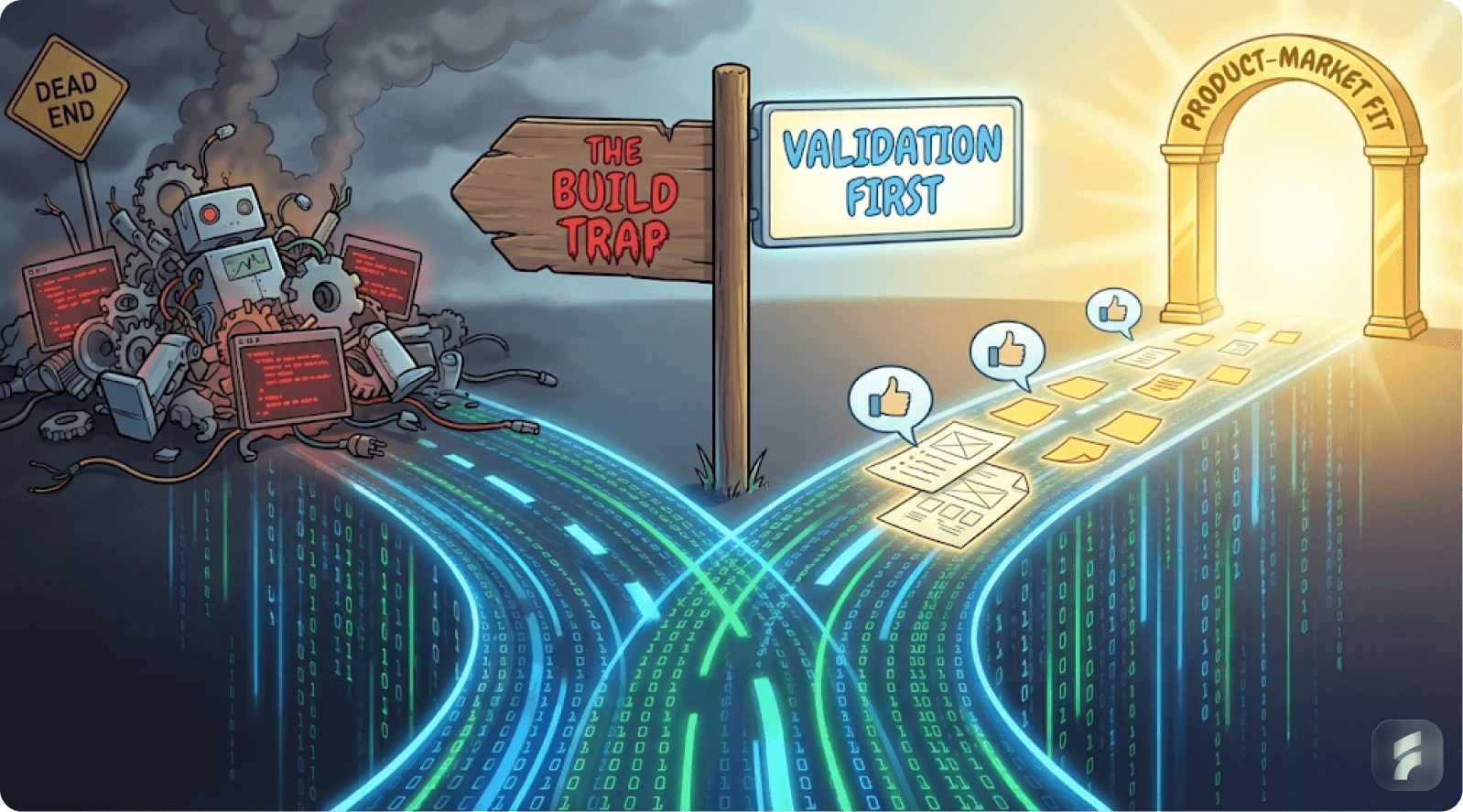
Understanding the Build Trap
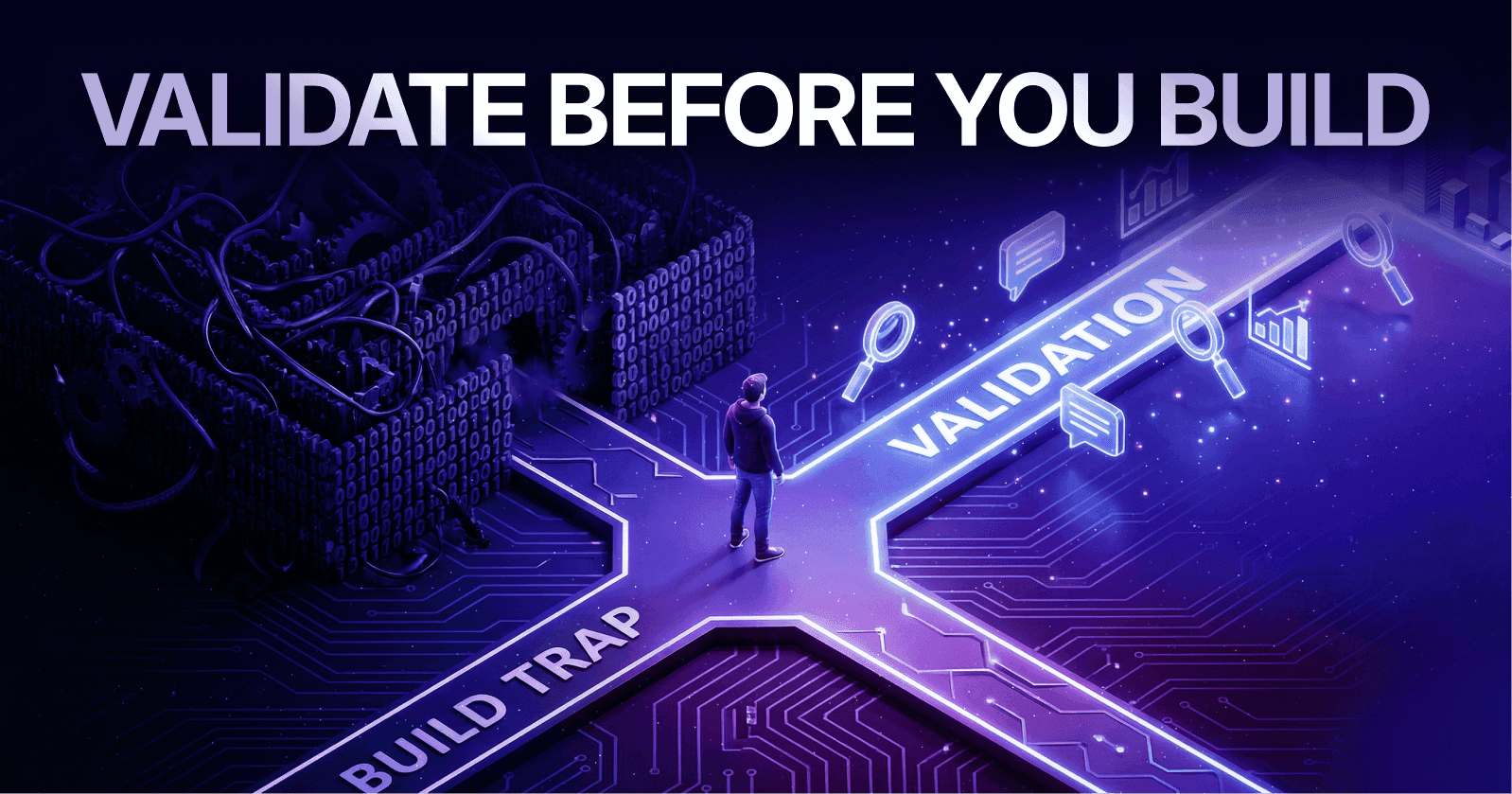
This is the build trap—a seductive pitfall where founders fall in love with their solution rather than understanding their customer's problem.
The more features you add, the more code you write, the more you convince yourself that the product is heading in the right direction. Then, months and thousands of dollars later, you realize nobody wants it.
According to research from CB Insights, the lack of market need consistently ranks as the number one cause of startup mortality, affecting nearly half of all failed ventures.
The Validation Alternative
The good news? You don't have to learn this lesson the hard way.
Validating your idea before writing a single line of code is the smartest investment you can make as a founder. It costs almost nothing, takes weeks instead of months, and turns vague hunches into concrete evidence about whether your idea has real market potential.
This guide will walk you through why validation matters, how to do it right, and the proven techniques that founders have used to build billion-dollar companies—all before launching their MVPs. If you're looking to build a product with confidence, understanding product design principles is essential.
The Importance of Validating Your Idea Before Writing Code

Why Validation Matters More Than You Think
Imagine spending six months building a product, hiring developers, designing interfaces, writing documentation, and deploying infrastructure. Then you launch to crickets.
No downloads. No signups. No customers.
This isn't a hypothetical scenario—it's a common reality. One founder shared their painful experience: "I fell into the classic trap of building features in isolation, thinking I knew what customers wanted. I was mistaken. I ended up creating a whole range of automation tools that nobody was interested in. I was developing based on my assumptions of what customers wanted, rather than listening to their actual feedback."
Six months lost. Zero revenue. Complete pivot required.
What Validation Could Have Prevented
That same founder could have spent two weeks talking to customers, run a quick landing page test, and discovered within days that their assumptions were wrong.
Studies show that early-stage validation reduces development waste by 60-70%. This isn't just about saving money—it's about preserving founder momentum and team morale.
The Shift in Mindset
Steve Blank, legendary startup mentor and author of The Four Steps to the Epiphany, revolutionized how founders think about building.
His core principle: "There are no facts inside your building, so get outside."
Instead of asking "Can I build this?" founders should be asking "Should I build this? And will customers actually pay for it?"
This shift from execution-first to validation-first has become the foundation of the Lean Startup methodology popularized by Eric Ries. As Ries emphasizes: "Progress is not measured by lines of code written, but by learning. The goal is not to build faster—it's to learn faster."
Understanding Customer Discovery
Customer discovery is the systematic process of identifying who your customers are, what problems they face, and whether your proposed solution addresses a genuine need.
According to research from Stanford's entrepreneurship program, startups that conduct structured customer discovery are 2.5 times more likely to achieve product-market fit within their first year.
The process reduces what experts call "solution bias"—the cognitive trap of becoming attached to your idea before validating the underlying problem.
The Three Critical Questions You Must Answer Before Coding
Before you write a single line of code, you need validated answers to three questions:
1. Is there a real problem?
Do customers actually experience the pain point you're solving? How frequently? How much does it cost them (in time, money, frustration)?
Research from Harvard Business Review shows that 67% of product failures stem from solving problems that customers don't consider urgent or important.
2. Will they pay for a solution?
Not just "Would you use this?" but "Would you actually spend money on this?"
Nimi Kular, co-founder of Jaswant's Kitchen, captures this perfectly: "Market evaluation, surveys, and feedback from friends and family can point you in the right direction, but money is the only thing that can validate a product."
This concept is known as "willingness to pay validation"—the single most reliable predictor of market viability.
3. Are you solving it the right way?
Even if the problem is real and people will pay for something, your specific solution might miss the mark.
Will your approach be better than existing alternatives? Will customers use it the way you expect? Studies from MIT's Sloan School of Management indicate that 34% of startups fail due to poor product-market fit, even when addressing real problems.
The Cost of Skipping Validation
The numbers tell a dramatic story. According to CB Insights' research into startup failure:
42% fail due to lack of market need (the number one reason)
34% fail due to lack of product-market fit
75% of venture-backed startups fail, with nearly half never reaching profitability—proof that even well-funded companies can build the wrong thing
82% of failed startups cite "building in isolation" as a contributing factor
The Validation ROI
Compare that to startups that validated first: they pivot earlier, waste fewer resources, and move toward product-market fit faster.
Instagram's pivot from Burbn (a complex location-based app) to a focused photo-sharing platform took months, not years, because the founders were paying attention to user behavior from day one. Dropbox validated demand with a simple demo video before building a single feature.
Industry data from Y Combinator suggests that validated startups reach their first $100K in revenue 40% faster than those that skip validation.
What Validation Actually Saves You
By validating before coding, you:
Save 3-6 months of development time that could otherwise be spent building the wrong thing
Reduce development costs by 50-80% by avoiding features nobody wants
Attract better early-stage investors who see you've done customer discovery (not just technical planning)
Build customer relationships from day one, creating your first advocates and advisors
Pivot with confidence because you're making decisions based on evidence, not ego
According to Gartner research, companies that implement systematic validation processes reduce time-to-market by an average of 35% while simultaneously improving product success rates.
Key Takeaway: Validation is the difference between building what you think customers want and building what they actually need. The statistics are clear: startups that validate first save time, money, and emotional energy while dramatically increasing their odds of success. The cost of validation is minimal; the cost of skipping it is catastrophic.

How to Validate Your Idea: 7 Proven Techniques
The beautiful part about validation is that you have options.
Different ideas require different approaches, and different stages of certainty require different levels of rigor. Here are seven battle-tested techniques, used by founders who went on to build billion-dollar companies.
1. Customer Interviews: The Foundation of All Validation
The simplest, cheapest, and most insightful validation technique is still direct conversation.
How to Do It
Conduct 20-25 in-depth interviews with potential customers. The goal isn't to pitch your product—it's to understand their world.
According to Nielsen Norman Group, 15-20 interviews typically uncover 85-90% of core user needs and pain points. Beyond 25 interviews, you hit diminishing returns unless entering a new customer segment.
The Interview Framework
Ask about:
What's the hardest part about [their specific pain point]?
How do you currently solve this problem?
What have you already tried?
Would you pay for a better solution?
The key is asking about past behavior, not future intentions.
"Would you use a product like this?" almost always gets a "yes" (people are naturally polite). But "Can you tell me about the last time this problem cost you money or time?" reveals whether they actually care.
The Five Whys Technique
Use the "5 whys" technique to dig deeper. When someone mentions a frustration, keep asking "why?" until you get to the root cause.
This method, developed at Toyota and popularized by lean manufacturing, helps uncover underlying motivations rather than surface-level symptoms.
Real Example: Open Bay
Rob Infantino, founder of Open Bay (a marketplace connecting car owners with repair shops), did this right.
He spent months outside his building talking to both vehicle owners and repair shops. He didn't just ask what they wanted—he watched how they currently solved the problem, what frustrated them, and whether they'd actually use a marketplace.
This two-sided discovery informed every decision. When he built the prototype, he had confidence that both customer segments would actually use it because he'd already proven they needed it.
The Interview Gotcha
People will tell you what they think you want to hear.
Eric Ries warns: "If you talked to 10 customers and they all said they love your product, that's like asking someone 'Is my baby beautiful?' and they say yes to your face."
The question is whether they'll actually do something (sign up, pay, change their behavior).
Research from Stanford's d.school shows that behavioral evidence is 7 times more predictive of actual adoption than stated preferences.
Key Takeaway: Customer interviews provide qualitative depth that no other method can match. When done correctly—focusing on past behavior, digging for root causes, and avoiding confirmation bias—they reveal the true nature of customer problems and whether your solution addresses a genuine need.
2. Smoke Test Landing Pages: Proof of Demand in One Week
A smoke test landing page is a simple, single-page website describing your product as if it already exists.
You drive traffic to it and measure whether real people click to learn more, enter their email, or attempt to "buy" it.
How to Do It
Write a clear, compelling headline that communicates your core value proposition
Explain the problem and your solution in 2-3 sentences
Add a single call-to-action button (e.g., "Join the Waitlist," "Start Free Trial," or "Buy Now")
Drive targeted traffic via Facebook ads, Google ads, or relevant online communities (Reddit, LinkedIn groups, forums)
Track what happens: What's your click-through rate? Conversion rate? Email signup rate?
Benchmark Metrics
A reasonable benchmark: if 3-5% of visitors sign up, you've got something worth exploring.
If it's below 1%, you need to refine your message or market. If it's above 10%, you might have a winner on your hands.
According to data from Unbounce, the average landing page conversion rate across industries is 4.6%, but top performers achieve 10-15% or higher.
Understanding Signal Quality
These conversion rates represent "activation intent"—a validated signal that visitors understand your value proposition and want to engage further.
Real Example: ConvertKit's Landing Page Test
Nathan Barry, founder of ConvertKit (a platform for creators to build their audience), ran a landing page smoke test before building anything.
He created a simple page describing the product, added a few screenshots, and set up an email capture form. He drove targeted traffic from newsletter communities and creator forums.
The conversion rate he saw wasn't just validation—it became his first 50 signups, who became his first customers and feedback sources.
The Smoke Test Advantage
You get real data, not opinions.
People vote with their clicks and email addresses, not with what they think sounds nice in a conversation. Baymard Institute research shows that actual user behavior is 12 times more reliable than survey responses for predicting product adoption.
Cost-Effectiveness
The entire smoke test process costs $100-500 and takes 3-7 days to complete. Compare that to $50,000-200,000 and 3-6 months for building an MVP. The return on validation investment is extraordinary.
Key Takeaway: Smoke test landing pages provide quantitative proof of demand with minimal investment. By measuring actual behavior rather than stated intent, you get reliable signals about market interest before committing to development. The technique is fast, cheap, and remarkably predictive of real-world adoption.
3. Clickable Prototypes: Show, Don't Tell
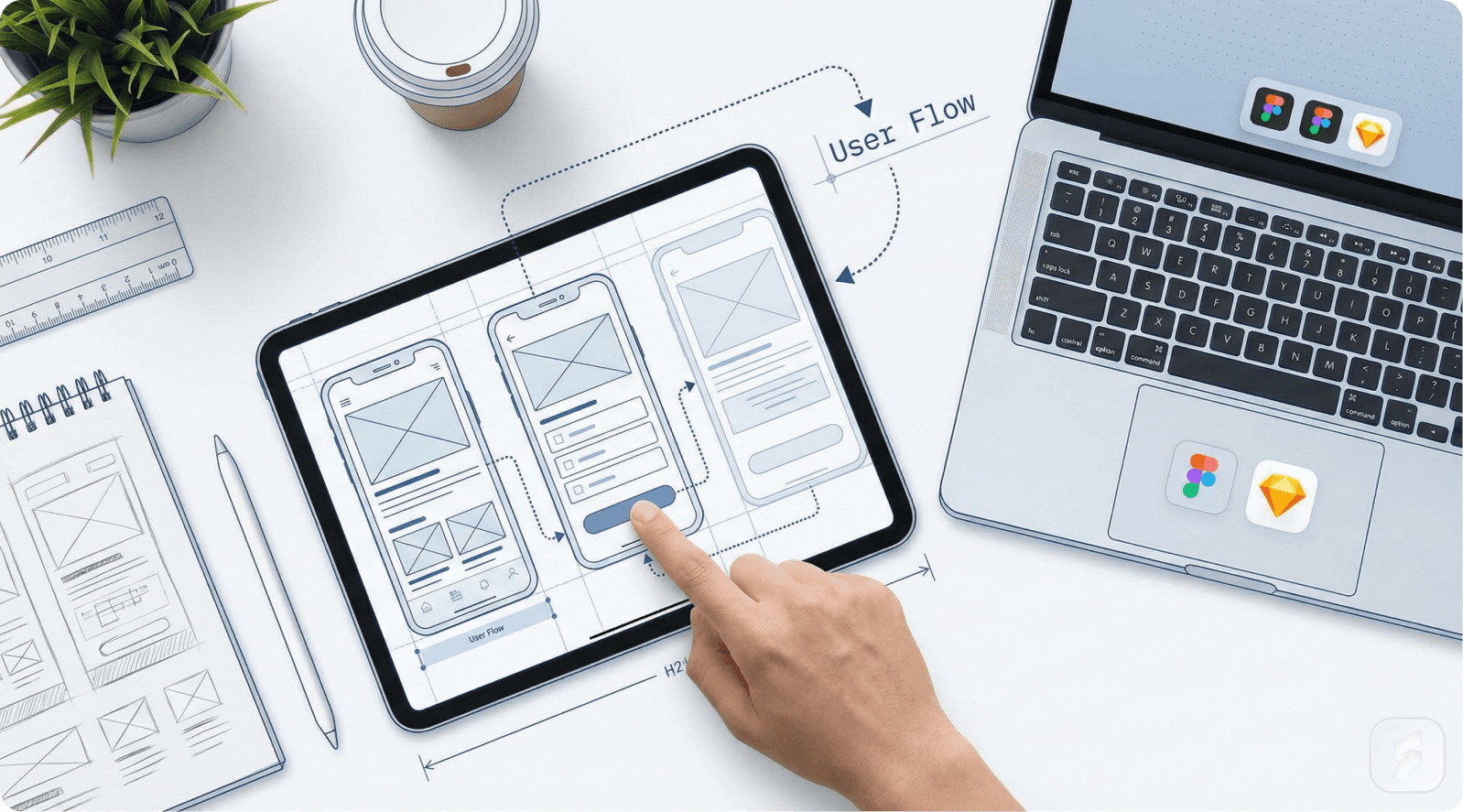
Building a full product is expensive. Building a clickable prototype (sometimes called a "Wizard of Oz" prototype) costs almost nothing but teaches you more than a survey ever could.
How to Do It
Design key screens using tools like Figma, Sketch, Balsamiq, or Webflow
Link screens together so users can "click through" the main user flows (the critical paths to completing your core action)
Test with 5-10 users by watching them use the prototype without guidance
Pay attention to: Where do they get confused? Where do they click? Do they find the main action obvious or hidden?
Understanding Interaction Patterns
The magic is that clickable prototypes feel real enough to get genuine reactions but are easy enough to change that you can iterate based on what you learn.
As one founder noted about validating UX decisions: "Use clickable prototypes (Figma) to test user flows before hiring developers. If users can't get through the prototype, they won't use the product."
Nielsen Norman Group research confirms that prototype testing with just 5 users uncovers 85% of usability issues. Testing with 10 users pushes that to 95%.
Measuring Cognitive Load
During prototype testing, measure:
Task completion rate: Can users finish the primary action?
Time on task: How long does it take?
Error rate: How many mistakes do they make?
Mental model alignment: Does the interface match how users think about the problem?
Real Example: Dropbox's Demo Video
Dropbox took the prototype concept to the extreme.
Instead of even building a clickable prototype, founder Drew Houston created a 3-minute demo video showing how the file-syncing service would work. He posted it to a tech-focused online community and included a simple email signup link.
The response was immediate: thousands of signups overnight for a product that didn't exist yet.
That single 3-minute video validated the entire core concept and generated his first user base.
The lesson: sometimes you don't even need a polished prototype. A well-crafted video or visual mockup can be enough to prove whether people get it.
Prototype Fidelity Considerations
Research from MIT Media Lab shows that low-fidelity prototypes often generate better feedback because users focus on functionality rather than visual polish. High-fidelity prototypes work better when testing specific interaction patterns.
Key Takeaway: Clickable prototypes bridge the gap between abstract concepts and concrete experiences. They reveal usability issues, validate user flows, and confirm whether your mental model matches your customers' expectations—all without writing production code. The technique is especially valuable for complex products where user experience will make or break adoption.
4. Concierge MVP: The Manual Delivery Test
If your product is a service or requires human touch, a "concierge MVP" might be your best bet.
You manually deliver your entire service to a handful of customers without building any technology.
How to Do It
Find 5-10 ideal customers who face your problem most acutely
Offer to solve their problem manually (you doing all the work, not automation)
Deliver the service personally with white-glove service
Document everything: How long does it take? What do you have to do? What do customers love? What frustrates them?
Ask them to pay something (even $50 or $100) to validate they actually value it
Collect feedback on what worked and what would need to be different for them to use an automated version
Understanding Service-to-Product Translation
This approach is particularly powerful for marketplace, SaaS, and service businesses where the core value is the outcome, not the technology.
McKinsey research shows that 73% of successful B2B SaaS companies started with some form of manual service delivery before automating.
Real Example: Food on the Table
Founder Manuel Rosso validated his grocery-planning app idea by personally creating custom grocery lists and meal plans for customers.
He'd go shopping with them, understand their preferences, and manually build plans tailored to their budget and dietary needs. This manual work taught him exactly what features mattered and revealed that his initial assumptions about how people shopped were completely wrong.
When he finally built the app, he knew exactly what to build because he'd learned from real, one-on-one interaction.
The Deep Learning Advantage
This technique is labor-intensive, but it generates the deepest customer understanding possible.
You experience every pain point, every edge case, and every moment of delight or frustration that customers encounter.
According to Harvard Business School research, founders who manually deliver their service first reduce feature bloat by an average of 40% because they know exactly which capabilities drive value.
Key Takeaway: Concierge MVPs provide unmatched insight into customer needs by forcing you to experience the problem-solving process yourself. The manual approach reveals operational realities, customer preferences, and value drivers that surveys and interviews might miss. While labor-intensive, it dramatically increases the odds that your eventual product will solve the right problem in the right way.
5. Find 10 Customers Willing to Pay
Rob Walling, founder of Drip (an email marketing automation platform acquired for eight figures), used a deceptively simple validation technique: find 10 people willing to pay.
How to Do It
Identify the specific problem your product solves
Find people in your target audience who experience this problem (LinkedIn, email outreach, communities)
Ask directly: "Would you pay $X per month for a product that solves [specific problem]?"
When someone says yes, follow up: "Can I put you down as a paying customer? I'm launching in [timeframe]."
Collect these commitments as proof of demand
The Payment Commitment Signal
Walling actually sent emails to 17 people in his target market. 10 committed to paying, which became his first customer base and early revenue stream.
Critically, these 10 customers weren't hypothetical—they'd actually agreed to pay. That's the validation bar.
Research from Y Combinator shows that pre-commitment conversion rates (people who agree to pay before the product exists) typically run 30-50% of stated interest. If 10 out of 17 commit, that's an exceptionally strong signal.
Real Example: Drip's Launch
When Walling and his co-founder Derek finally launched Drip, they didn't have to convince people the product was needed.
They had 10 pre-committed customers ready to go, already intimately involved in product decisions. When they opened signups, Drip hit $7,000 in recurring monthly revenue in the first month because demand had already been proven.
The Insight: Money as Ultimate Validator
Money is the ultimate validator. Not "I'd use this," but "I'll pay for this."
As Walling himself states: "Revenue is the most honest feedback you can get. Everything else is just conversation."
According to data from Stripe Atlas, startups that secure pre-payments are 3.2 times more likely to reach $100K ARR within their first year compared to those who don't.
Key Takeaway: Finding 10 paying customers before you build transforms validation from theoretical to financial. When people commit money—even small amounts—they reveal their true priorities and needs. This technique provides both market validation and initial runway while building a foundation of engaged early adopters who can guide product development.
6. Pre-Sales and Pre-Orders: The Sales Test
If you're B2B or have a more substantial offering, pre-selling before building is the ultimate validation.
How to Do It
Create a simple landing page describing your product and pricing
Drive qualified traffic (your target customers, not random web visitors)
Include a "Buy Now" or "Pre-Order" button that actually accepts payment
Track: How many people buy? At what price? What objections come up?
Understanding Price Sensitivity
If even 5-10 people will pre-pay for your product before it exists, you've passed a significant validation threshold.
Pre-sales also reveal price sensitivity. According to research from ProfitWell, testing multiple price points during pre-sales can increase eventual revenue per customer by 20-30% by identifying the optimal pricing strategy early.
The B2B Advantage
For B2B products, pre-sales often take the form of pilot agreements or letters of intent. These documents create mutual commitment and provide additional validation signals:
Are customers willing to commit resources (time, personnel, budget)?
Do they involve multiple stakeholders in the decision?
Are they willing to pay meaningful amounts ($1,000+)?
Risk Mitigation Through Pre-Sales
Pre-sales dramatically reduce financial risk. Founders who collect $10,000-50,000 in pre-orders before building can self-fund initial development or present stronger cases to investors.
Data from Kickstarter shows that projects that exceed their funding goals by 3x or more have a 90% completion rate, compared to just 35% for projects that barely hit their minimum.
Key Takeaway: Pre-sales represent the gold standard of validation: customers putting real money behind their stated interest before the product exists. This technique provides financial validation, reduces risk, and creates accountability to deliver. The pre-sales process also reveals pricing dynamics, objection patterns, and true buying intent.
7. The Build-Measure-Learn Loop
Finally, the most systematic approach combines multiple techniques in an iterative cycle.
The Framework
Build a minimal version (landing page, prototype, or concierge MVP)
Measure user behavior (sign-ups, clicks, questions, feedback)
Learn what worked and what didn't
Repeat with a refined hypothesis
Understanding Iterative Validation
This is the core of the Lean Startup methodology. Rather than validating everything upfront, you're running rapid experiments, learning from each one, and compounding your knowledge.
According to Eric Ries: "The fundamental activity of a startup is to turn ideas into products, measure how customers respond, and then learn whether to pivot or persevere."
Cycle Time Optimization
The key metric is cycle time: how quickly can you complete one full loop? Research from Stanford's technology ventures program shows that teams that complete validation cycles in under 2 weeks are 4 times more likely to achieve product-market fit than those with 4+ week cycles.
Real Example: Instagram's Burbn-to-Instagram Pivot
Instagram's founders, Kevin Systrom and Mike Krieger, launched their first app "Burbn" as a location-based social network (like Foursquare).
It had check-ins, plan-making, and photo-sharing. Users weren't engaged.
Instead of doubling down, they measured user behavior and noticed something: the only feature people consistently used was photo-sharing.
Rather than adding more features, they learned from this data and made a radical decision: delete 90% of the code and relaunch as a focused photo-sharing app.
The Evidence-Driven Pivot
This wasn't luck—it was validation in action. They built something, measured what worked, and pivoted based on evidence.
The result: 25,000 users on day one, and a $1 billion acquisition 18 months later.
According to research from First Round Capital, startups that pivot based on user behavior data are 2.7 times more successful than those that pivot based on founder intuition alone.
Key Takeaway: The build-measure-learn loop represents systematic validation through continuous experimentation. By treating each iteration as a learning opportunity and measuring actual user behavior, you accumulate evidence about what works and what doesn't. This approach reduces the risk of any single validation method while accelerating the path to product-market fit.
Common Validation Mistakes to Avoid
Before you start validating, watch out for these traps that undermine even well-intentioned validation efforts.
Asking About the Future, Not the Past
"Would you use this?" is worthless. "Tell me about the last time this frustrated you" is gold.
Research from the Behavioral Economics Research Center shows that stated future intentions have only a 14% correlation with actual behavior. Past behavior, by contrast, predicts future behavior with 67% accuracy.
Why This Happens
This is due to the intention-action gap—the cognitive bias where people overestimate their future behavior because they haven't accounted for the friction, cost, and effort involved in actually using a product.
Talking to Friends and Family
They're naturally biased toward being supportive. Talk to strangers in your target market.
According to Y Combinator research, validation from friends and family has zero predictive value for market success. Their feedback is contaminated by relationship dynamics, not product merit.
The Solution
Find people who have the problem but don't know you. Their honesty will be brutal and valuable.
Seeking Confirmation Instead of Truth
If you're looking for yes-answers to validate what you already believe, you'll find them. Instead, actively look for reasons your idea might be wrong.
This is confirmation bias in action—the tendency to search for, interpret, and recall information that confirms pre-existing beliefs.
The Disconfirmation Approach
As philosopher Karl Popper argued, good science attempts to falsify hypotheses, not confirm them. Apply this to validation: try to prove yourself wrong, not right.
Research from Carnegie Mellon shows that entrepreneurs who actively seek disconfirming evidence make better strategic decisions and pivot earlier when needed.
Confusing Interest with Commitment
People can be interested in a free product that offers no value. Real validation involves them doing something that costs them (time, money, effort).
According to Harvard Business Review, 83% of people who express interest in a product never take action. Only behaviors that involve friction—signing up, paying, waiting—constitute meaningful validation.
The Commitment Hierarchy
From weakest to strongest validation signals:
Verbal interest
Email signup
Waitlist with timeline
Pre-order deposit
Full pre-payment
Validating the Wrong Thing
Validate demand before validating features. Validate the problem before validating your solution.
Many founders skip straight to feature validation ("Would you use this specific feature?") without confirming that the underlying problem is urgent enough to warrant any solution at all.
The Proper Sequence
Problem validation: Does this problem exist and matter?
Solution validation: Would customers pay for a solution?
Approach validation: Is your solution the right one?
Feature validation: Which specific capabilities matter most?
Key Takeaway: Validation mistakes stem from cognitive biases, social dynamics, and improper sequencing. By asking about past behavior, seeking strangers' honest feedback, looking for disconfirmation, measuring commitment not interest, and validating in the right order, you transform validation from a feel-good exercise into a rigorous evidence-gathering process.
From Validation to MVP to Product-Market Fit
Once you've validated demand, you're ready to build. But you're not building blindly.
What Validation Gives You
You have:
Confirmed customer problems from direct conversations
Quantified market demand from landing page tests or pre-sales
Prototyped user flows so you know what people actually expect
Early customers who understand your vision and will provide feedback
Understanding the Validation-to-MVP Transition
Your MVP now has a purpose: not to prove people want something, but to refine how to deliver it.
Your early customers become co-creators, not test subjects. According to research from the Product Development and Management Association, MVPs built after validation achieve product-market fit 3.5 times faster than those built speculatively.
The MVP Definition Shift
Eric Ries defines an MVP as "the version of a new product which allows a team to collect the maximum amount of validated learning about customers with the least effort."
Notice: it's about learning, not launching. Your MVP isn't your final product—it's your next validation experiment.
Real-World Success Stories
This is why companies like Airbnb, Dropbox, and Uber didn't fail despite launching in crowded markets. They'd already validated demand before code touched a single server. They knew their customers wanted what they were building.
Airbnb's Validation Journey
Airbnb started by renting out their own apartment during a conference when hotels were sold out. This concierge MVP validated that people would actually pay strangers to stay in their homes—a radical behavioral assumption.
Uber's Regional Testing
Uber validated city-by-city, starting with San Francisco where the founders could manually test the service. They validated demand, pricing, and driver supply before building scalable technology.
The Product-Market Fit Milestone
Product-market fit occurs when you've validated not just initial demand but sustained engagement and growth.
Marc Andreessen defines it as: "being in a good market with a product that can satisfy that market." According to First Round Capital, 70% of successful startups report achieving product-market fit within 18 months if they validate first, compared to 3+ years for those who don't.
Measuring Product-Market Fit
Sean Ellis, who coined the term "growth hacking," developed a simple test: If 40% of your users say they'd be "very disappointed" if your product disappeared, you've reached product-market fit.
This metric, known as the Ellis Test, has been validated across thousands of startups as the most reliable leading indicator of sustained growth.
Key Takeaway: Validation doesn't end when you start building—it transitions into a continuous cycle of learning and refinement. By entering the MVP stage with validated demand, confirmed problems, and engaged early customers, you dramatically increase your odds of achieving product-market fit quickly and efficiently. The goal shifts from "Will anyone want this?" to "How do we deliver this at scale?"
Your Next Step: Taking Action Today
You have an idea. That's great. But ideas aren't validated—assumptions are.
The Week-One Action Plan
This week, pick one validation technique:
If you're early-stage and unsure about the problem: Do five customer interviews
If you want to test market demand: Launch a landing page test
If you want to prove people will actually use it: Build a clickable prototype
If you're in B2B or services: Start your concierge MVP with 3-5 customers
If you have a specific target market: Find 10 people willing to commit to paying
The Validation Timeline
Don't aim for perfection. Aim for evidence.
Spend $100 and two weeks to learn what months of building would teach you anyway. The goal isn't validation for its own sake—it's to go from "I think this might work" to "I know this will work" before you bet your savings on it.
Research from MIT Sloan shows that structured validation processes typically take 2-4 weeks and cost under $500, yielding insights worth 10-20x that investment in avoided waste.
Overcoming Analysis Paralysis
A common objection: "But I could validate forever and never build!"
This is valid. The key is setting clear validation thresholds:
Complete 20 customer interviews
Achieve 5% landing page conversion
Get 10 paying pre-customers
Validate with 5 prototype tests
Once you hit these thresholds, build. Validation is about reducing uncertainty, not eliminating it.
The Build Trap Is Real—And Avoidable
The build trap is real. But it's also entirely avoidable.
Get outside, talk to customers, and let evidence guide your decisions. As Melissa Perri, author of Escaping the Build Trap, notes:
"Companies that focus on outputs (features shipped) instead of outcomes (customer value delivered) inevitably fall into the build trap. Validation keeps you focused on outcomes."
According to McKinsey research, companies that adopt outcome-based product development increase innovation ROI by an average of 47%.
Your Future Self Will Thank You
Your future self—and your bank account—will thank you.
The difference between a failed startup and a successful one often comes down to a simple choice: validate first, or build and hope. The evidence overwhelmingly favors validation.
You have the tools. You have the techniques. You have the examples. Now take the first step: talk to a customer, launch a landing page, or build a prototype.
Whatever you choose, start today. Because every day you spend building without validation is a day you might be building the wrong thing.
For comprehensive support throughout your validation journey, explore Saasfactor's resources and discover how professional UX audit services can help refine your product vision before you commit to development.
Glossary: Key Validation Terms
Activation Intent
The measured willingness of potential customers to take a specific action (signup, purchase, pre-order) that indicates genuine interest in a product.
Build Trap
A product development anti-pattern where teams focus on shipping features rather than delivering customer value, often resulting in products nobody wants.
Build-Measure-Learn Loop
An iterative validation framework where teams build minimal versions, measure user behavior, learn from the results, and refine their approach in rapid cycles.
Clickable Prototype
An interactive mockup that simulates core product functionality without backend code, allowing users to click through key workflows for validation purposes.
Cognitive Load
The mental effort required for users to understand and use a product. Lower cognitive load typically correlates with higher adoption rates.
Concierge MVP
A validation approach where founders manually deliver the entire service to customers without automation, learning operational requirements before building technology.
Customer Discovery
The systematic process of identifying target customers, understanding their problems, and validating whether a proposed solution addresses genuine needs.
Intention-Action Gap
The behavioral economics phenomenon where stated future intentions poorly predict actual behavior due to unanticipated friction, cost, and effort.
Mental Model
The internal representation users have of how a system works. Products that align with users' existing mental models reduce learning curves and increase adoption.
Product-Market Fit
The stage where a product successfully satisfies a proven market demand, typically indicated by sustainable growth, high retention, and organic word-of-mouth.
Smoke Test
A validation technique where a product is marketed as if it exists (via landing page, ads, or mockups) to measure demand before investing in development.
Solution Bias
The cognitive trap where entrepreneurs become attached to their proposed solution before validating whether the underlying problem is worth solving.
Validation Threshold
Predefined quantitative or qualitative benchmarks (e.g., 20 interviews, 5% conversion rate, 10 paying customers) that indicate sufficient evidence to proceed with development.
Willingness to Pay
The amount customers are genuinely prepared to spend for a solution, validated through actual payment commitments rather than hypothetical survey responses.
Wizard of Oz Prototype
A validation approach where the product appears automated to users but is manually operated behind the scenes, allowing founders to test value delivery before building scalable technology.
References & Authoritative Sources
This article draws on research and insights from the following authoritative institutions and experts:
Research Institutions:
CB Insights (startup failure analysis)
Harvard Business Review (entrepreneurship research)
Stanford d.school and Technology Ventures Program
MIT Sloan School of Management
Nielsen Norman Group (user research)
McKinsey & Company (innovation research)
Carnegie Mellon University (decision-making research)
Behavioral Economics Research Center
Product Development and Management Association
Industry Organizations:
Y Combinator (startup accelerator data)
First Round Capital (venture analysis)
Gartner (technology research)
Baymard Institute (UX research)
ProfitWell (SaaS metrics)
Stripe Atlas (startup data)
Thought Leaders & Authors:
Steve Blank (The Four Steps to the Epiphany, The Startup Owner's Manual)
Eric Ries (The Lean Startup)
Melissa Perri (Escaping the Build Trap)
Marc Andreessen (product-market fit framework)
Sean Ellis (growth hacking, Ellis Test)
Rob Walling (founder, Drip)
Nathan Barry (founder, ConvertKit)
Validation Platforms & Tools:
Unbounce (landing page analytics)
Kickstarter (crowdfunding data)
Figma, Sketch, Balsamiq (prototyping tools)