


Last Update:
Feb 23, 2026

Share

SaaS UX Projects Typically Cost $12K–$150K+
Pricing depends on scope, product complexity, and team structure. Early-stage UX projects start around $12K, while enterprise redesigns can exceed $150KPricing Model Matters as Much as Budget
Fixed-price and milestone-based models provide better predictability and outcome alignment than hourly or per-person contractsAvoid Per-Person UX Pricing for Product-Critical Work
SaaS UX requires multiple disciplines—research, UX architecture, UI design, and testing. One generalist designer is rarely enough for meaningful impactMilestone-Based Teams Reduce Risk
Structured phases (discovery → UX → UI → testing → implementation support) improve accountability, reduce scope creep, and tie payments to progressRetainers Work Best for Ongoing Optimization
Growth-stage SaaS products benefit from deliverable-based retainers focused on experimentation, UX debt cleanup, and activation improvementsOutcome-Focused Agencies Win
The best SaaS UX partners prioritize activation, retention, and measurable business metrics—not just interface aestheticsTransparent, Fixed Models Improve Founder Confidence
Models like fixed 60-day UX redesigns combined with monthly retainers offer predictable costs and clear deliverables
If you're a SaaS founder in the pricing decision phase, you're not just asking "How much does UX cost?"—you're asking "What exactly am I buying, and will it move my metrics?" This guide breaks down real pricing ranges, models, and why milestone-based partnerships often deliver better outcomes than hourly contracts.
Key Insight: Professional SaaS UX engagements typically range from $12,000 to $150,000+ depending on scope and complexity. The pricing model you choose matters as much as the budget itself.
Why Most SaaS Teams Should Avoid Per-Person UX Pricing
Most SaaS companies—especially in early and growth stages—don't need to hire individual designers. They need a design partner with a complete skill stack to help them:
Design or redesign the core product
Ship specific new features that drive activation and retention
Run user research and usability testing
Optimize onboarding, activation, and retention flows
Fix UX debt and inconsistent user experiences
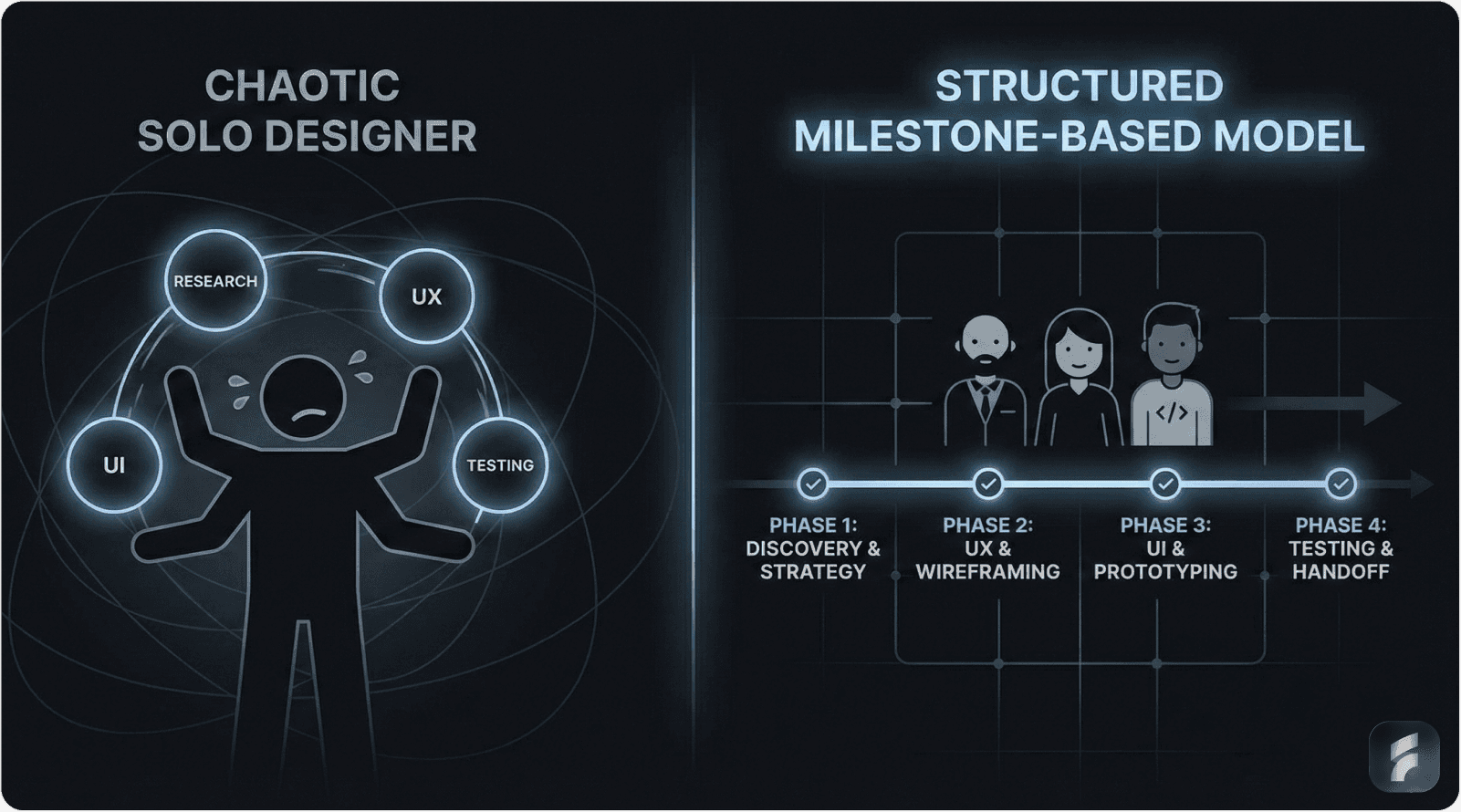
Here's the challenge: delivering on these goals requires multiple UX disciplines working together, not just one generalist designer. A serious SaaS UX engagement typically involves:
UX Research: User interviews, surveys, Jobs-to-be-Done analysis, task analysis
UX Design: Information architecture, user flows, wireframes, interaction patterns
UI Design: Visual design, component libraries, design systems
Prototyping: Low and high-fidelity prototypes for testing and stakeholder alignment
Usability Testing: Moderated/unmoderated tests, remote testing, A/B concept validation
UX Optimization: Ongoing experimentation and data-driven improvements
The Problem with Hourly and Per-Person Models
Trying to cover all these disciplines with a single augmented designer on an hourly contract creates three major problems for SaaS teams:
You pay for time, not outcomes. Hours spent don't equal business results.
You get a generalist instead of specialized expertise. One person can't be world-class at research, UX architecture, visual design, AND testing.
You micromanage an external resource. Instead of tracking milestones and business metrics, you're tracking timesheets and individual tasks.
That's why UX pricing best-practice guides increasingly recommend fixed-price, deliverable-based, or value-based models for product-critical work—especially for redesigns and feature development.
Common UX Agency Pricing Models for SaaS
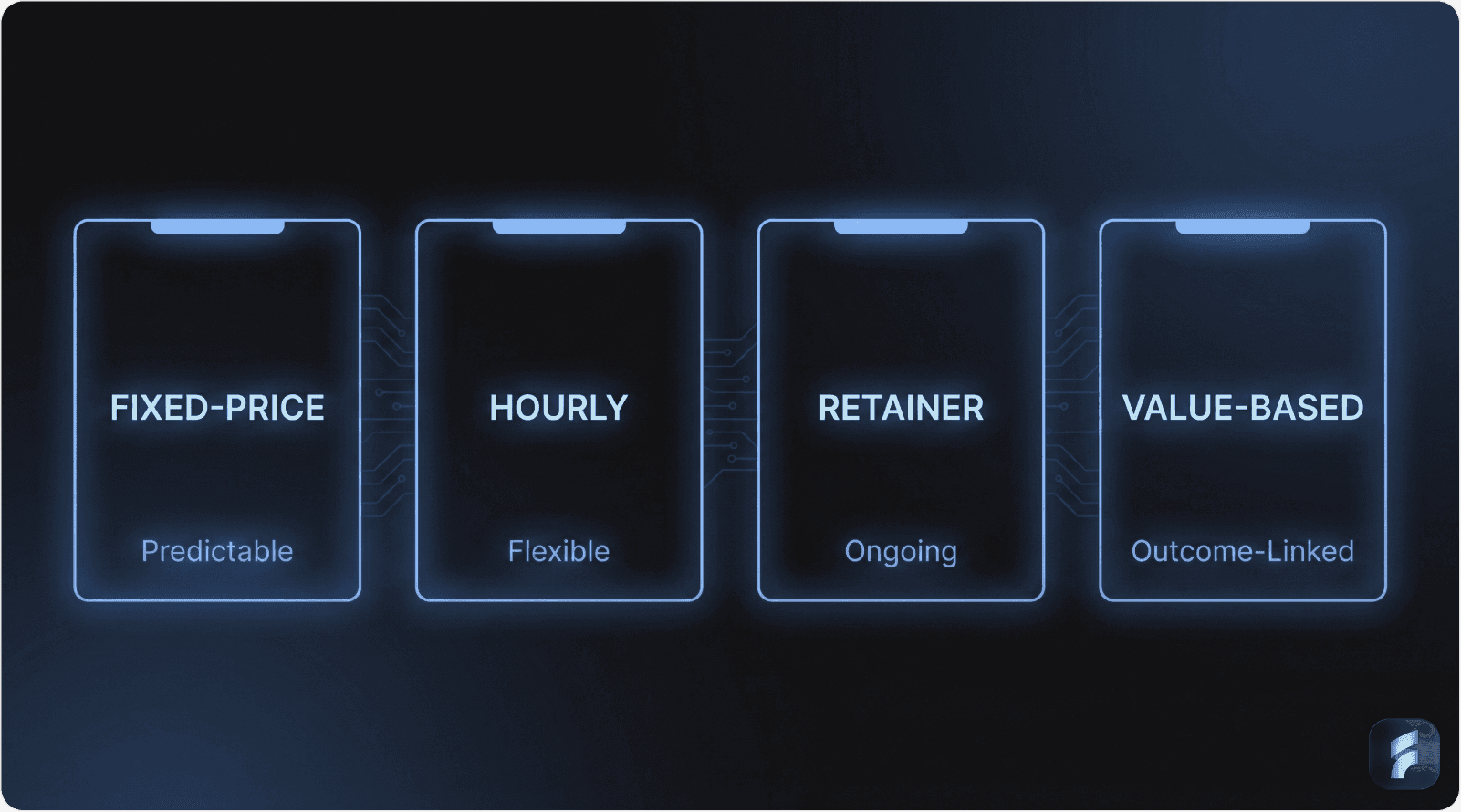
Across UI/UX agencies working with SaaS startups and scale-ups, four pricing models dominate. Understanding each helps you choose the right fit for your project.
1. Fixed-Price (Project-Based)
Best for: Clear scopes like "redesign our core product" or "rebuild onboarding flow"
With fixed-price engagements, you agree on a total budget upfront for a defined set of deliverables and milestones. This is the most common model for MVP design, major redesigns, and tightly scoped feature releases.
Typical Budget Ranges:
Early-stage SaaS UX/UI: $12,000–$40,000 for essential product flows and onboarding
Mid-size SaaS redesigns: $15,000–$70,000+ depending on screen count and complexity
Large/enterprise SaaS: $30,000–$150,000+ including design systems, multiple user roles, and integrations
Advantages: Easier for internal approvals and budgeting—you know the total cost before you start. Clear deliverables reduce scope creep.
2. Hourly / Time & Materials
Best for: Vague, experimental, or "we're not sure what we need yet" work
You pay per hour or day for a designer or team. Typical UX agency rates range from $75–$250+ per hour in mature markets, with global averages varying by region and seniority.
The trade-off: High flexibility but weak predictability. You must tightly manage scope or watch costs balloon. This model easily turns into the "per-person pricing" problem we want to avoid for goal-driven SaaS redesigns.
3. Retainer (Ongoing Partnership)
Best for: Growth-stage SaaS products needing continuous UX improvements, experimentation, and support
You pay a recurring monthly fee for ongoing UX/UI work. Retainers can be structured as:
Hourly-based: "Up to X hours per month" (less predictable outcomes)
Deliverable-based: "X sprints, Y tests, Z feature designs per month" (better outcome focus)
Best-practice guides increasingly recommend deliverable-based or value-based retainers over pure hourly retainers. Why? They shift focus from inputs (hours logged) to outputs (features shipped, tests completed, metrics improved).
Supports: Long-term product evolution rather than one-off projects.
4. Value-Based / Performance-Linked
Best for: When UX improvements can be directly tied to measurable business KPIs
Pricing is tied to value created—for example, a base fee plus bonuses when activation improves, churn drops, or expansion revenue increases. More complex to structure but strongly aligns agency and client incentives.
A practical hybrid pattern many agencies adopt: fixed-price for initial redesign + retainer for continuous optimization + optional performance bonuses.
Why Milestone-Based, Multi-Discipline Teams Work Better
If you think of UX as a set of milestones rather than a bag of hours, it becomes much easier to align expectations, track progress, and manage budgets.
A typical SaaS UX redesign or improvement project passes through milestones like:
Phase | Key Activities | Deliverables |
|---|---|---|
1. Discovery & Research | Stakeholder interviews, analytics review, competitor analysis, user interviews | Research report, opportunity map, problem statements |
2. UX Strategy & Flows | Persona refinement, journey mapping, information architecture, user flows | User journeys, flow diagrams, IA documentation |
3. UX Design & Wireframes | Low/medium-fidelity wireframes for core flows, mapping states and edge cases | Annotated wireframes, interaction specs |
4. UI Design & System | Visual language, components, patterns for product-wide reuse | High-fidelity screens, design system, style guide |
5. Prototyping & Testing | Interactive prototypes, usability tests, findings analysis | Clickable prototypes, test reports, prioritized fixes |
6. Implementation Support | Design QA, iteration based on real user behavior | Engineering handoff, iteration recommendations |
Each phase requires different strengths: researchers, UX architects, UI designers, and testers. It's unrealistic—and risky—to expect one person to excel at all of this for a serious SaaS product.
How Milestone-Based Teams Solve This
A milestone-based, team-driven model delivers:
The combined skill set you actually need — research, UX, UI, testing expertise working together
Payment for progress, not hours — you pay when milestones complete, not for individual salaries or tracked time
Reduced management overhead — founders track milestones and KPIs, not who designed which Figma frame
Saasfactor's Pricing Model: Fixed UX Fix + Monthly Retainer
SaaSfactor positions itself as a global, SaaS-focused product design agency with a unique value proposition: UX as a revenue lever. Instead of selling "a designer," they offer a multidisciplinary UX team as a single, predictable package with 100% transparent milestone tracking.
Fix Your UX in 60 Days | Ongoing Retainer |
|---|---|
$15,000 | $5,000/month |
Fixed budget. Complete team. Clear milestones. | Continuous UX improvement. Milestone-based delivery. |
What You're Actually Buying: | What's Included: |
✔ Complete multidisciplinary team (UX designers, UX researchers, UI designers, UX testers) | ✔ Continuous access to the same multidisciplinary UX team |
✔ Discovery and UX audit (interviews, heuristic analysis, analytics review) | ✔ Milestone-based work each month (sprint improvements, experiments, UX debt cleanup) |
✔ UX flows, wireframes, and structural fixes | ✔ Ongoing research, new feature UX/UI, and usability testing |
✔ UI design updates and component-level refinements | ✔ Support for iterations, new flows, and funnel optimization |
✔ Prototypes and usability tests on real users | ✔ 100% transparent milestone tracking—you see exactly what's being delivered |
✔ Prioritized change list for engineering handoff |
Why This Model Works for Founders
SaaSfactor's approach solves the key pain points of traditional UX agency pricing:
Predictable Costs: $15K for 60-day fix, $5K fixed monthly retainer. No surprise invoices.
No Micromanagement: You don't juggle freelancers or manage individual UX hires. One team, one point of contact.
Full Skill Coverage: Access to all necessary UX disciplines (research, UX design, UI design, testing) under one virtual team.
Clear Milestones: Every phase has defined deliverables you can present to investors or stakeholders. Progress is trackable and transparent.
Value-Driven Pricing: You're paying for outcomes (fixed UX, improved flows, tested features), not hourly timesheets or individual headcounts.
Compared to general market ranges—where similar SaaS redesigns often run $15K–$70K+ and premium studio retainers can exceed $8K–$15K/month—SaaSfactor sits in the mid-market sweet spot with strong SaaS specialization and transparent delivery.
How to Choose the Right UX Agency and Budget for Your SaaS
Once you understand the models available, the practical question becomes: what should you actually budget, and how do you choose the right partner?
Step 1: Match Budget to Product Stage
Industry benchmarks broadly suggest:
Early-Stage SaaS (MVP to early traction)
Budget: $12,000–$40,000 for core UX/UI
Focus: Onboarding optimization, core value delivery, basic design system
Model: Fixed-price project or short retainer
Growth-Stage SaaS
Budget: $40,000–$200,000+ over time (combining redesigns and ongoing optimization)
Focus: Advanced dashboards, multi-role flows, analytics interfaces, mature design systems
Model: Fixed redesign + ongoing retainer
Enterprise / Complex Platforms
Budget: $30,000–$150,000+ for comprehensive redesigns
Focus: Cross-platform consistency, multi-role access, complex navigation, third-party integrations
Model: Phased project with dedicated team + long-term partnership
Where SaaSfactor Fits: The $15K/60-day fix plus $5K/month retainer is ideal for early and growth-stage products that need serious UX help but aren't ready for top-tier, six-figure agency retainers.
Step 2: Prioritize Value Over Hourly Rates
When evaluating agencies, look for these signals of value-oriented partnerships:
Do they propose fixed or milestone-based pricing for well-defined scopes? (Green flag)
Is the engagement multi-disciplinary (research, UX, UI, testing) or just "a designer"? (Multi-disciplinary is better)
Are they comfortable committing to concrete deliverables per phase or month? (Concrete deliverables = better accountability)
Do they talk about business outcomes (activation, retention, conversion) or just design outputs? (Outcome focus wins)
The best UX pricing guides consistently recommend shifting conversations from "how many hours?" to "what outcomes and deliverables do we get each month?"
Step 3: Demand Milestones and Success Metrics
For any UX redesign or improvement project, ask agencies to clearly define:
Phases: Discovery, UX design, UI design, testing, implementation support
Concrete deliverables for each phase: Research reports, user flows, wireframes, prototypes, test results
Timelines and check-in points: Weekly syncs? Bi-weekly milestone reviews?
Success metrics: How will you measure success? (e.g., reduced onboarding friction, better task completion rates, improved activation percentages)
Well-structured UX engagements emphasize milestone clarity as the core defense against scope creep and misalignment. If an agency can't articulate clear phases and deliverables, that's a red flag.
Ready to Fix Your SaaS UX?
SaaSfactor offers transparent, milestone-based UX redesign starting at $15,000 for 60 days—with a complete multidisciplinary team, not just a single designer.
What you get: Clear deliverables. Fixed pricing. Trackable milestones. Real business outcomes.
Putting It All Together: Your UX Agency Decision Framework
If you're a SaaS founder deciding on UX agency budget and engagement model, here's your actionable framework:
1. Treat UX as a multi-disciplinary function, not a single hire.
You need research, UX architecture, UI design, and testing expertise—not just one generalist.
2. Prefer fixed or milestone-based pricing for clear projects.
Reserve hourly engagements for truly exploratory work. Use retainers for ongoing evolution.
3. Use market benchmarks as a sanity check.
Roughly $12K–$40K for early-stage UX, significantly more for complex enterprise products. Don't go with the cheapest option if you want real results.
4. Consider models like Saasfactor's for transparency and predictability.
$15,000 to fix your UX in 60 days with a full team. $5,000/month retainer for continuous, milestone-based UX support with no per-head micromanagement—just clear outcomes and trackable milestones.
Bottom line: You're not buying "a designer for X hours." You're buying a design partnership that helps your SaaS ship better experiences and move real business metrics. Choose a model—and an agency—that aligns with outcomes, provides transparency, and gives you the full skill stack you actually need.