



Last Update:
Table of Contents
No headings found in Blog Content.
Share


Cheap UX design ($10/hour) often costs 2-3 times more through fixes, redesigns, and lost revenue
Experienced designers reduce usability issues by up to 80% and can improve conversion rates by 400%
Every dollar invested in UX research can return up to $100 in value
Premium UX designers integrate business strategy, cutting development time by 33% and preventing costly technical debt
Poor UX directly impacts revenue through higher churn, reduced conversions, and increased support costs
Last month, a founder came to us with a familiar story.
His SaaS product had been live for eight months. The features worked. The pricing was competitive. But something was broken. Users would sign up enthusiastically, start the onboarding process, and then... vanish. His trial-to-paid conversion rate sat at 11%, while his competitors were hitting 30% or higher.
"I don't understand," he told us during our first call. "We hired a designer. The screens look fine."
When we dug into his product, we saw the problem immediately. His designer had charged $15 an hour and delivered exactly what you'd expect at that rate: screens that looked acceptable in isolation but created chaos when users actually tried to use them. The login flow asked for information in the wrong order. The onboarding experience dumped users into a dashboard with no context. The setup screen overwhelmed new users with options they didn't understand yet.
His "fine" design was costing him roughly $47,000 per month in lost conversions.
We see this pattern constantly at Saasfactor. Founders trying to be prudent with their budgets, making what seems like a rational choice, only to discover they've purchased an expensive problem instead of an affordable solution.
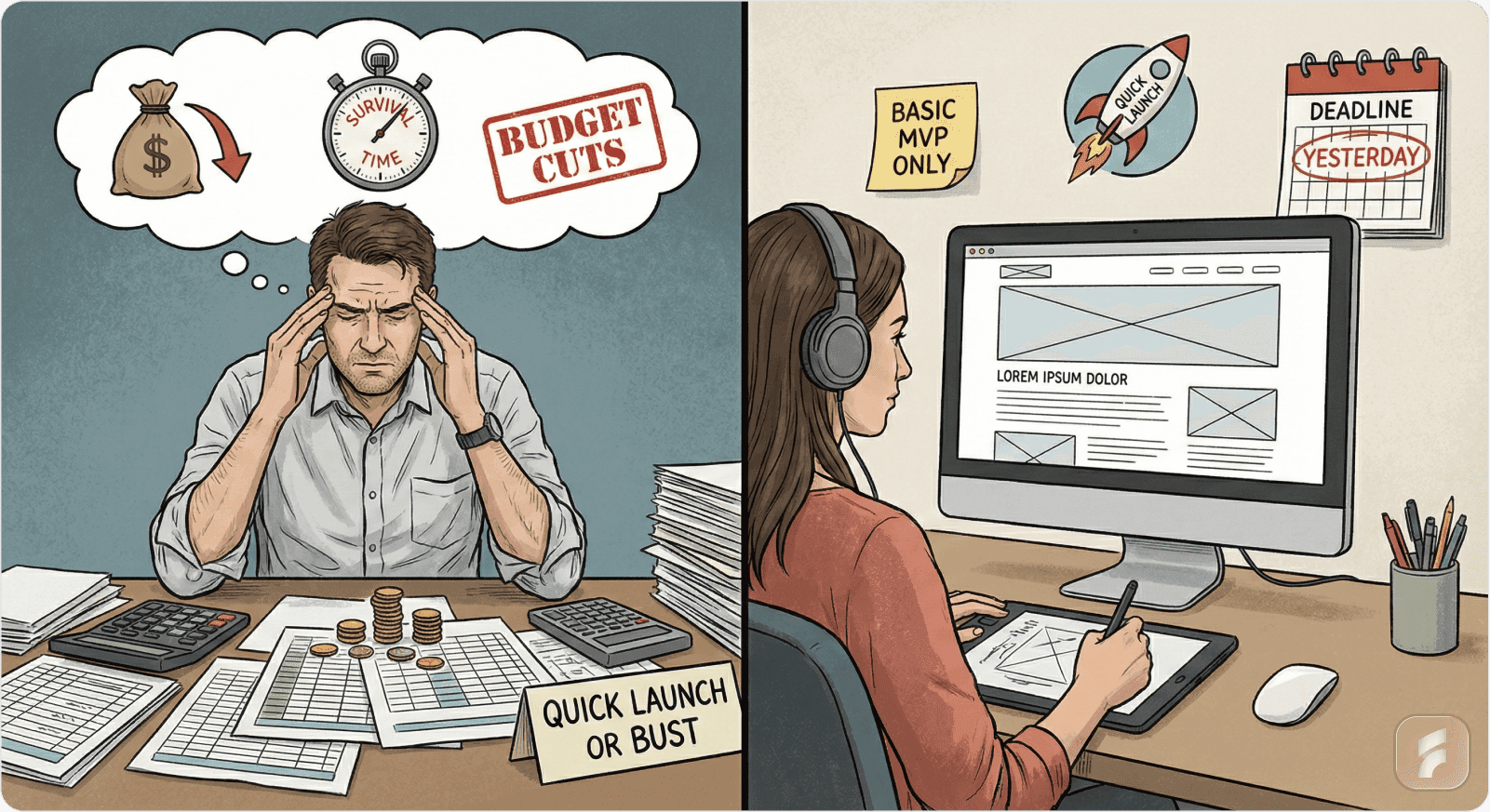
Why Founders Choose Cheap Design (We Get It)
When founders tell us they're considering a designer who charges $10 to $20 per hour, we don't judge. We understand the reasoning completely. Here's what we hear most often:
Limited runway means every dollar must stretch further , With 12-18 months of cash, spending $15,000 on design feels like burning through weeks of survival time
Design seems like a commodity skill , Figma is Figma, right? Someone charging $15/hour uses the same tools as someone charging $150/hour
The product just needs to be "good enough" to validate , We're not building the final version yet, just testing the concept with early adopters
Technical founders often underestimate design complexity , If we can build the backend, how hard can visual design be? It's just making things look nice
Pressure to ship quickly overshadows quality concerns , Our competitor just launched, we need something in market now, and faster is cheaper
These aren't bad reasons. They're pragmatic responses to real constraints. But here's what we've learned from working with hundreds of SaaS products: that affordable designer isn't actually affordable.
They're a subscription to future disasters.
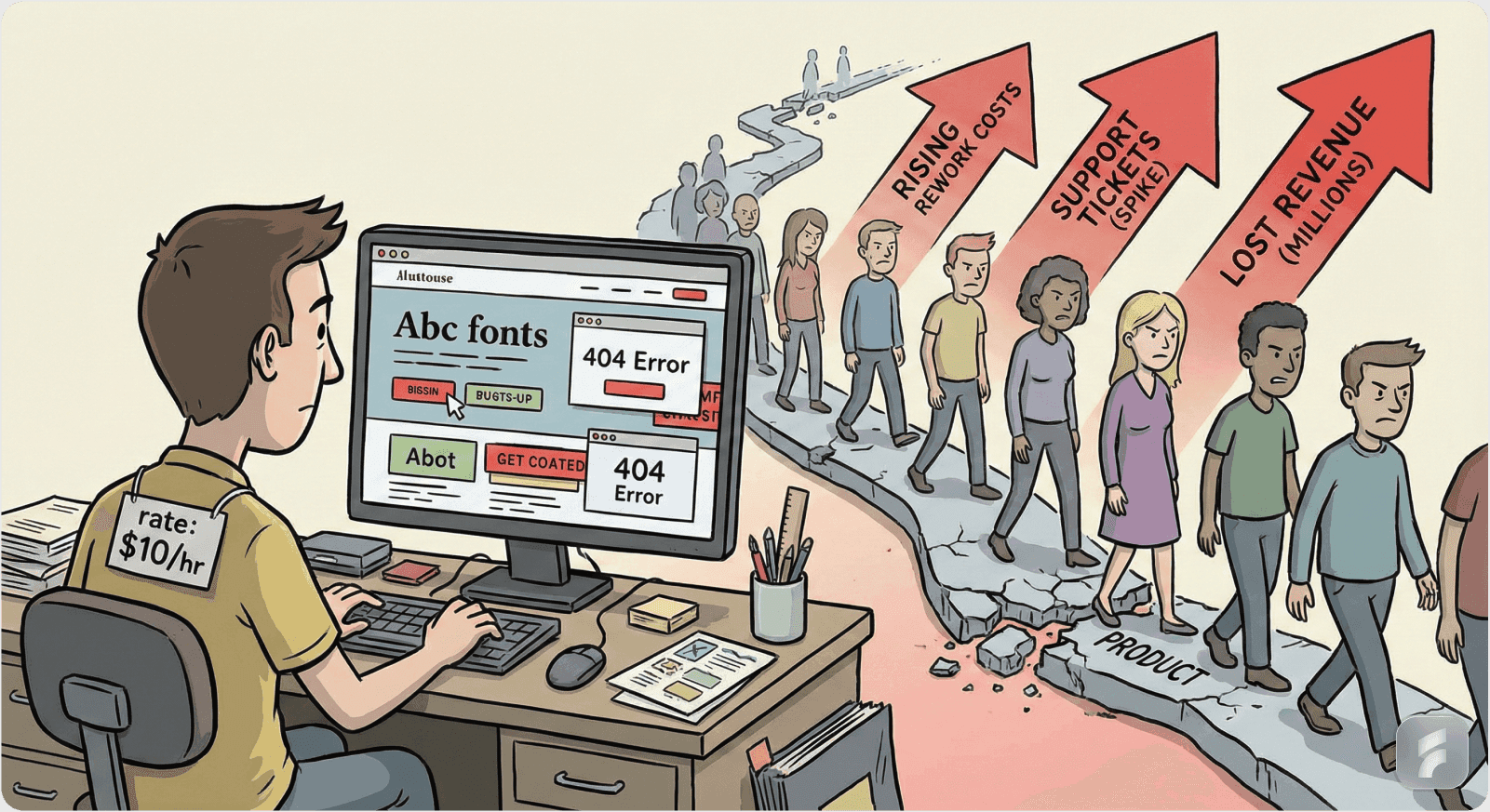
The True Cost of Cheap Design
Industry research reveals something we witness firsthand: companies typically spend two to three times their initial "savings" fixing the problems created by inexperienced design work. We've seen products completely rebuilt because the original UX was so problematic it was cheaper to start over than to fix it piece by piece.
The expensive part isn't the designer's hourly rate. It's everything that cascades from inadequate design.
Think about it this way: that $10-per-hour designer spending 40 hours on your dashboard costs you $400 upfront. But when users can't figure out your interface, when they abandon your trial signup screen in confusion, when your support team gets buried in "how do I..." tickets, that's when the real bill arrives.
10 Critical Differences Between Cheap and Expensive UX Designers
Let's break down exactly what separates a $10/hour designer from a $150/hour professional, because the gap is far wider than hourly rates suggest.
1. Experience and Skill Depth
Cheap designers typically have 1-2 years of experience handling simple tasks and working from templates. Expensive designers bring 5-10+ years of expertise across UX research, strategy, and solving complex problems. According to the Nielsen Norman Group, experienced UX practitioners reduce usability issues by up to 80%, dramatically improving product quality from the start.
2. Research and User Understanding
Low-cost designers skip thorough user research because they can't afford to spend days on discovery at their rates. This guessing game risks costly usability failures. Industry experts note that investing in UX research can yield an ROI of up to 9,900%, products built on actual user insights perform exponentially better than those built on assumptions.
3. Strategic Thinking
Expensive designers integrate UX decisions with business goals, actively working to boost KPIs like customer retention, conversion rates, and lifetime value. Forrester research shows that a 1-point improvement in customer experience scores can increase revenue by $334 million over three years for a company with $1 billion in revenue. That principle scales to companies of any size.
4. Design Quality and Usability
High-quality UX results in 400% higher conversion rates on average, according to the UX Design Institute. Cheap UX often produces inconsistent interfaces that confuse users and reduce engagement. The difference isn't just aesthetic, it's functional, affecting whether users can actually accomplish their goals.
5. Prototyping and Iteration
Top-tier UX designers use rapid prototyping and usability testing, cutting development time by 33% and costs by up to 50%, per McKinsey studies. Cheaper providers skip iterations to save time, leading to expensive post-launch fixes when problems emerge in production rather than testing.
6. Collaboration and Communication
Senior UX designers excel at cross-team collaboration, reducing project overruns by up to 25%. They translate between user needs, business goals, and technical constraints. Poor communication with cheaper designers often leads to delays, misaligned expectations, and costly rework cycles.
7. Innovation and Problem Solving
Experienced designers contribute innovative solutions that differentiate products in crowded markets. This matters critically, Harvard Business Review reports that 70% of product launches fail due to lack of market fit or poor user experience. Great designers reduce this risk by finding elegant solutions to complex problems.
8. Risk and Accountability
Expensive designers typically provide contracts, guarantees, and clear accountability structures, lowering project risk substantially. Lack of accountability with low-cost UX increases the risk of missed deadlines, poor deliverables, and designers who disappear mid-project with no recourse.
9. Long-Term Cost Efficiency
Although cheaper UX saves money initially, companies may spend 2-3 times that amount on later fixes, per reports from the Design Management Institute. Investing upfront in robust UX prevents technical debt, reduces development rework, and avoids the cascade of costs from shipping broken experiences.
10. Brand and Customer Trust
A seamless UX increases Net Promoter Scores (NPS) by up to 20 points, boosting referrals and loyalty organically. Poor UX ranks among the top reasons customers abandon brands, directly causing revenue loss. Premium designers build trust through every interaction, while cheap design erodes it.
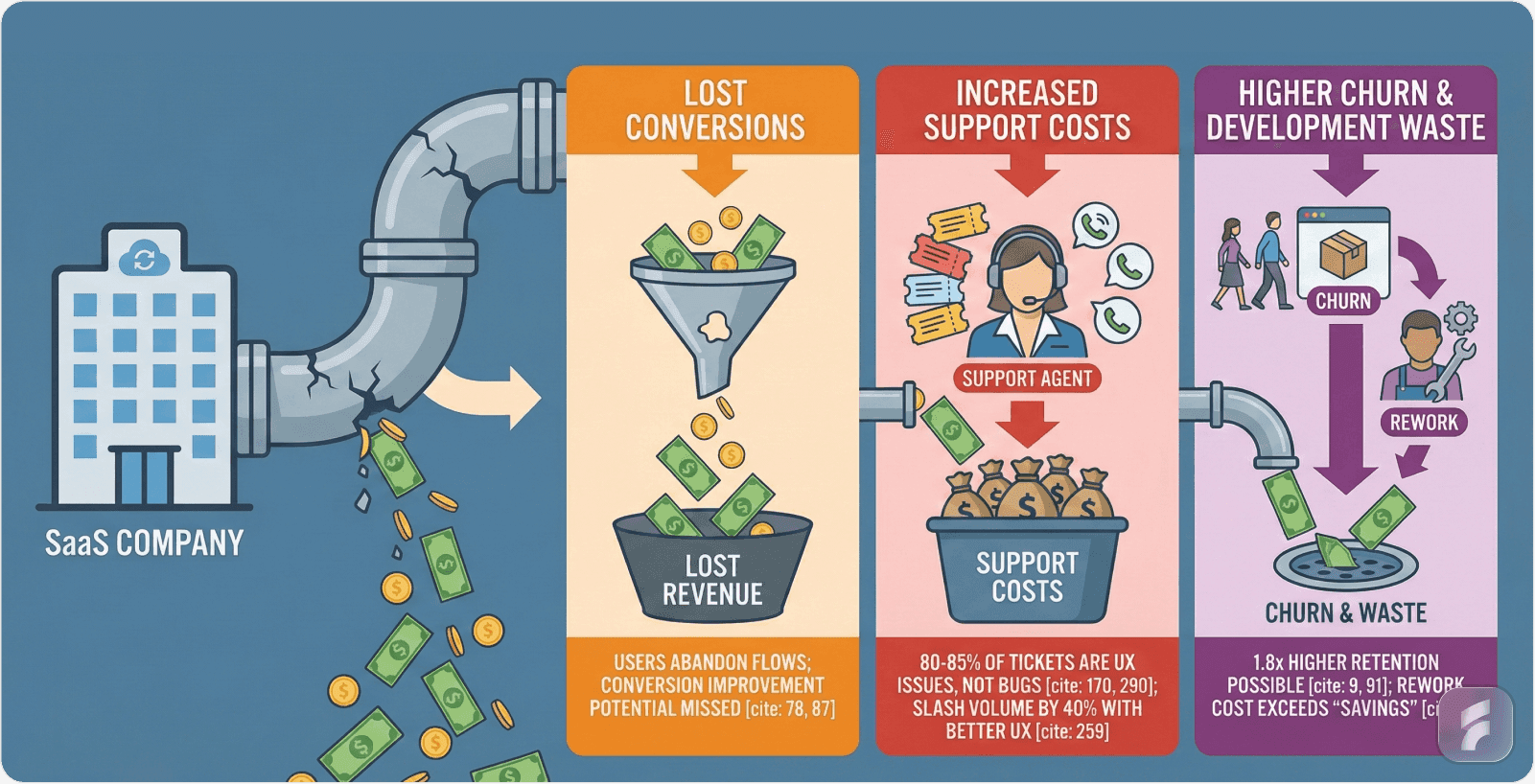
The Compounding Costs We Don't See Coming
The obvious costs of cheap design are just the surface. Sure, there's the money spent on redesigns when the first attempt fails. But the hidden expenses can be devastating.
Let's look at real numbers, because abstract warnings don't capture the actual financial impact.
Scenario: A SaaS product with 1,000 monthly trial signups, $99/month pricing, targeting 25% trial-to-paid conversion
Here's how bad UX compounds into massive monetary losses:
Lost Conversions from Poor Onboarding
Expected conversions at 25%: 250 customers/month
Actual conversions with bad UX at 11%: 110 customers/month
Lost customers per month: 140
Monthly revenue loss: 140 × $99 = $13,860/month
Annual impact: $166,320/year
Increased Support Costs
With good UX: 2 support tickets per 10 users = 200 tickets/month
With bad UX: 6 support tickets per 10 users = 600 tickets/month
Additional tickets: 400/month
Cost per ticket (avg $15 handling time): $6,000/month
Annual impact: $72,000/year
Higher Churn from Confusing Experience
Good UX monthly churn: 3%
Bad UX monthly churn: 8%
Extra customers lost on base of 500 paying customers: 25 per month
Lost MRR: 25 × $99 = $2,475/month in immediate revenue
Lost lifetime value (assuming 24-month average): 25 × $99 × 24 = $59,400/month in LTV
Development Time Waste
Engineering hours fixing UX-related issues: 80 hours/month
Developer cost at $100/hour: $8,000/month
Annual impact: $96,000/year
Failed Feature Adoption
Users who discover key features with good UX: 70%
Users who discover key features with bad UX: 30%
This reduces effective product value, increasing churn by estimated 15%
Additional monthly churn: 75 customers × $99 = $7,425/month
Annual impact: $89,100/year
Total First-Year Cost of Bad UX Design: $482,820
And remember, that founder initially "saved" maybe $10,000 by hiring cheap design instead of investing $20,000 in premium UX. The return on spending more would have been roughly 4,800%.
Development teams lose countless hours interpreting vague design specifications, building interfaces that don't quite work, then rebuilding them when users struggle. One engineering leader told us his team spent roughly 30% of their time fixing preventable UX issues that an experienced designer would have caught before a single line of code was written.
Support costs explode when interfaces confuse users. We've analyzed support tickets for dozens of SaaS products and found that 40-60% of inquiries stem from UX problems, not actual bugs or missing features. Users asking "how do I..." questions are users encountering design failures.
Customer acquisition becomes exponentially more expensive when word-of-mouth suffers. Research shows that a seamless UX can increase Net Promoter Scores by up to 20 points. Poor UX does the opposite, it turns potential advocates into people who warn others away.
One company we consulted for calculated that their budget UX was costing them $8,200 per month in additional support staffing, $12,000 per month in lost conversions, and an unmeasurable amount in reduced referrals and reputation damage. Their designer's rate? $18 an hour, which they'd chosen specifically to save money.
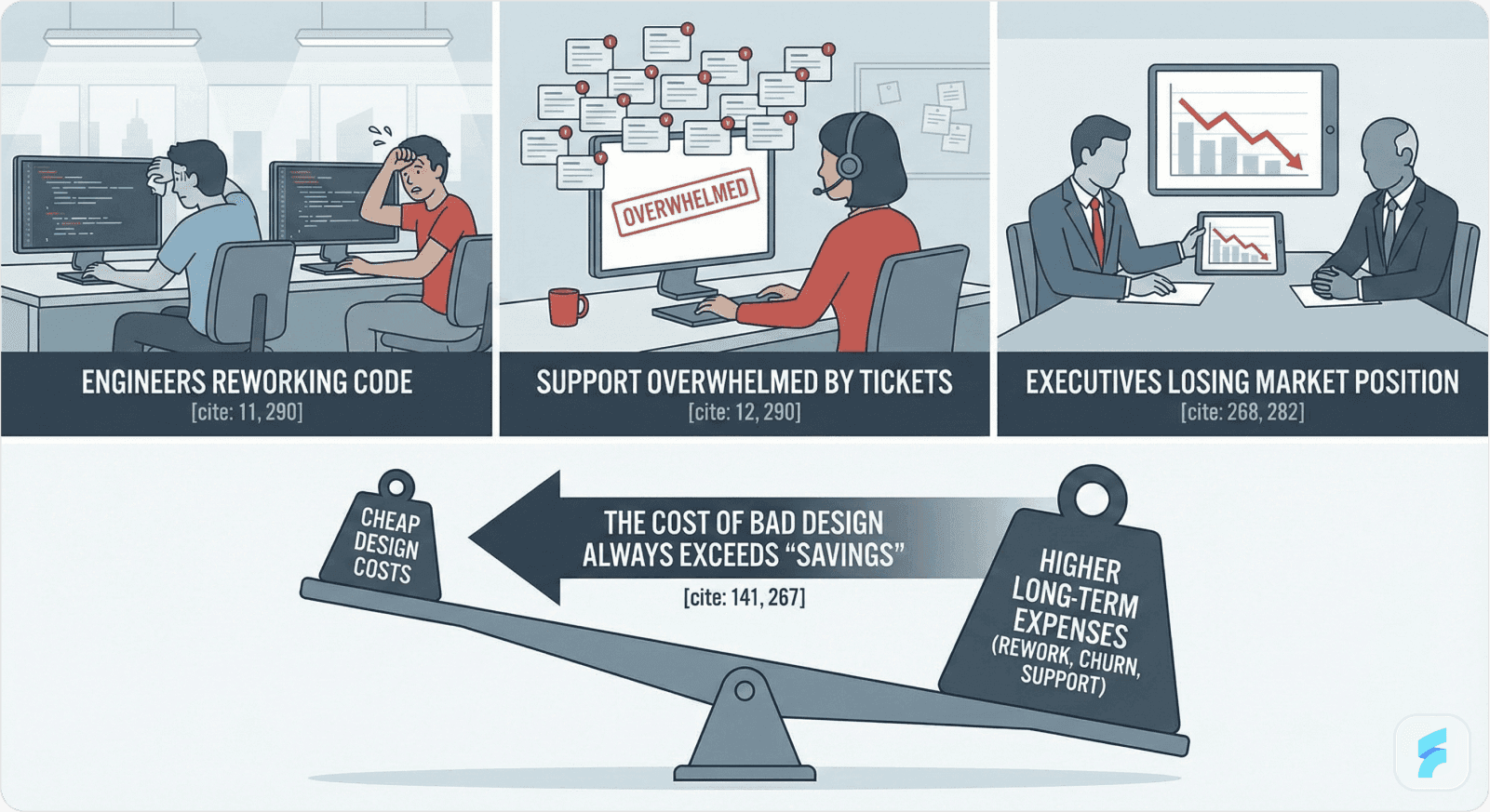
When Cheap Design Costs More Than Money
Beyond dollars, there's an opportunity cost that's harder to quantify but equally painful: time.
Markets move fast. Competitors don't wait. When a product launches with poor UX, then needs six months of fixes and redesigns, that's six months of market share going to someone else. That's six months of potential customers forming habits with competing products. That's six months of momentum lost.
We've worked with companies that spent their entire first year fighting against their own interface instead of focusing on growth. By the time they got the UX right, their head start had evaporated.
The Design Management Institute reports findings that align with what we see: companies that invest in design upfront avoid spending two to three times that amount fixing problems later. But more importantly, they avoid the time sink. They avoid the team morale drain of constantly rebuilding. They avoid the market position erosion.
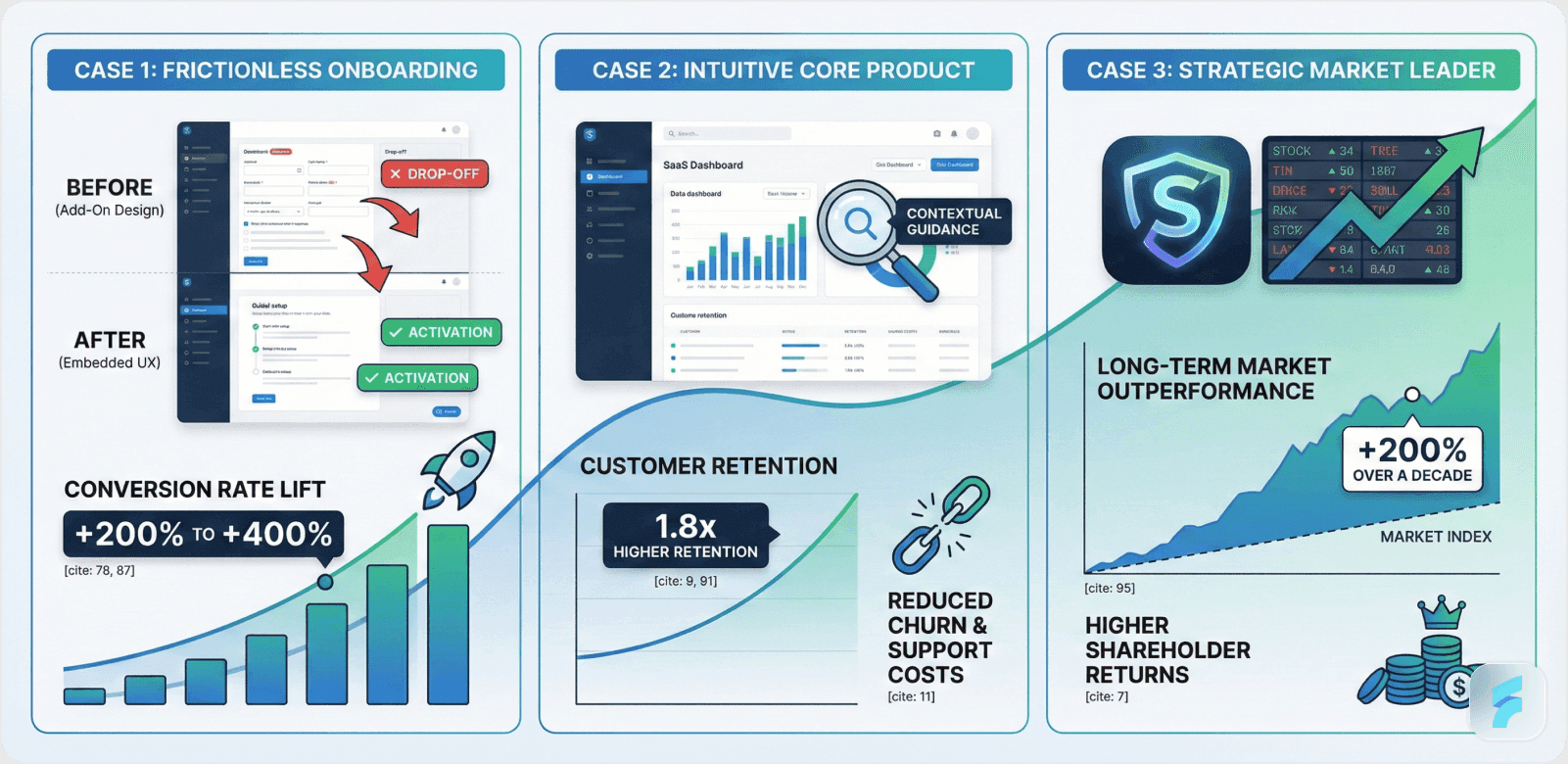
The Companies That Bet Big on Design (And Won)
The most compelling evidence comes from watching companies that made design a strategic priority from the beginning.
Airbnb's Design-Led Foundation
Brian Chesky and Joe Gebbia, both graduates of the Rhode Island School of Design, built Airbnb with design as a foundational principle rather than an afterthought. Early investors initially told them "we love everything, but you and your idea," partly because "designers don't start companies."
But their design-first approach led to extraordinary outcomes, by focusing on design-driven decisions and user experience, Airbnb achieved record-breaking cash flows exceeding $3.4 billion. Today, Airbnb is worth $76 billion and operates in 220 regions.
What made the difference? Chesky embedded his creative roots in Airbnb's culture, product, and community, using design not just for aesthetics but to solve trust problems, creating a system that allows strangers to live together. Their use of storyboarding to map guest experiences, anticipate issues, and ensure smooth journeys became instrumental in their success.
As Chesky says, "the best thing for engineers and product managers is to pair them with great design from the beginning, because otherwise it's like running and one of your legs is shorter than the other".
Stripe's Developer-First Design Excellence
Patrick and John Collison built Stripe with an obsessive focus on design thinking applied to infrastructure. When they started in 2010, accepting payments online required navigating complex relationships with banks and processors, taking months to integrate.
The Collisons saw this as a fundamental infrastructure problem and created Stripe's famous "seven lines of code" promise, any developer could accept payments in minutes, not months. This design-driven simplicity helped Stripe grow 38% year-over-year in 2024, with the company now valued at $95 billion and processing over $1.4 trillion in annual payment volume.
Patrick Collison's approach is instructive: "He sees complexity as a design flaw, not a feature". That mindset, treating poor user experience as a problem to solve rather than accept, made Stripe different in a crowded fintech space.
Dropbox's Focus on Simplicity
Drew Houston founded Dropbox in 2007 after forgetting his USB drive on a bus trip, immediately coding a solution focused on making file access seamless. His vision was simple: a folder that automatically syncs to the cloud, accessible from any device.
Houston's focus on creating a product that "just worked" set Dropbox apart from competitors with complicated solutions. By 2009, Dropbox had over a million users, reaching 50 million by 2011, largely due to the platform's simplicity and ease of use. Houston emphasized that "what our customers really value is the sharing and collaboration, not just the storage," and credited their focus on "design and building great products" as key to standing out.
Today, Dropbox serves over 700 million registered users with a valuation exceeding $9 billion.
The pattern is clear: these founders didn't treat design as decoration. They treated it as core infrastructure, as fundamental as their code. And the market rewarded that approach with billions in value.
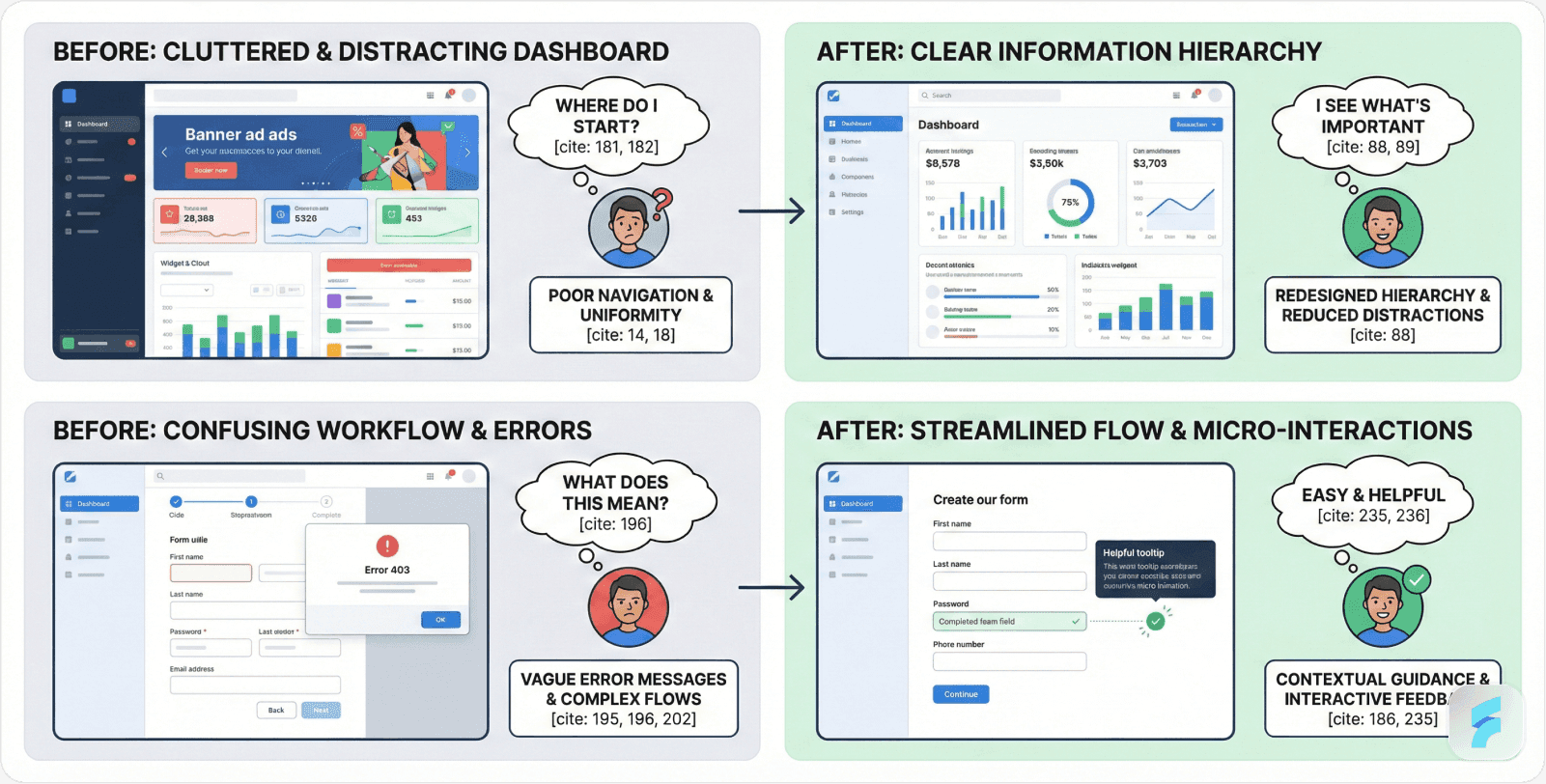
What Great UX Design Actually Looks Like in Practice
When we bring experienced designers into projects, certain patterns emerge consistently.
They obsess over micro interactions, not because animations are cool, but because they provide feedback that reduces user anxiety. When we've helped implement thoughtful micro interactions on SaaS screen design, users report feeling more confident and in control, even when the underlying functionality hasn't changed.
They sweat the details of information hierarchy. One client had a trial signup screen that was technically asking for the same information as competitors, but arranged it in a way that felt invasive. Reordering those fields based on psychological principles, asking for easy information first, building trust before requesting sensitive data, improved signup completion by 29%.
They understand that improving SaaS screen layout to reduce churn isn't about cramming more information into view. Often it's the opposite. It's about removing distractions, creating clear paths, and making the most important actions obvious.
They think in systems, not screens. Best UX fixes for SaaS trial signup screen aren't isolated to that one screen, they consider what happens before it (marketing messaging), what happens during it (trust and clarity), and what happens after it (onboarding follow-through).
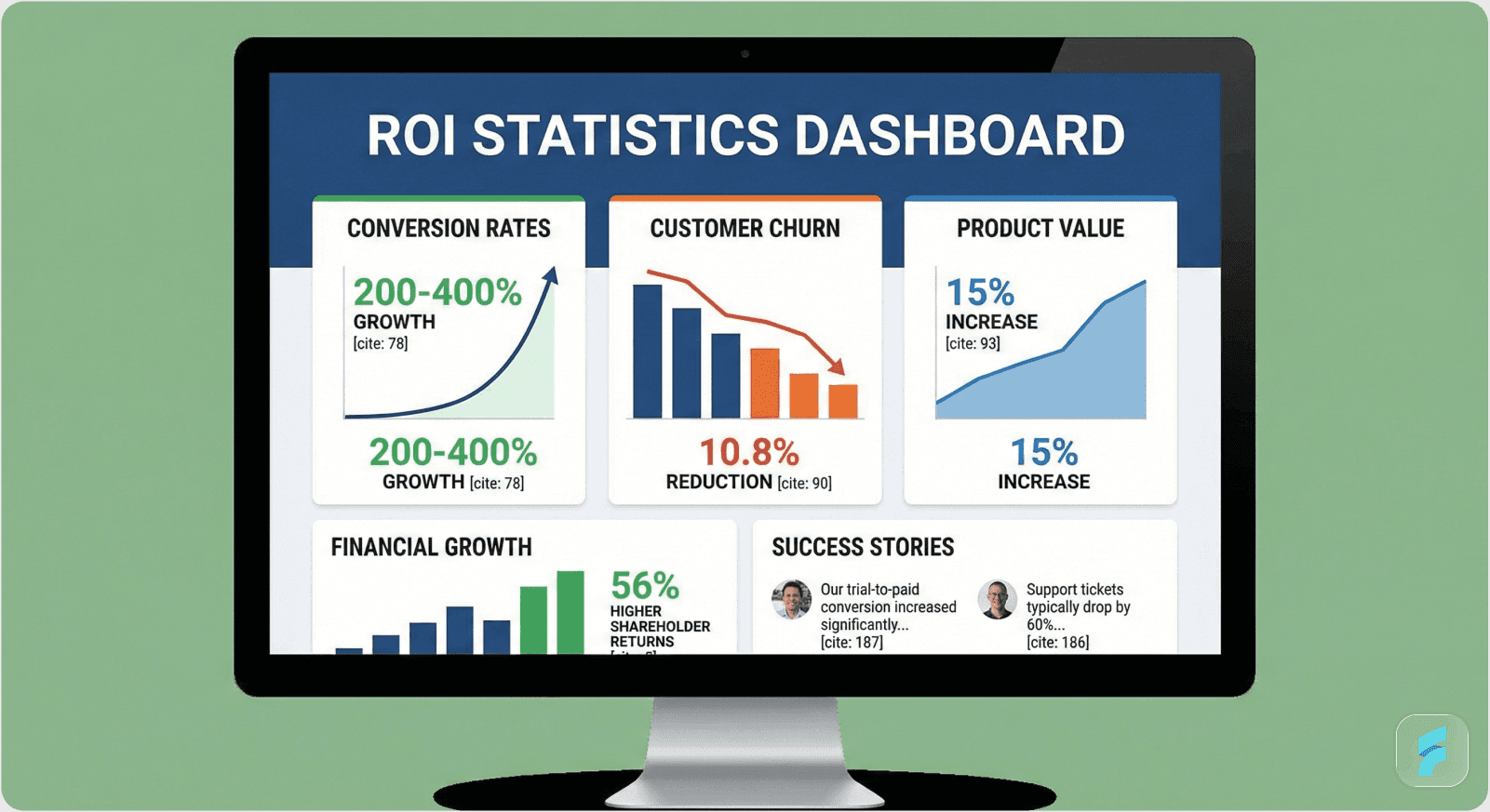
The ROI That Actually Matters
Let's talk numbers, because ultimately, this is a business decision.
The UX Design Institute reports that high-quality UX results in 400% higher conversion rates on average. We've seen similar results. A client spending $12,000 on premium UX design generated an additional $67,000 in revenue within three months through improved conversions alone.
Another client invested $18,000 in redesigning their core user flows. Within six months, they'd reduced churn by 23%, increased average customer lifetime value by $340, and cut support costs by 41%. The ROI was over 800%.
McKinsey studies show that top-tier UX designers who use rapid prototyping and usability testing can cut development time by 33% and costs by up to 50%. We've experienced this. When design is done right upfront, engineering becomes dramatically more efficient. There's less guessing, fewer surprises, and minimal rework.
One engineering team told us that working with an experienced designer was "like having a map instead of wandering in the dark." Their sprint velocity increased because they spent time building instead of figuring out what to build.
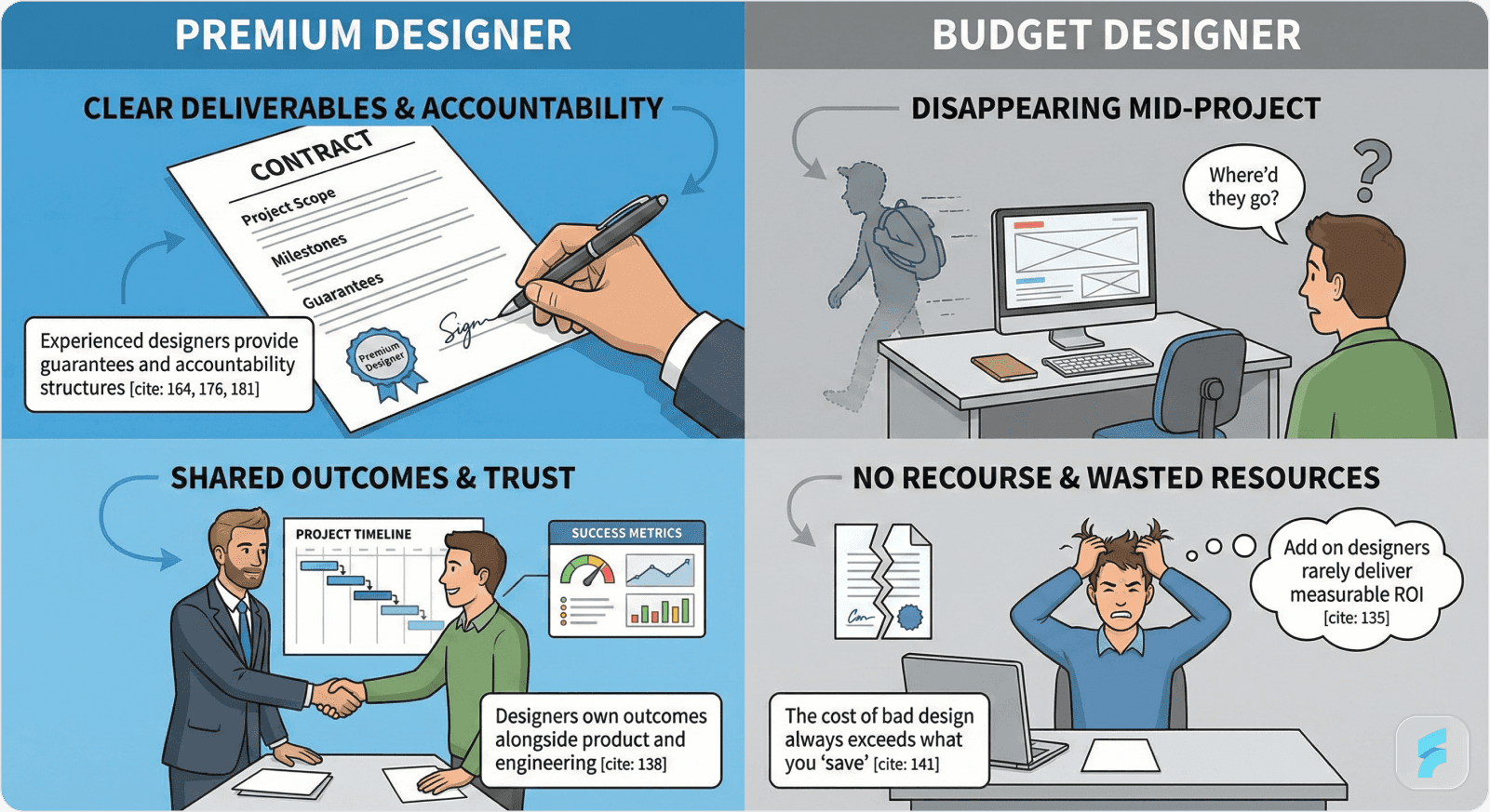
The Accountability Factor
There's another dimension that matters: accountability.
When we pay premium rates, we're typically working with designers who have reputations to protect. They provide contracts with clear deliverables. They offer revision rounds and quality guarantees. They have portfolios of successful projects and references we can check.
Budget designers often have none of this. When a project goes wrong, there's little recourse. We've heard too many stories of founders losing deposits to disappeared designers or receiving unusable work with no path to fixes.
The risk isn't evenly distributed. Cheap design carries risk we're accepting. Premium design often comes with accountability structures that reduce that risk substantially.
The Long View
Here's what we've come to understand after years of working in this space: the question isn't whether we can afford experienced UX design. It's whether we can afford not to invest in it.
Every month that a product operates with poor UX is a month of:
Lost conversions that never come back
Customers churning who might have stayed
Support costs that drain resources
Technical debt that gets harder to fix
Market position eroding to competitors with better experiences
Team morale suffering from building things that don't work
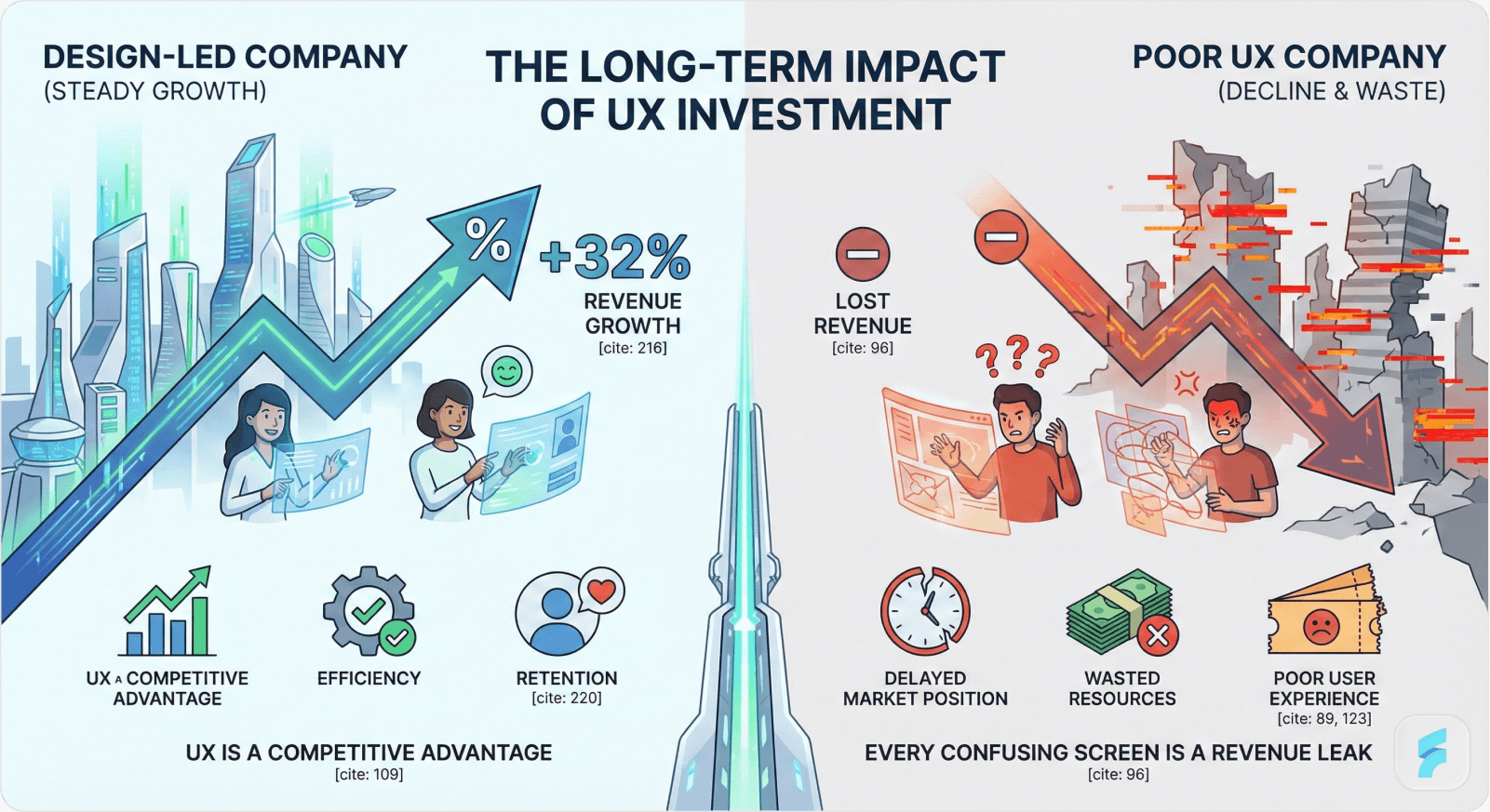
These costs accumulate. They compound. A $20,000 investment in good UX design today might prevent $150,000 in fixes and lost revenue over the next year.
Jakob Nielsen, a legendary figure in UX, said: "The return on investment in UX is often underestimated and can outstrip most other investments." We've seen this truth repeatedly. The companies that invest early in great UX spend less overall and grow faster than those trying to save money with budget design.
The Clarity We Gained
After working with hundreds of SaaS products, we've reached a simple conclusion: UX design is not a cost. It's an investment in removing the barriers between our product and the people who need it.
Those barriers show up everywhere. In login screens that create distrust. In onboarding flows that confuse instead of guide. In dashboards that overwhelm instead of empower. In setup processes that feel like obstacles. In checkout experiences that make users second-guess their decisions.
Every one of these friction points costs money. Not just in that moment, but in every moment afterward. A user who abandons a trial doesn't just represent one lost sale, they represent lost lifetime value, lost referrals, and lost opportunity.
Premium UX design identifies these friction points before users encounter them. It removes the invisible walls. It creates paths instead of obstacles.
This isn't about making things pretty, though good design often is beautiful. It's about making things work, actually work, for the humans trying to use them.
When we stop seeing design as decoration and start seeing it as infrastructure, the investment makes perfect sense. We wouldn't build a SaaS product on unreliable servers to save money. We wouldn't skip security testing to ship faster. These would be obviously foolish economies.
The same logic applies to UX. Cheap design is expensive infrastructure. Premium design is investing in the foundation that everything else builds on.
The path forward is clearer than we initially thought. Yes, premium UX design requires a larger upfront investment. But that investment prevents the cascade of costs, financial and otherwise, that poor design inevitably creates.
We're not just buying better-looking screens. We're buying fewer support tickets, higher conversion rates, lower churn, faster development cycles, better team morale, and ultimately, sustainable growth.
That's not an expense. That's strategy.