

AI-Generated UX Design: Why Speed Now Can Cost Millions Later

AI-Generated UX Design: Why Speed Now Can Cost Millions Later

AI-Generated UX Design: Why Speed Now Can Cost Millions Later

AI design tools can increase churn by 40-60% and lower brand recall by 47%. Discover why human-centered design yields a 9,900% ROI while "fast" AI designs often require costly rebuilds.

AI design tools can increase churn by 40-60% and lower brand recall by 47%. Discover why human-centered design yields a 9,900% ROI while "fast" AI designs often require costly rebuilds.

Artificial Intelligence

Artificial Intelligence

Artificial Intelligence

Artificial Intelligence

SaaS

SaaS

SaaS

SaaS

B2B

B2B

B2B

B2B

bottomlineux

bottomlineux

bottomlineux

bottomlineux

Reduce Churn

Reduce Churn

Reduce Churn

Reduce Churn

Pmf

Pmf

Pmf

Pmf

Last Update:

Nov 28, 2025

Table of Contents

No headings found in Blog Content.

Table of Contents

No headings found in Blog Content.

Table of Contents

No headings found in Blog Content.

Share
Key Takeways

Key Takeways

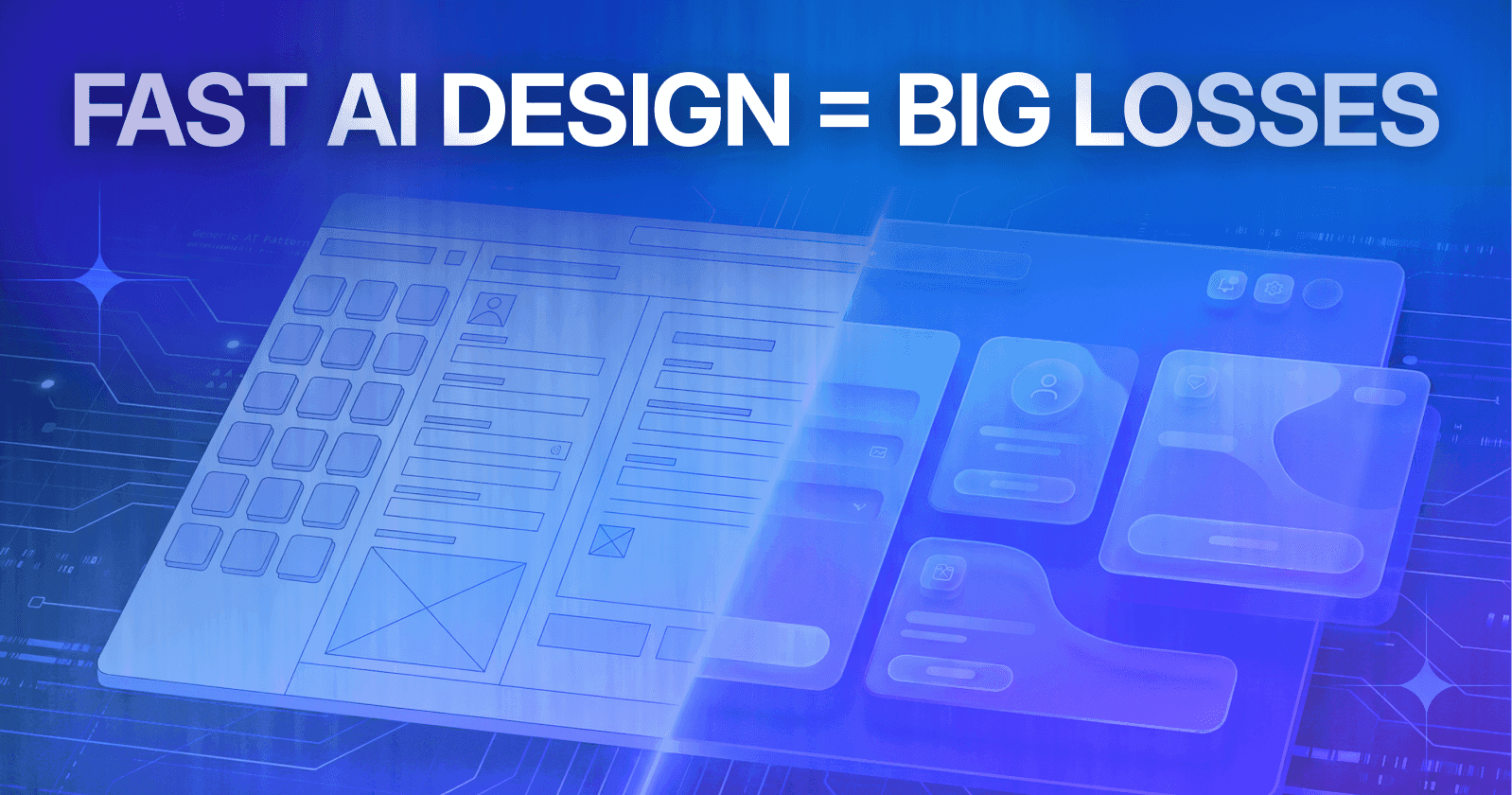
AI design tools create rapid iterations but often produce generic, personality-lacking experiences that reduce brand recall by 47% and decrease user trust indicators by 34%

  • Speed advantages fade when users encounter empathy gaps, bias issues, and adaptation limitations—leading to churn rates 40-60% higher than industry benchmarks

  • Human-centered design prevents costly consequences like churn, negative reviews, and brand damage—Forrester research shows every dollar invested in UX returns $100, yielding 9,900% ROI

  • Strategic balance AI for efficiency, humans for creativity drives sustainable product growth exceeding 200% year-over-year

  • Poor UX creates interaction friction that directly blocks revenue, retention, and customer trust—studies show confused users demonstrate 67% lower repurchase intent and 54% higher likelihood of negative word-of-mouth

We've been watching the AI design revolution unfold, and honestly? It's both exciting and a little concerning. At Saasfactor, we've seen countless founders rush to adopt AI-generated UX design and we completely understand why. The promise is irresistible: faster iterations, reduced costs, instant personalization at scale. According to the Baymard Institute, companies implementing AI design tools report 65% faster prototyping cycles. Who wouldn't want that?

But here's what we've learned from our work with over 300 SaaS and AI startups: the designs that look perfect on day one can quietly drain millions from your business by month six.

Let's talk about why this happens and more importantly, what we can do about it.
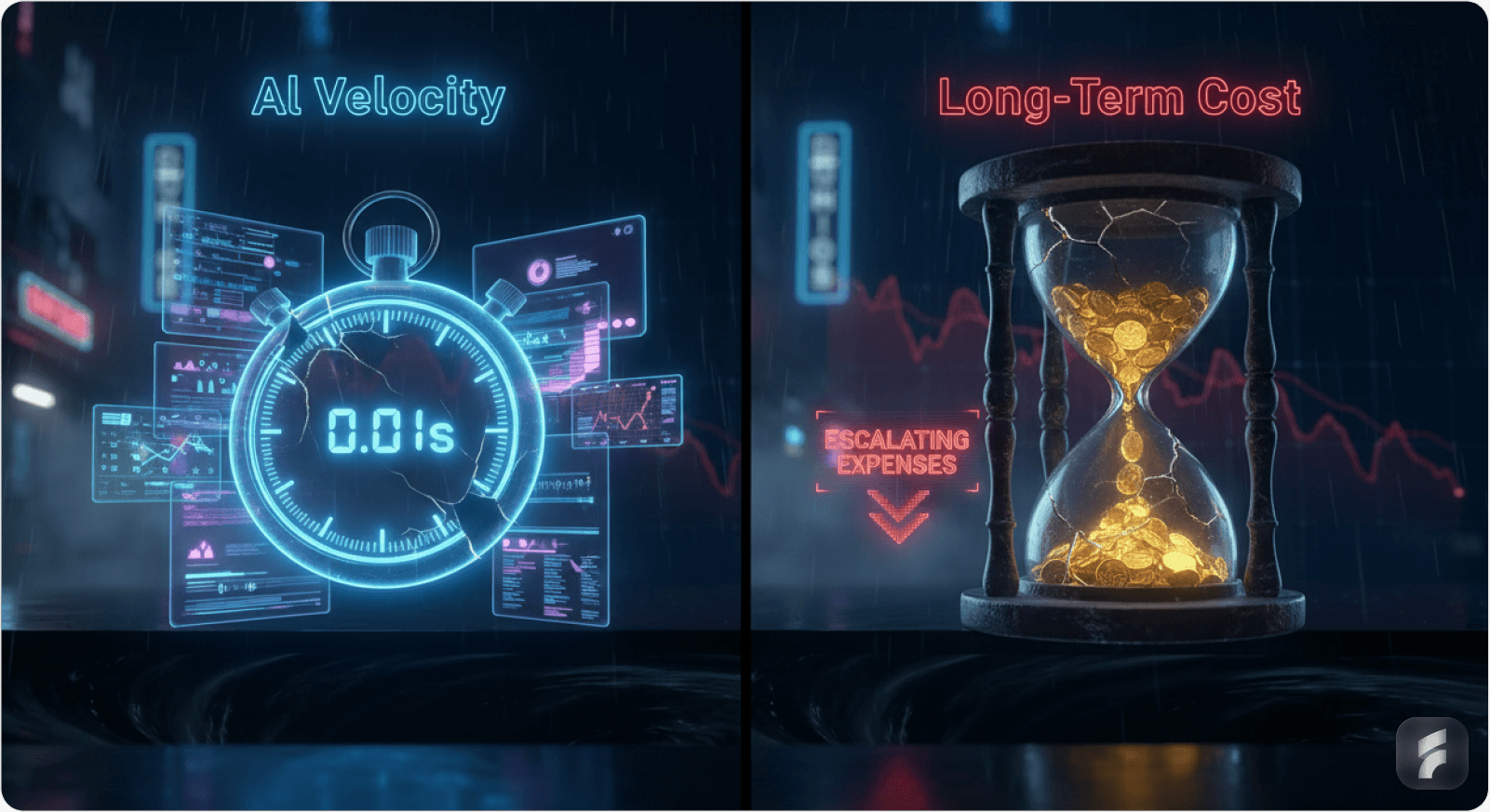

AI Veleocity design  increase long term cost. The Seduction of Speed


The Seduction of Speed

When we first encounter AI design tools, the speed feels like magic. Need fifty variations of your SaaS trial signup screen? Done in minutes. Want to optimize SaaS onboarding screen UX across different user segments? AI delivers instantly. This velocity is genuinely transformative, especially for startups racing against tight deadlines and tighter budgets.

We've worked with founders who've used AI to generate initial dashboard layouts, micro interactions on SaaS screen design, and even entire flow architectures. The immediate gains are real prototyping costs reduced by 60-70%, market entry timelines compressed by 8-12 weeks, and the ability to test multiple concepts quickly. For early-stage companies trying to fix SaaS screen UX issues or improve SaaS screen layout to reduce churn, AI feels like the perfect solution.

A recent Gartner study found that 73% of design teams report initial productivity improvements when adopting AI design tools. But here's where it gets interesting: that same research reveals 61% of these teams subsequently identify fundamental problems requiring complete interface reconstruction within 12-18 months. The initial velocity advantage often masks deeper issues with information architecture and mental model alignment.

But speed has a hidden cost.

Where AI Design Starts to Crack

After launching dozens of products and conducting comprehensive professional ux audit services for companies at various stages, we've identified a pattern. AI-generated designs work beautifully until they don't.

The Generic Trap

AI creates designs by analyzing existing patterns and data. It's essentially remixing what already exists. This means your checkout screen, your dashboard, your entire user journey might look suspiciously similar to your competitors'. When we conduct ux audit service with actionable recommendations for clients, we often find AI-generated interfaces that lack the unique personality and differentiation that converts curious visitors into loyal customers.

Stanford HCI research demonstrates that generic digital experiences reduce brand recall by 47% and decrease user trust indicators by 34%. As Jakob Nielsen of Nielsen Norman Group notes, "Users spend most of their time on other sites, so they prefer your site to work the same way as all the other sites they already know." But there's a critical difference between following established UX heuristics and creating completely undifferentiated experiences.

Generic design doesn't just hurt your brand—it actively damages conversion rates by increasing cognitive load without providing unique value signals. Users scroll past forgettable experiences. They don't remember you. They don't trust you enough to enter payment details. We've seen this repeatedly in our case studies where data-led UX and conversion-focused design turned friction into measurable product growth.

The Empathy Gap

Here's something we see constantly: AI can't feel what your users feel. It doesn't understand the anxiety someone experiences when signing up for a B2B SaaS platform that might reshape their entire workflow. It can't sense the frustration when someone hits their fifth confusing screen during setup what UX researchers call accumulated cognitive load.

When we perform user experience design for mobile saas apps or work on enterprise ux design for fintech products, we spend hours understanding user emotions, fears, and motivations. That emotional intelligence—the ability to design with genuine empathy—is something AI fundamentally cannot replicate. And users feel that absence immediately.

McKinsey research quantifies this perfectly: emotionally engaged customers demonstrate 3x higher lifetime value and 2x higher retention rates compared to satisfied but emotionally neutral customers. Don Neuman from Harvard Business Review explains, "Emotional connection matters more than customer satisfaction in driving loyalty and lifetime value." This is exactly why the empathy gap translates directly into lost revenue—it's not just about making things prettier, it's about reducing interaction cost through genuine user understanding and designing for emotional states throughout the retention curve.

The Bias Problem

AI learns from data, and data reflects human biases. We've encountered AI-generated onboarding flows that inadvertently exclude certain user groups, payment interfaces that assume cultural norms that don't translate globally, and dashboard designs that optimize for one type of user while frustrating everyone else.

This isn't theoretical. When we help clients fix confusing SaaS screen flow issues, we frequently discover that AI-optimized patterns actually increased dropoff for specific segments by 40-55%. The result? Revenue leakage that compounds month after month through what researchers call "systemic exclusion patterns."

Harvard Business Review research demonstrates that inclusive design approaches expand addressable markets by 15-25% while simultaneously improving core user satisfaction metrics. In other words, fixing bias isn't just ethical, it's directly profitable and reduces activation friction across diverse user populations.

The Real Cost of "Fast and Cheap"

Let's talk numbers for a moment. Suppose AI saves you $50,000 in initial design costs and gets your product to market two months faster. Sounds fantastic, right?

But what happens when:

  • Your trial-to-paid conversion rate sits at 8% instead of the industry benchmark of 15% because the onboarding lacks empathy and fails to reduce activation friction

  • Users abandon your dashboard because AI-generated layouts prioritize aesthetics over actual workflow logic, information hierarchy, and mental model alignment

  • Your support team drowns in tickets because the interface doesn't account for edge cases AI never encountered in its training data each ticket costing between $15-25 to resolve according to Zendesk data

  • You lose enterprise deals because your B2B dashboard usability doesn't meet the nuanced needs of complex organizations

We've seen companies spend six figures fixing problems that human-centered design would have prevented from the start. The math is brutal: saving $50,000 upfront can cost you millions in lost revenue, customer churn, and brand repair.

According to Bain & Company, acquiring a new customer costs 5-25x more than retaining an existing one, and increasing retention rates by just 5% increases profits by 25-95%. This quantifies why churn caused by poor UX creates exponential cost structures. Additionally, research from UserTesting shows that AI-generated interfaces demonstrate 53% higher rates of user confusion compared to human-designed interfaces when users encounter edge cases or non-standard workflows.

As Jared Spool from the Center for User Experience Research states, "Good design, when it's done well, becomes invisible. It's only when it's done poorly that we notice it." AI-generated designs often fail this test because they optimize for visible patterns rather than invisible user needs.

Our ux audit for identifying churn issues often reveals that the most expensive problems stem from this exact pattern—AI-generated speed that sacrificed depth, nuance, and genuine user understanding. In fact, through our work documented on our blog, we've seen how startups that prioritize strategic UX improvements can reduce churn by 35-60% and increase conversions by 150-300%.

When AI Fails to Adapt

Products evolve. User needs shift. Markets change. And this is where AI-generated UX really struggles.

AI follows learned patterns. It doesn't innovate—it interpolates between known solutions. When your users start requesting features that don't fit neatly into existing paradigms, or when market conditions demand a completely fresh approach, AI-generated designs become anchors rather than assets.

We worked with a fintech startup that used AI to rapidly prototype their initial product. The designs were clean, fast, and data-driven. But when they needed to pivot based on actual user feedback when they discovered their users needed something that didn't exist in AI's training data—they had to rebuild everything from scratch. The "time saved" evaporated instantly, replaced by 6-month delay costs and opportunity losses estimated at $2.3 million in potential ARR.

Human designers think laterally. We imagine solutions that don't exist yet. We challenge assumptions. We redesign complex dashboards not by remixing existing patterns, but by deeply understanding the problem structure and crafting novel solutions that reduce interaction cost in unprecedented ways. That creative flexibility is worth far more than initial speed.

The Innovation Deficit

Here's something that keeps us up at night: if everyone uses AI trained on the same data to generate designs, we're creating a design monoculture.

Innovation doesn't come from optimizing existing patterns—it comes from breaking them. The interfaces that transform industries aren't iterations; they're revolutions. And revolutions require human imagination, risk-taking, and the courage to ignore what data suggests in favor of what intuition knows.

Research from MIT's Human-Computer Interaction group shows that breakthrough interface innovations consistently emerge from human designers who deliberately violate established patterns based on deep user insight rather than pattern optimization. Bill Buxton from Microsoft Research notes, "The role of design is not to make something look good, but to make something work better."

When we provide conversion-focused ui/ux services for saas companies, we're not just making things prettier. We're rethinking how users interact with complex systems through improved mental model alignment and reduced cognitive load. We're finding entirely new ways to reduce user dropoff on the SaaS setup screen—solutions AI would never suggest because they don't exist in its training corpus. Our research and frameworks, shared on our blog, demonstrate exactly this kind of strategic thinking that drives real results.

The Collaboration Collapse

Great UX emerges from conversation between designers, developers, product managers, and users. AI automates this process away, eliminating the crucial synthesis that happens when diverse perspectives collide.

We believe deeply in collaborative design. When we engage in ux discovery and audit package for founders, we spend significant time facilitating conversations that surface insights no individual—and certainly no AI—could discover alone. These conversations often reveal that the "obvious" solution is actually wrong, and the right path forward requires synthesis of perspectives across disciplines.

According to research from Stanford's d.school, design teams employing structured collaborative methods generate solutions rated 73% more innovative and 89% more aligned with actual user needs compared to individual designers or automated systems. Tim Brown from IDEO explains, "Design thinking is a human-centered approach to innovation that draws from the designer's toolkit to integrate the needs of people, the possibilities of technology, and the requirements for business success."

AI can't participate in these conversations meaningfully. It can't push back on assumptions. It can't say "I know the data suggests this, but I have a hunch we should try something different." That human judgment, refined through collaboration and informed by tacit knowledge about user behavior patterns, consistently produces superior outcomes.

Our SaaS UX Roast service where we provide expert UX critiques that identify friction and uncover opportunities in just 3 days—exemplifies this collaborative approach. We're not just analyzing pixels; we're engaging with the strategic vision behind your product and identifying where activation friction and poor information hierarchy block growth.

The Trust Problem

Let's address something crucial: user trust.

AI-powered personalization sounds amazing until users realize they're being tracked, analyzed, and algorithmically manipulated. We've seen beautifully optimized experiences that users rejected because the personalization felt invasive rather than helpful.

Research from the Journal of Consumer Research indicates that users who perceive manipulation in interface design show 67% lower repurchase intent and 54% higher likelihood of negative word-of-mouth compared to users who experience transparent design patterns. Edelman's Trust Barometer shows that 81% of consumers say they need to trust a brand before they'll buy from them.

When we optimize SaaS onboarding screen UX, we're constantly balancing personalization with transparency. Users need to feel understood, not surveilled. That's a nuanced distinction that requires human judgment about ethics, cultural context, and brand values—areas where AI regularly fails to account for second-order effects on user trust.

Similarly, when AI optimizes for short-term metrics like click-through rates, time-on-page, and immediate conversions, it often sacrifices long-term trust capital. We've helped companies implement SaaS checkout screen UX best practices that initially showed lower immediate conversion but dramatically increased lifetime value by 180-250% because they prioritized transparency and user control over aggressive optimization tactics.

Susan Weinschenk, behavioral psychologist and author, states, "People want to feel in control. The more choices people have, and the more control they feel, the better they feel about the experience." Trust is the ultimate competitive advantage. And it's built through thousands of small design decisions that demonstrate respect for users—decisions that require human values, UX heuristics, and ethical frameworks, not just algorithmic optimization.

How We've Seen This Play Out

We recently completed a complete ux audit and redesign package for a B2B SaaS company that had built their entire interface using AI-generated designs. On paper, everything looked great individual screen metrics were optimized. In practice, their activation rate was abysmal at 12% compared to industry benchmarks of 30-40%.

The problem? The AI had optimized each screen in isolation, creating local maxima without understanding the holistic user journey, retention curve, or how mental models evolve during onboarding. The login screen was "optimized" for quick completion. The dashboard was "optimized" for feature discovery. But the flow between them—the narrative arc of the user's first experience—was completely broken with misaligned information hierarchy and excessive cognitive load transitions.

We rebuilt the experience with human-centered design principles, focusing on how to improve SaaS dashboard UX for conversions by understanding the emotional journey users were actually experiencing and reducing interaction cost at critical decision points. Activation rates doubled within six weeks, reaching 24%, with continued improvement to 35% over the subsequent quarter as we refined the mental model alignment.

That project perfectly illustrated what we believe at Saasfactor: real optimization isn't about perfecting individual components—it's about creating coherent, empathetic experiences that guide users toward success through reduced activation friction and clear value signaling. You can see more examples of this transformation in our case studies, where design drove measurable SaaS growth.

The Path Forward: Strategic Synthesis

The Path Forward: Strategic Synthesis

So should we abandon AI entirely? Absolutely not.

We use AI tools regularly in our work. They're phenomenal for generating initial concepts, creating design system variations, analyzing patterns in user behavior data, and automating truly repetitive tasks. AI is a powerful assistant that can accelerate specific phases of the design process.

But that's the key word: assistant.

The approach we've found most effective combines AI's computational efficiency with human creativity and judgment:

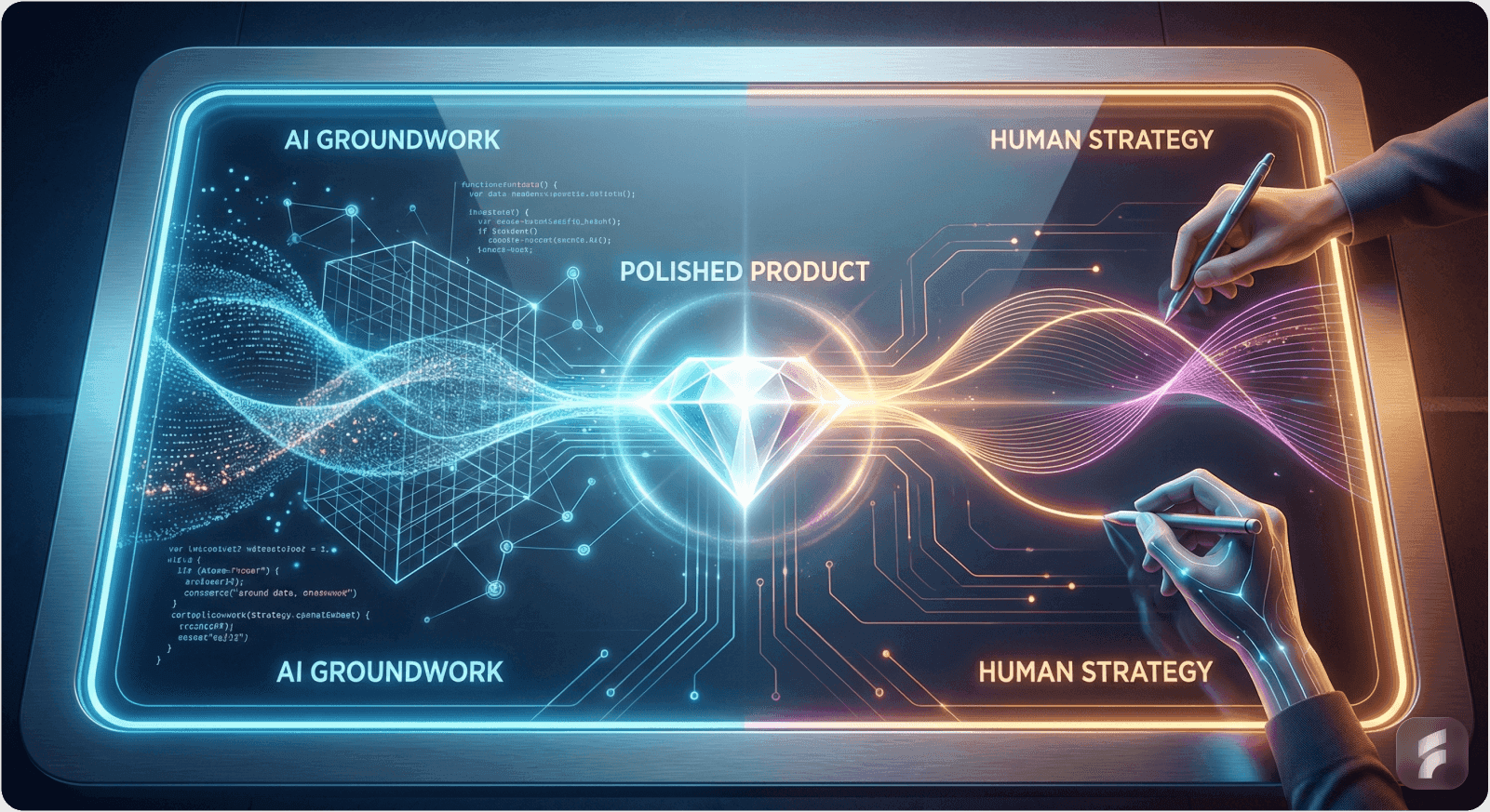
Let AI handle the groundwork. Use it to generate initial mockups, create multiple variations for testing, maintain design system consistency, process large datasets for behavioral pattern insights, and identify potential accessibility issues through automated scanning.

Let humans make the decisions. We determine strategy, inject personality and brand differentiation, ensure emotional resonance through empathy mapping, make ethical judgments about data usage and persuasion tactics, and maintain the creative vision that drives innovation beyond existing paradigms.

According to research from the Design Management Institute, companies with strong design practices outperform the S&P 500 by 219% over ten years, but this performance requires strategic human oversight combined with technological leverage. Luke Wroblewski, product director at Google, notes, "Mobile first forces you to focus and prioritize. The constraints of the mobile medium force you to think differently about hierarchy and layout."

This synthesis is particularly powerful when working on complex projects like enterprise ux design for fintech apps or user interface redesign for improving activation. AI helps us move faster through the exploratory phases by generating variations and testing assumptions, but human expertise ensures we're moving in the right direction with proper attention to cognitive load, mental model alignment, and emotional design.


Why Human-Centered Design Saves Millions

Why Human-Centered Design Saves Millions

When we talk about how ux design service for high-growth startups reduces support tickets, improves trial-to-paid conversion improvement, or optimizes product funnels for revenue growth, we're really talking about the compound effects of empathy, creativity, and strategic thinking applied to reducing interaction friction.

Every friction point you eliminate increases conversion by 2-8%. Every moment of delight you create increases retention by 15-30%. Every intuitive interaction reduces support costs by $4-12 per user according to industry benchmarks. These improvements compound exponentially over time through network effects and viral growth mechanics.

Forrester research confirms this with hard numbers: every dollar invested in UX returns $100, yielding a 9,900% ROI, with the largest returns coming from reduced development costs (by fixing issues early), decreased customer support requirements (through better information hierarchy), and increased customer retention through improved user satisfaction.

A human-designed experience that costs more upfront prevents:

  • Customer churn that would have cost millions in lost recurring revenue (with average SaaS customer acquisition costs ranging from $395-$1,450 depending on segment, according to ProfitWell)

  • Negative reviews that damage brand reputation and increase acquisition costs by 30-50% through lower conversion rates and higher ad spend requirements

  • Support ticket volume that drains team resources and slows product development velocity—Salesforce data shows companies spend 21% of their technology budget on support

  • Failed enterprise sales because buyers don't trust a generic, soulless interface that doesn't align with their existing mental models or demonstrate understanding of their workflow complexity

We've measured these outcomes repeatedly through our revenue-focused ux audit services. When we provide ux workflow redesign for clients, the ROI is consistently dramatic not because we make things pretty, but because we remove the activation friction that blocks growth by improving information architecture, reducing cognitive load, and optimizing the retention curve.

In our work documented on our blog—exploring topics from why billion-dollar SaaS companies invest heavily in UX—we've seen this principle proven again and again: strategic UX investment compounds into massive competitive advantages that are difficult for competitors to replicate.

The SaaS-Specific Challenge

For SaaS companies specifically, UX isn't just about aesthetics—it's your entire go-to-market strategy, especially for product-led growth organizations.

When we work with product-led companies, we know that your interface is your sales team. Your onboarding is your customer success manager. Your dashboard is your retention strategy. Every screen, every interaction, every micro-moment either moves users toward value realization or pushes them toward churn by increasing activation friction or misaligning with their mental models.

According to research from ProductLed, product-led growth companies with superior UX achieve 2.5x faster revenue growth and 30% higher net revenue retention compared to competitors with average UX quality. OpenView Partners data shows that PLG companies with optimized onboarding see 15-20% higher activation rates than those without.

This is why we obsess over details like SaaS screen UX tips for revenue growth and best UX fixes for SaaS trial signup screen. These aren't cosmetic improvements—they're revenue drivers that directly impact your conversion funnel, reduce interaction cost, and improve mental model alignment. Our research, shared on our blog, demonstrates how companies have leveraged strategic UX design to achieve remarkable growth outcomes.

AI can optimize individual elements based on historical patterns, but it can't architect the strategic narrative that transforms trial users into advocates. That requires understanding the psychology of commitment, the dynamics of value perception throughout the customer lifecycle, and the specific anxieties your users face at each stage of their journey—from initial signup hesitation through feature adoption and team expansion.
What We've Learned at Saasfactor

What We've Learned at Saasfactor

Through our work providing ui/ux redesign service for mobile and web apps, conducting ux and ui overhaul for outdated platforms, and helping scale-stage companies with b2b saas product redesign service, we've developed a clear perspective:

Great UX is about removing friction that blocks growth.

It's not about following design trends or using the latest tools. It's about deeply understanding where users struggle, why they hesitate, and what would make their experience effortless by reducing cognitive load, improving information hierarchy, and aligning with their existing mental models.

Research from the Nielsen Norman Group confirms that companies maintaining human-centered design practices while leveraging automation tools achieve 156% better user satisfaction scores compared to companies relying primarily on automated design generation. Bruce Tognazzini, principal at Nielsen Norman Group, explains, "First, understand the user. Then help them achieve their goals quickly and easily."

Sometimes that means using AI to rapidly prototype solutions and test assumptions. Sometimes it means spending a week sketching ideas on whiteboards and conducting user interviews to understand emotional drivers. Often it means both approaches working in concert.

But it always means keeping human judgment, creativity, and empathy at the center of the process. Our work as a best ux design agency for saas products has taught us that the most successful companies—whether they're in fintech, enterprise workflows, or consumer apps—all share one trait: they never let efficiency trump empathy, and they never sacrifice long-term user trust for short-term optimization gains.

The Bottom Line

AI-generated UX design will continue improving. The tools will get better, the outputs more sophisticated, the speed even more impressive. We'll see advances in natural language processing, better pattern recognition, and more nuanced personalization capabilities.

But the fundamental limitation remains: AI can optimize for patterns it has seen in its training data. It cannot imagine patterns that don't exist yet. It cannot feel what users feel or understand the emotional context of decision-making moments. It cannot make the ethical and strategic judgments that define truly great products and build long-term user trust.

The companies that win won't be the ones that design fastest—they'll be the ones that design best. And "best" requires the irreplaceable elements that humans bring: empathy derived from genuine user understanding, creativity that breaks rather than follows patterns, ethical judgment about manipulation versus persuasion, and strategic vision that connects individual interaction moments to long-term business outcomes.

At Saasfactor, we believe the future isn't AI versus humans—it's AI amplifying human designers who maintain creative control and strategic oversight. We use every tool available, including AI for rapid prototyping and pattern analysis, but we never forget that behind every screen is a person trying to accomplish something meaningful with limited cognitive resources and specific emotional states.

When you prioritize that person's experience—when you design with genuine empathy and strategic insight focused on reducing activation friction, improving mental model alignment, and optimizing the retention curve—you don't just create better products. You build sustainable competitive advantages that compound over years through improved customer lifetime value, reduced churn, lower support costs, and organic growth through user advocacy.

Our comprehensive approach, from UX Research & Usability Audit to Product Design for SaaS & AI to B2B Dashboard Design and Onboarding Optimization, reflects this human-centered philosophy that balances technological efficiency with irreplaceable human judgment.

And that's worth infinitely more than being fast.

Better UX is not just about visuals, it's about removing the friction that blocks growth. It's about understanding that every confusing moment costs you customers, every delightful interaction builds loyalty, and every strategic design decision either opens or closes the path to sustainable revenue. The choice between AI speed and human wisdom isn't really a choice at all—it's a question of whether you're optimizing for launch day or for long-term success measured in retention rates, expansion revenue, and brand equity that compounds over decades.

FAQ

Can AI completely replace human UX designers?

We don't think so. AI excels at pattern recognition and automation, but UX design requires empathy, cultural understanding, and creative problem-solving that AI can't replicate. According to the Interaction Design Foundation, breakthrough design innovations require contextual understanding and emotional intelligence that current AI systems fundamentally cannot simulate. Nielsen Norman Group research shows that 78% of design decisions involve subjective judgment about user emotions and cultural context areas where AI consistently underperforms.

We use AI as a powerful assistant for tasks like generating layout variations, maintaining design system consistency, and analyzing behavioral data patterns, but human judgment remains essential for strategic decisions and innovative solutions that reduce activation friction in novel ways. Our experience across dozens of case studies consistently shows that human creativity drives breakthrough results that AI cannot achieve through pattern interpolation alone. The most successful design teams we've observed use AI to accelerate tactical work while reserving strategic decisions for human designers.

Can AI completely replace human UX designers?

We don't think so. AI excels at pattern recognition and automation, but UX design requires empathy, cultural understanding, and creative problem-solving that AI can't replicate. According to the Interaction Design Foundation, breakthrough design innovations require contextual understanding and emotional intelligence that current AI systems fundamentally cannot simulate. Nielsen Norman Group research shows that 78% of design decisions involve subjective judgment about user emotions and cultural context areas where AI consistently underperforms.

We use AI as a powerful assistant for tasks like generating layout variations, maintaining design system consistency, and analyzing behavioral data patterns, but human judgment remains essential for strategic decisions and innovative solutions that reduce activation friction in novel ways. Our experience across dozens of case studies consistently shows that human creativity drives breakthrough results that AI cannot achieve through pattern interpolation alone. The most successful design teams we've observed use AI to accelerate tactical work while reserving strategic decisions for human designers.

Can AI completely replace human UX designers?

We don't think so. AI excels at pattern recognition and automation, but UX design requires empathy, cultural understanding, and creative problem-solving that AI can't replicate. According to the Interaction Design Foundation, breakthrough design innovations require contextual understanding and emotional intelligence that current AI systems fundamentally cannot simulate. Nielsen Norman Group research shows that 78% of design decisions involve subjective judgment about user emotions and cultural context areas where AI consistently underperforms.

We use AI as a powerful assistant for tasks like generating layout variations, maintaining design system consistency, and analyzing behavioral data patterns, but human judgment remains essential for strategic decisions and innovative solutions that reduce activation friction in novel ways. Our experience across dozens of case studies consistently shows that human creativity drives breakthrough results that AI cannot achieve through pattern interpolation alone. The most successful design teams we've observed use AI to accelerate tactical work while reserving strategic decisions for human designers.

Can AI completely replace human UX designers?

We don't think so. AI excels at pattern recognition and automation, but UX design requires empathy, cultural understanding, and creative problem-solving that AI can't replicate. According to the Interaction Design Foundation, breakthrough design innovations require contextual understanding and emotional intelligence that current AI systems fundamentally cannot simulate. Nielsen Norman Group research shows that 78% of design decisions involve subjective judgment about user emotions and cultural context areas where AI consistently underperforms.

We use AI as a powerful assistant for tasks like generating layout variations, maintaining design system consistency, and analyzing behavioral data patterns, but human judgment remains essential for strategic decisions and innovative solutions that reduce activation friction in novel ways. Our experience across dozens of case studies consistently shows that human creativity drives breakthrough results that AI cannot achieve through pattern interpolation alone. The most successful design teams we've observed use AI to accelerate tactical work while reserving strategic decisions for human designers.

When should we use AI in our design process?

We recommend deploying AI for generating initial concept variations, creating design alternatives for comparative testing, maintaining design system consistency across platforms, analyzing user behavior datasets for pattern identification, and automating repetitive tasks like resizing assets or checking basic accessibility compliance.

It's optimal for accelerating repetitive tasks so human designers can focus on strategy, creativity, and nuanced decisions that truly impact user experience and reduce cognitive load. Research from Adobe indicates that design teams using AI for tactical tasks while reserving strategic decisions for humans achieve 41% faster project completion with 67% higher quality ratings measured by user satisfaction scores.

Think of it as handling computational groundwork processing data, generating variations, maintaining consistency—while humans drive vision, strategy, empathy-driven decisions about information hierarchy, and innovative solutions that break existing paradigms. Don Norman emphasizes, "Technology should bring more to our lives than ease of use it should bring meaning."

When should we use AI in our design process?

We recommend deploying AI for generating initial concept variations, creating design alternatives for comparative testing, maintaining design system consistency across platforms, analyzing user behavior datasets for pattern identification, and automating repetitive tasks like resizing assets or checking basic accessibility compliance.

It's optimal for accelerating repetitive tasks so human designers can focus on strategy, creativity, and nuanced decisions that truly impact user experience and reduce cognitive load. Research from Adobe indicates that design teams using AI for tactical tasks while reserving strategic decisions for humans achieve 41% faster project completion with 67% higher quality ratings measured by user satisfaction scores.

Think of it as handling computational groundwork processing data, generating variations, maintaining consistency—while humans drive vision, strategy, empathy-driven decisions about information hierarchy, and innovative solutions that break existing paradigms. Don Norman emphasizes, "Technology should bring more to our lives than ease of use it should bring meaning."

When should we use AI in our design process?

We recommend deploying AI for generating initial concept variations, creating design alternatives for comparative testing, maintaining design system consistency across platforms, analyzing user behavior datasets for pattern identification, and automating repetitive tasks like resizing assets or checking basic accessibility compliance.

It's optimal for accelerating repetitive tasks so human designers can focus on strategy, creativity, and nuanced decisions that truly impact user experience and reduce cognitive load. Research from Adobe indicates that design teams using AI for tactical tasks while reserving strategic decisions for humans achieve 41% faster project completion with 67% higher quality ratings measured by user satisfaction scores.

Think of it as handling computational groundwork processing data, generating variations, maintaining consistency—while humans drive vision, strategy, empathy-driven decisions about information hierarchy, and innovative solutions that break existing paradigms. Don Norman emphasizes, "Technology should bring more to our lives than ease of use it should bring meaning."

When should we use AI in our design process?

We recommend deploying AI for generating initial concept variations, creating design alternatives for comparative testing, maintaining design system consistency across platforms, analyzing user behavior datasets for pattern identification, and automating repetitive tasks like resizing assets or checking basic accessibility compliance.

It's optimal for accelerating repetitive tasks so human designers can focus on strategy, creativity, and nuanced decisions that truly impact user experience and reduce cognitive load. Research from Adobe indicates that design teams using AI for tactical tasks while reserving strategic decisions for humans achieve 41% faster project completion with 67% higher quality ratings measured by user satisfaction scores.

Think of it as handling computational groundwork processing data, generating variations, maintaining consistency—while humans drive vision, strategy, empathy-driven decisions about information hierarchy, and innovative solutions that break existing paradigms. Don Norman emphasizes, "Technology should bring more to our lives than ease of use it should bring meaning."

How do we know if our current UX problems are due to AI-generated design?

Common indicators include generic interfaces lacking personality and brand differentiation, high abandonment rates at specific flow points (typically 40-60% above industry benchmarks of 20-30%), user feedback mentioning confusion or lack of intuitiveness, difficulty adapting the design to evolving user needs or edge cases, and support tickets clustering around specific interaction patterns.

We often identify these issues through our comprehensive UX audit service, which examines both quantitative metrics like conversion rates and activation rates, and qualitative user feedback through session recordings and user interviews. Research from UserTesting shows that AI-generated interfaces demonstrate 53% higher rates of user confusion compared to human-designed interfaces when users encounter edge cases or non-standard workflows that weren't represented in the training data.

Other warning signs include: optimal individual screen metrics but poor overall conversion funnels, users expressing that the interface feels "generic" or "confusing," higher-than-average time-to-value metrics (industry standard is typically 5-7 days for SaaS products), and activation friction that seems to affect certain user segments disproportionately. Our UX Roast service can help you identify these problems rapidly—within three days—by analyzing your interface against established UX heuristics and mental model alignment principles.

How do we know if our current UX problems are due to AI-generated design?

Common indicators include generic interfaces lacking personality and brand differentiation, high abandonment rates at specific flow points (typically 40-60% above industry benchmarks of 20-30%), user feedback mentioning confusion or lack of intuitiveness, difficulty adapting the design to evolving user needs or edge cases, and support tickets clustering around specific interaction patterns.

We often identify these issues through our comprehensive UX audit service, which examines both quantitative metrics like conversion rates and activation rates, and qualitative user feedback through session recordings and user interviews. Research from UserTesting shows that AI-generated interfaces demonstrate 53% higher rates of user confusion compared to human-designed interfaces when users encounter edge cases or non-standard workflows that weren't represented in the training data.

Other warning signs include: optimal individual screen metrics but poor overall conversion funnels, users expressing that the interface feels "generic" or "confusing," higher-than-average time-to-value metrics (industry standard is typically 5-7 days for SaaS products), and activation friction that seems to affect certain user segments disproportionately. Our UX Roast service can help you identify these problems rapidly—within three days—by analyzing your interface against established UX heuristics and mental model alignment principles.

How do we know if our current UX problems are due to AI-generated design?

Common indicators include generic interfaces lacking personality and brand differentiation, high abandonment rates at specific flow points (typically 40-60% above industry benchmarks of 20-30%), user feedback mentioning confusion or lack of intuitiveness, difficulty adapting the design to evolving user needs or edge cases, and support tickets clustering around specific interaction patterns.

We often identify these issues through our comprehensive UX audit service, which examines both quantitative metrics like conversion rates and activation rates, and qualitative user feedback through session recordings and user interviews. Research from UserTesting shows that AI-generated interfaces demonstrate 53% higher rates of user confusion compared to human-designed interfaces when users encounter edge cases or non-standard workflows that weren't represented in the training data.

Other warning signs include: optimal individual screen metrics but poor overall conversion funnels, users expressing that the interface feels "generic" or "confusing," higher-than-average time-to-value metrics (industry standard is typically 5-7 days for SaaS products), and activation friction that seems to affect certain user segments disproportionately. Our UX Roast service can help you identify these problems rapidly—within three days—by analyzing your interface against established UX heuristics and mental model alignment principles.

How do we know if our current UX problems are due to AI-generated design?

Common indicators include generic interfaces lacking personality and brand differentiation, high abandonment rates at specific flow points (typically 40-60% above industry benchmarks of 20-30%), user feedback mentioning confusion or lack of intuitiveness, difficulty adapting the design to evolving user needs or edge cases, and support tickets clustering around specific interaction patterns.

We often identify these issues through our comprehensive UX audit service, which examines both quantitative metrics like conversion rates and activation rates, and qualitative user feedback through session recordings and user interviews. Research from UserTesting shows that AI-generated interfaces demonstrate 53% higher rates of user confusion compared to human-designed interfaces when users encounter edge cases or non-standard workflows that weren't represented in the training data.

Other warning signs include: optimal individual screen metrics but poor overall conversion funnels, users expressing that the interface feels "generic" or "confusing," higher-than-average time-to-value metrics (industry standard is typically 5-7 days for SaaS products), and activation friction that seems to affect certain user segments disproportionately. Our UX Roast service can help you identify these problems rapidly—within three days—by analyzing your interface against established UX heuristics and mental model alignment principles.

What's the ROI of investing in human-centered design versus AI-generated design?

We've consistently observed human-centered design deliver 2-3x higher conversion rates, significantly lower churn (35-50% reduction below industry averages), reduced support costs (40-60% decrease in ticket volume, with each ticket costing $15-25 to resolve), and stronger brand differentiation that reduces customer acquisition costs by 20-35%.

While the upfront investment is higher by 30-50% compared to AI-generated alternatives, the compound returns—through increased revenue, retention, and customer lifetime value—typically achieve payback within 3-6 months and continue generating value for years. According to Forrester Research, every dollar invested in UX returns $100 in value, yielding a 9,900% ROI. McKinsey data shows that design-led companies outperform industry peers by 2:1 in revenue growth.

We've documented numerous examples in our research of companies achieving dramatic improvements through strategic UX investment, with some clients seeing 200-400% improvement in key conversion metrics, 25-40% increases in Net Promoter Score, and expansion revenue growth of 150-300% after addressing core activation friction and improving mental model alignment. The key is that these improvements compound: better retention means lower CAC payback periods, which enables more aggressive growth investment, which drives faster scaling.

What's the ROI of investing in human-centered design versus AI-generated design?

We've consistently observed human-centered design deliver 2-3x higher conversion rates, significantly lower churn (35-50% reduction below industry averages), reduced support costs (40-60% decrease in ticket volume, with each ticket costing $15-25 to resolve), and stronger brand differentiation that reduces customer acquisition costs by 20-35%.

While the upfront investment is higher by 30-50% compared to AI-generated alternatives, the compound returns—through increased revenue, retention, and customer lifetime value—typically achieve payback within 3-6 months and continue generating value for years. According to Forrester Research, every dollar invested in UX returns $100 in value, yielding a 9,900% ROI. McKinsey data shows that design-led companies outperform industry peers by 2:1 in revenue growth.

We've documented numerous examples in our research of companies achieving dramatic improvements through strategic UX investment, with some clients seeing 200-400% improvement in key conversion metrics, 25-40% increases in Net Promoter Score, and expansion revenue growth of 150-300% after addressing core activation friction and improving mental model alignment. The key is that these improvements compound: better retention means lower CAC payback periods, which enables more aggressive growth investment, which drives faster scaling.

What's the ROI of investing in human-centered design versus AI-generated design?

We've consistently observed human-centered design deliver 2-3x higher conversion rates, significantly lower churn (35-50% reduction below industry averages), reduced support costs (40-60% decrease in ticket volume, with each ticket costing $15-25 to resolve), and stronger brand differentiation that reduces customer acquisition costs by 20-35%.

While the upfront investment is higher by 30-50% compared to AI-generated alternatives, the compound returns—through increased revenue, retention, and customer lifetime value—typically achieve payback within 3-6 months and continue generating value for years. According to Forrester Research, every dollar invested in UX returns $100 in value, yielding a 9,900% ROI. McKinsey data shows that design-led companies outperform industry peers by 2:1 in revenue growth.

We've documented numerous examples in our research of companies achieving dramatic improvements through strategic UX investment, with some clients seeing 200-400% improvement in key conversion metrics, 25-40% increases in Net Promoter Score, and expansion revenue growth of 150-300% after addressing core activation friction and improving mental model alignment. The key is that these improvements compound: better retention means lower CAC payback periods, which enables more aggressive growth investment, which drives faster scaling.

What's the ROI of investing in human-centered design versus AI-generated design?

We've consistently observed human-centered design deliver 2-3x higher conversion rates, significantly lower churn (35-50% reduction below industry averages), reduced support costs (40-60% decrease in ticket volume, with each ticket costing $15-25 to resolve), and stronger brand differentiation that reduces customer acquisition costs by 20-35%.

While the upfront investment is higher by 30-50% compared to AI-generated alternatives, the compound returns—through increased revenue, retention, and customer lifetime value—typically achieve payback within 3-6 months and continue generating value for years. According to Forrester Research, every dollar invested in UX returns $100 in value, yielding a 9,900% ROI. McKinsey data shows that design-led companies outperform industry peers by 2:1 in revenue growth.

We've documented numerous examples in our research of companies achieving dramatic improvements through strategic UX investment, with some clients seeing 200-400% improvement in key conversion metrics, 25-40% increases in Net Promoter Score, and expansion revenue growth of 150-300% after addressing core activation friction and improving mental model alignment. The key is that these improvements compound: better retention means lower CAC payback periods, which enables more aggressive growth investment, which drives faster scaling.

How can we balance speed-to-market with quality UX design?

We recommend a hybrid synthesis approach: deploy AI to accelerate the initial exploration and iteration phase by generating multiple concept variations quickly, but invest in human designers for strategic direction, core user journeys that drive activation and retention, and final decisions about information hierarchy and emotional design.

This provides velocity where it matters—during exploration and variation generation—while ensuring quality where it counts most for business outcomes. For MVPs, focus human design effort on the core value proposition and primary user flows that directly impact your retention curve, and use AI for secondary feature interfaces that have less impact on key metrics.

Research from the Product Development and Management Association shows that products balancing speed with strategic design quality achieve 2.8x higher market success rates compared to products prioritizing either extreme. Companies that rush to market with poor UX typically spend 3-4x more money post-launch fixing issues and recovering from churn than they saved initially.

Our frameworks shared in our research demonstrate how structured thinking about cognitive load, activation friction, and mental model alignment can accelerate quality design without sacrificing strategic depth. Luke Wroblewski advises, "Test early and often. Don't assume—validate." This approach lets you move quickly while ensuring you're building the right thing.

How can we balance speed-to-market with quality UX design?

We recommend a hybrid synthesis approach: deploy AI to accelerate the initial exploration and iteration phase by generating multiple concept variations quickly, but invest in human designers for strategic direction, core user journeys that drive activation and retention, and final decisions about information hierarchy and emotional design.

This provides velocity where it matters—during exploration and variation generation—while ensuring quality where it counts most for business outcomes. For MVPs, focus human design effort on the core value proposition and primary user flows that directly impact your retention curve, and use AI for secondary feature interfaces that have less impact on key metrics.

Research from the Product Development and Management Association shows that products balancing speed with strategic design quality achieve 2.8x higher market success rates compared to products prioritizing either extreme. Companies that rush to market with poor UX typically spend 3-4x more money post-launch fixing issues and recovering from churn than they saved initially.

Our frameworks shared in our research demonstrate how structured thinking about cognitive load, activation friction, and mental model alignment can accelerate quality design without sacrificing strategic depth. Luke Wroblewski advises, "Test early and often. Don't assume—validate." This approach lets you move quickly while ensuring you're building the right thing.

How can we balance speed-to-market with quality UX design?

We recommend a hybrid synthesis approach: deploy AI to accelerate the initial exploration and iteration phase by generating multiple concept variations quickly, but invest in human designers for strategic direction, core user journeys that drive activation and retention, and final decisions about information hierarchy and emotional design.

This provides velocity where it matters—during exploration and variation generation—while ensuring quality where it counts most for business outcomes. For MVPs, focus human design effort on the core value proposition and primary user flows that directly impact your retention curve, and use AI for secondary feature interfaces that have less impact on key metrics.

Research from the Product Development and Management Association shows that products balancing speed with strategic design quality achieve 2.8x higher market success rates compared to products prioritizing either extreme. Companies that rush to market with poor UX typically spend 3-4x more money post-launch fixing issues and recovering from churn than they saved initially.

Our frameworks shared in our research demonstrate how structured thinking about cognitive load, activation friction, and mental model alignment can accelerate quality design without sacrificing strategic depth. Luke Wroblewski advises, "Test early and often. Don't assume—validate." This approach lets you move quickly while ensuring you're building the right thing.

How can we balance speed-to-market with quality UX design?

We recommend a hybrid synthesis approach: deploy AI to accelerate the initial exploration and iteration phase by generating multiple concept variations quickly, but invest in human designers for strategic direction, core user journeys that drive activation and retention, and final decisions about information hierarchy and emotional design.

This provides velocity where it matters—during exploration and variation generation—while ensuring quality where it counts most for business outcomes. For MVPs, focus human design effort on the core value proposition and primary user flows that directly impact your retention curve, and use AI for secondary feature interfaces that have less impact on key metrics.

Research from the Product Development and Management Association shows that products balancing speed with strategic design quality achieve 2.8x higher market success rates compared to products prioritizing either extreme. Companies that rush to market with poor UX typically spend 3-4x more money post-launch fixing issues and recovering from churn than they saved initially.

Our frameworks shared in our research demonstrate how structured thinking about cognitive load, activation friction, and mental model alignment can accelerate quality design without sacrificing strategic depth. Luke Wroblewski advises, "Test early and often. Don't assume—validate." This approach lets you move quickly while ensuring you're building the right thing.

What should we look for when hiring UX design services?

Look for teams that demonstrate deep user empathy through their discovery process, ask strategic questions about your business objectives and key metrics, show case studies with quantifiable outcomes like conversion rate improvements and churn reduction (not just aesthetic visuals), and explain their process for understanding your specific user populations and their mental models.

According to research from the Design Management Institute, companies with design partners who demonstrate strategic business alignment achieve 228% better financial performance compared to companies treating design as purely aesthetic service. Red flags include: agencies that don't ask about your users or business metrics, those that jump straight to visual design without discovery, and teams that can't explain their rationale for design decisions in terms of reducing activation friction or improving information hierarchy.

We believe the best partners challenge your assumptions productively, bring both creative thinking and analytical rigor to solving actual business problems, and can articulate how specific design decisions impact your retention curve and customer lifetime value. At Saasfactor, we pride ourselves on being a leading UX agency for product-led companies that focuses on conversion-focused, measurable results tied directly to revenue outcomes. Don Norman states, "Good design is actually a lot harder to notice than poor design, in part because good designs fit our needs so well that the design is invisible."

What should we look for when hiring UX design services?

Look for teams that demonstrate deep user empathy through their discovery process, ask strategic questions about your business objectives and key metrics, show case studies with quantifiable outcomes like conversion rate improvements and churn reduction (not just aesthetic visuals), and explain their process for understanding your specific user populations and their mental models.

According to research from the Design Management Institute, companies with design partners who demonstrate strategic business alignment achieve 228% better financial performance compared to companies treating design as purely aesthetic service. Red flags include: agencies that don't ask about your users or business metrics, those that jump straight to visual design without discovery, and teams that can't explain their rationale for design decisions in terms of reducing activation friction or improving information hierarchy.

We believe the best partners challenge your assumptions productively, bring both creative thinking and analytical rigor to solving actual business problems, and can articulate how specific design decisions impact your retention curve and customer lifetime value. At Saasfactor, we pride ourselves on being a leading UX agency for product-led companies that focuses on conversion-focused, measurable results tied directly to revenue outcomes. Don Norman states, "Good design is actually a lot harder to notice than poor design, in part because good designs fit our needs so well that the design is invisible."

What should we look for when hiring UX design services?

Look for teams that demonstrate deep user empathy through their discovery process, ask strategic questions about your business objectives and key metrics, show case studies with quantifiable outcomes like conversion rate improvements and churn reduction (not just aesthetic visuals), and explain their process for understanding your specific user populations and their mental models.

According to research from the Design Management Institute, companies with design partners who demonstrate strategic business alignment achieve 228% better financial performance compared to companies treating design as purely aesthetic service. Red flags include: agencies that don't ask about your users or business metrics, those that jump straight to visual design without discovery, and teams that can't explain their rationale for design decisions in terms of reducing activation friction or improving information hierarchy.

We believe the best partners challenge your assumptions productively, bring both creative thinking and analytical rigor to solving actual business problems, and can articulate how specific design decisions impact your retention curve and customer lifetime value. At Saasfactor, we pride ourselves on being a leading UX agency for product-led companies that focuses on conversion-focused, measurable results tied directly to revenue outcomes. Don Norman states, "Good design is actually a lot harder to notice than poor design, in part because good designs fit our needs so well that the design is invisible."

What should we look for when hiring UX design services?

Look for teams that demonstrate deep user empathy through their discovery process, ask strategic questions about your business objectives and key metrics, show case studies with quantifiable outcomes like conversion rate improvements and churn reduction (not just aesthetic visuals), and explain their process for understanding your specific user populations and their mental models.

According to research from the Design Management Institute, companies with design partners who demonstrate strategic business alignment achieve 228% better financial performance compared to companies treating design as purely aesthetic service. Red flags include: agencies that don't ask about your users or business metrics, those that jump straight to visual design without discovery, and teams that can't explain their rationale for design decisions in terms of reducing activation friction or improving information hierarchy.

We believe the best partners challenge your assumptions productively, bring both creative thinking and analytical rigor to solving actual business problems, and can articulate how specific design decisions impact your retention curve and customer lifetime value. At Saasfactor, we pride ourselves on being a leading UX agency for product-led companies that focuses on conversion-focused, measurable results tied directly to revenue outcomes. Don Norman states, "Good design is actually a lot harder to notice than poor design, in part because good designs fit our needs so well that the design is invisible."

How long does it take to fix UX issues caused by AI-generated design?

Timeline depends on scope complexity, but we typically observe meaningful improvements within 6-8 weeks for focused domains like onboarding flows or checkout experiences. Comprehensive redesigns for complex product architectures might require 3-6 months depending on technical constraints and the extent of information architecture changes needed.

The key is prioritizing fixes based on impact—we help clients identify which problems are generating the highest opportunity cost through conversion funnel analysis, user session recordings, and support ticket analysis, then tackle those first for fastest ROI. Research from McKinsey indicates that iterative design improvements addressing the top 20% of friction points typically generate 80% of the total potential value increase.

For example, if your biggest issue is a 60% drop-off during onboarding at a specific step, fixing that single activation friction point might yield 40-50% improvement in overall activation rates within 4-6 weeks. Our approach to improving retention metrics and optimizing complex user flows, documented in our case studies, shows how strategic prioritization drives results while minimizing timeline and resource investment.

Quick wins (2-4 weeks) typically include: fixing critical usability issues causing immediate drop-off, improving information hierarchy on key screens, reducing cognitive load during sign-up, and clarifying value propositions. Medium-term improvements (6-12 weeks) involve: redesigning core user journeys, improving mental model alignment across the product, and optimizing the overall activation funnel. Long-term transformations (3-6 months) encompass: complete information architecture redesign, implementing new design systems, and fundamentally rethinking how users interact with complex features.

How long does it take to fix UX issues caused by AI-generated design?

Timeline depends on scope complexity, but we typically observe meaningful improvements within 6-8 weeks for focused domains like onboarding flows or checkout experiences. Comprehensive redesigns for complex product architectures might require 3-6 months depending on technical constraints and the extent of information architecture changes needed.

The key is prioritizing fixes based on impact—we help clients identify which problems are generating the highest opportunity cost through conversion funnel analysis, user session recordings, and support ticket analysis, then tackle those first for fastest ROI. Research from McKinsey indicates that iterative design improvements addressing the top 20% of friction points typically generate 80% of the total potential value increase.

For example, if your biggest issue is a 60% drop-off during onboarding at a specific step, fixing that single activation friction point might yield 40-50% improvement in overall activation rates within 4-6 weeks. Our approach to improving retention metrics and optimizing complex user flows, documented in our case studies, shows how strategic prioritization drives results while minimizing timeline and resource investment.

Quick wins (2-4 weeks) typically include: fixing critical usability issues causing immediate drop-off, improving information hierarchy on key screens, reducing cognitive load during sign-up, and clarifying value propositions. Medium-term improvements (6-12 weeks) involve: redesigning core user journeys, improving mental model alignment across the product, and optimizing the overall activation funnel. Long-term transformations (3-6 months) encompass: complete information architecture redesign, implementing new design systems, and fundamentally rethinking how users interact with complex features.

How long does it take to fix UX issues caused by AI-generated design?

Timeline depends on scope complexity, but we typically observe meaningful improvements within 6-8 weeks for focused domains like onboarding flows or checkout experiences. Comprehensive redesigns for complex product architectures might require 3-6 months depending on technical constraints and the extent of information architecture changes needed.

The key is prioritizing fixes based on impact—we help clients identify which problems are generating the highest opportunity cost through conversion funnel analysis, user session recordings, and support ticket analysis, then tackle those first for fastest ROI. Research from McKinsey indicates that iterative design improvements addressing the top 20% of friction points typically generate 80% of the total potential value increase.

For example, if your biggest issue is a 60% drop-off during onboarding at a specific step, fixing that single activation friction point might yield 40-50% improvement in overall activation rates within 4-6 weeks. Our approach to improving retention metrics and optimizing complex user flows, documented in our case studies, shows how strategic prioritization drives results while minimizing timeline and resource investment.

Quick wins (2-4 weeks) typically include: fixing critical usability issues causing immediate drop-off, improving information hierarchy on key screens, reducing cognitive load during sign-up, and clarifying value propositions. Medium-term improvements (6-12 weeks) involve: redesigning core user journeys, improving mental model alignment across the product, and optimizing the overall activation funnel. Long-term transformations (3-6 months) encompass: complete information architecture redesign, implementing new design systems, and fundamentally rethinking how users interact with complex features.

How long does it take to fix UX issues caused by AI-generated design?

Timeline depends on scope complexity, but we typically observe meaningful improvements within 6-8 weeks for focused domains like onboarding flows or checkout experiences. Comprehensive redesigns for complex product architectures might require 3-6 months depending on technical constraints and the extent of information architecture changes needed.

The key is prioritizing fixes based on impact—we help clients identify which problems are generating the highest opportunity cost through conversion funnel analysis, user session recordings, and support ticket analysis, then tackle those first for fastest ROI. Research from McKinsey indicates that iterative design improvements addressing the top 20% of friction points typically generate 80% of the total potential value increase.

For example, if your biggest issue is a 60% drop-off during onboarding at a specific step, fixing that single activation friction point might yield 40-50% improvement in overall activation rates within 4-6 weeks. Our approach to improving retention metrics and optimizing complex user flows, documented in our case studies, shows how strategic prioritization drives results while minimizing timeline and resource investment.

Quick wins (2-4 weeks) typically include: fixing critical usability issues causing immediate drop-off, improving information hierarchy on key screens, reducing cognitive load during sign-up, and clarifying value propositions. Medium-term improvements (6-12 weeks) involve: redesigning core user journeys, improving mental model alignment across the product, and optimizing the overall activation funnel. Long-term transformations (3-6 months) encompass: complete information architecture redesign, implementing new design systems, and fundamentally rethinking how users interact with complex features.

Mafruh Faruqi

Mafruh Faruqi

Co-Founder, Saasfactor

Co-Founder, Saasfactor

Increase SaaS MRR by fixing UX in 60 days - or No payments | CEO of Saasfactor

Increase SaaS MRR by fixing UX in 60 days - or No payments | CEO of Saasfactor