


Last Update:
Feb 16, 2026
Share

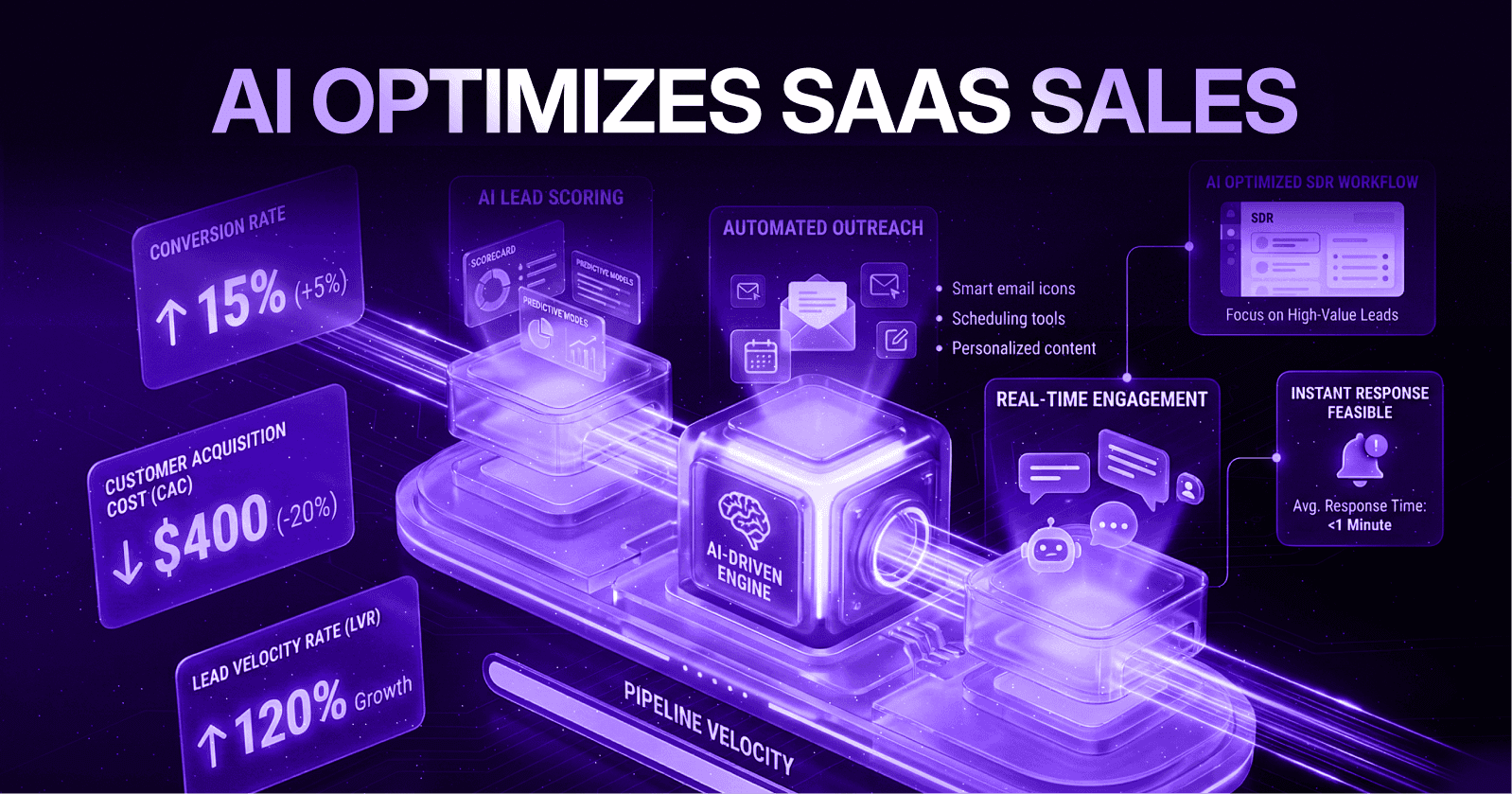
AI-driven sales automation delivers 40-60% productivity improvements and 30% conversion rate increases while reducing customer acquisition costs by 25%
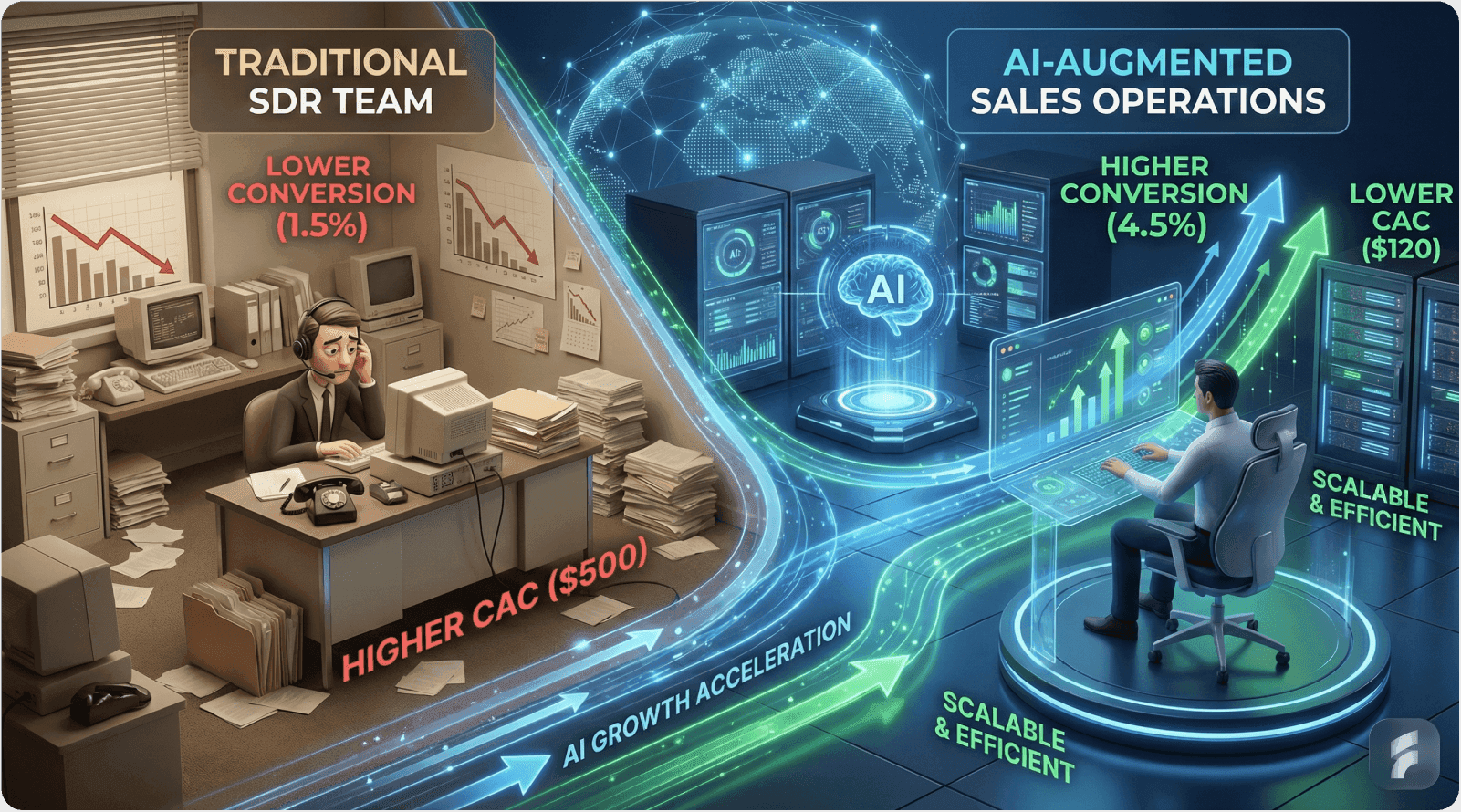
Traditional SDR-centric models face obsolescence as AI handles lead scoring, automated outreach, real-time engagement, and CRM intelligence at scale
Modern buyers complete 57% of their decision journey before engaging sales, requiring instant responses that only AI can provide economically
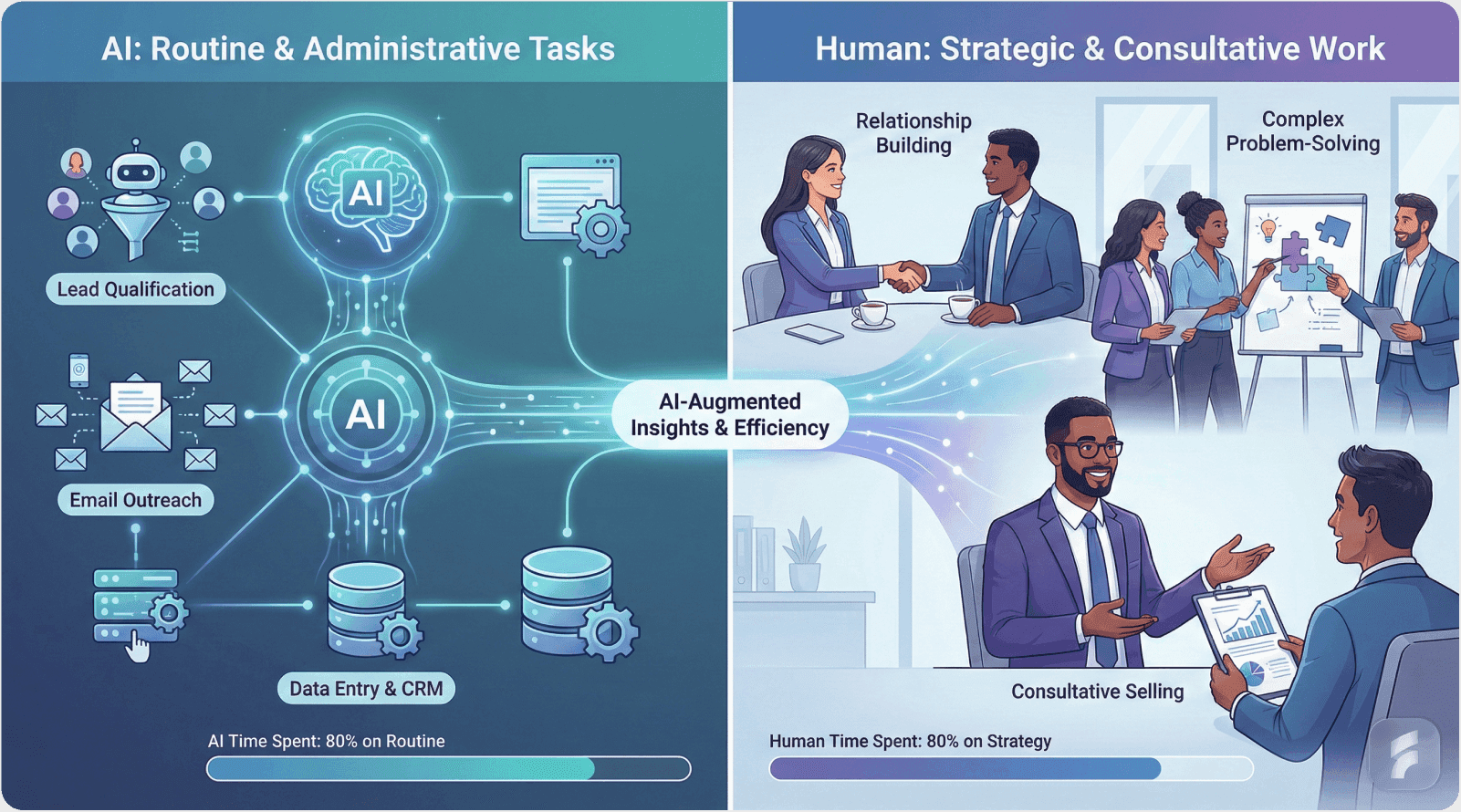
AI doesn't replace sales professionals—it elevates them from manual processors to strategic advisors focused on relationship building and complex problem-solving
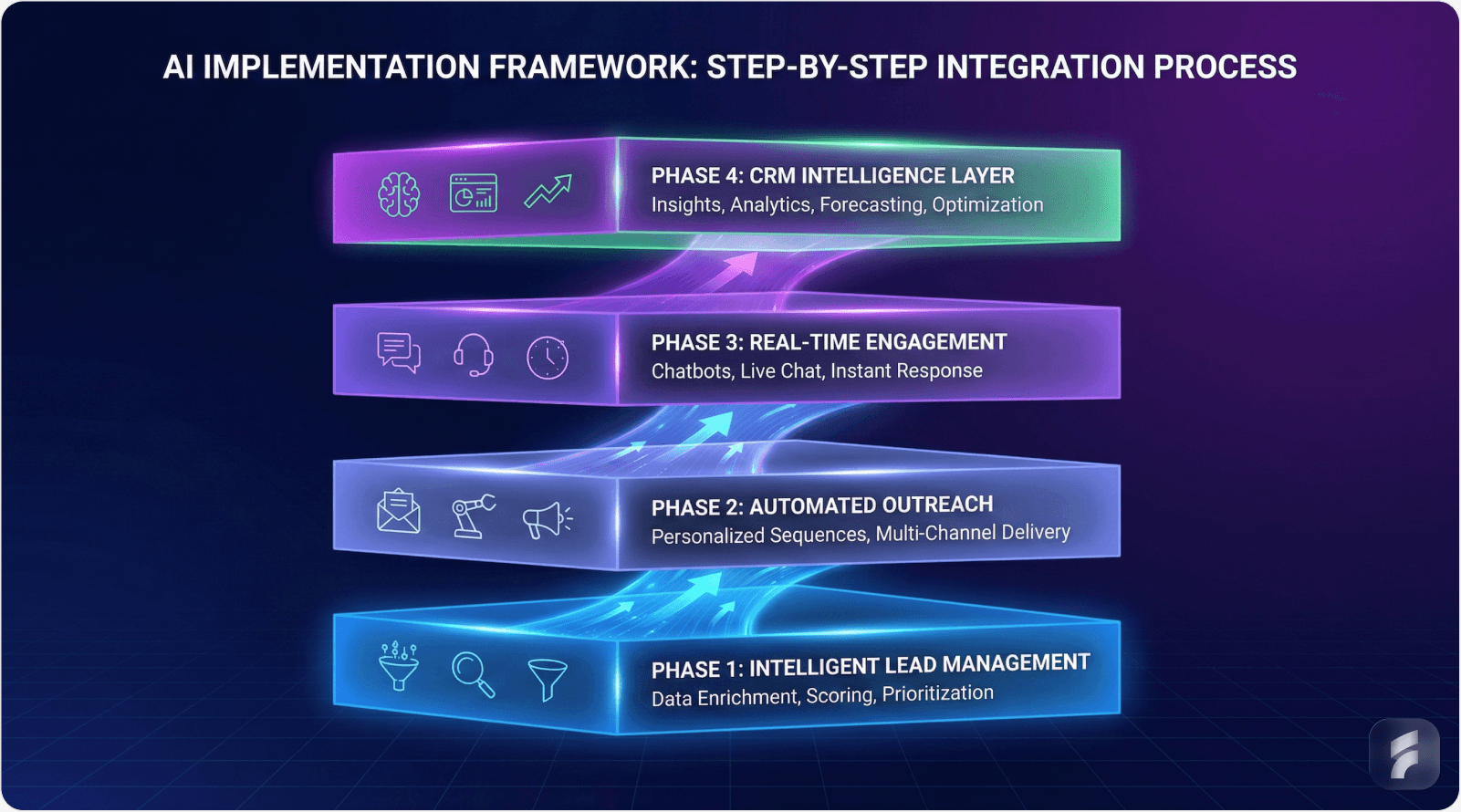
Successful implementation requires four phases: intelligent lead management, automated outreach orchestration, real-time engagement infrastructure, and CRM intelligence layers
Companies responding to leads within five minutes are 100x more likely to convert than those responding after 30 minutes—AI makes this economically feasible
AI-augmented sales teams report 71% higher job satisfaction and 44% longer tenure compared to traditional environments
Organizations maintaining static sales approaches risk competitive displacement as AI-adopting rivals achieve superior unit economics and customer experiences
Implementation success depends on data quality, comprehensive change management, privacy compliance, and phased deployment over 6-18 months
Future capabilities include generative AI for content creation, autonomous sales agents, and predictive market intelligence identifying opportunities before they become obvious
The SaaS sales landscape is undergoing its most significant transformation in two decades. Traditional sales development models, built on human-intensive outreach and manual qualification, are giving way to AI-augmented systems that fundamentally reshape how companies acquire and convert customers.
This shift isn't theoretical. Companies integrating AI into their sales operations report productivity gains of 40-60%, according to McKinsey research. The question is no longer whether to adopt AI, but how quickly your organization can adapt before competitors gain an insurmountable advantage.
Understanding the Traditional SaaS Sales Architecture
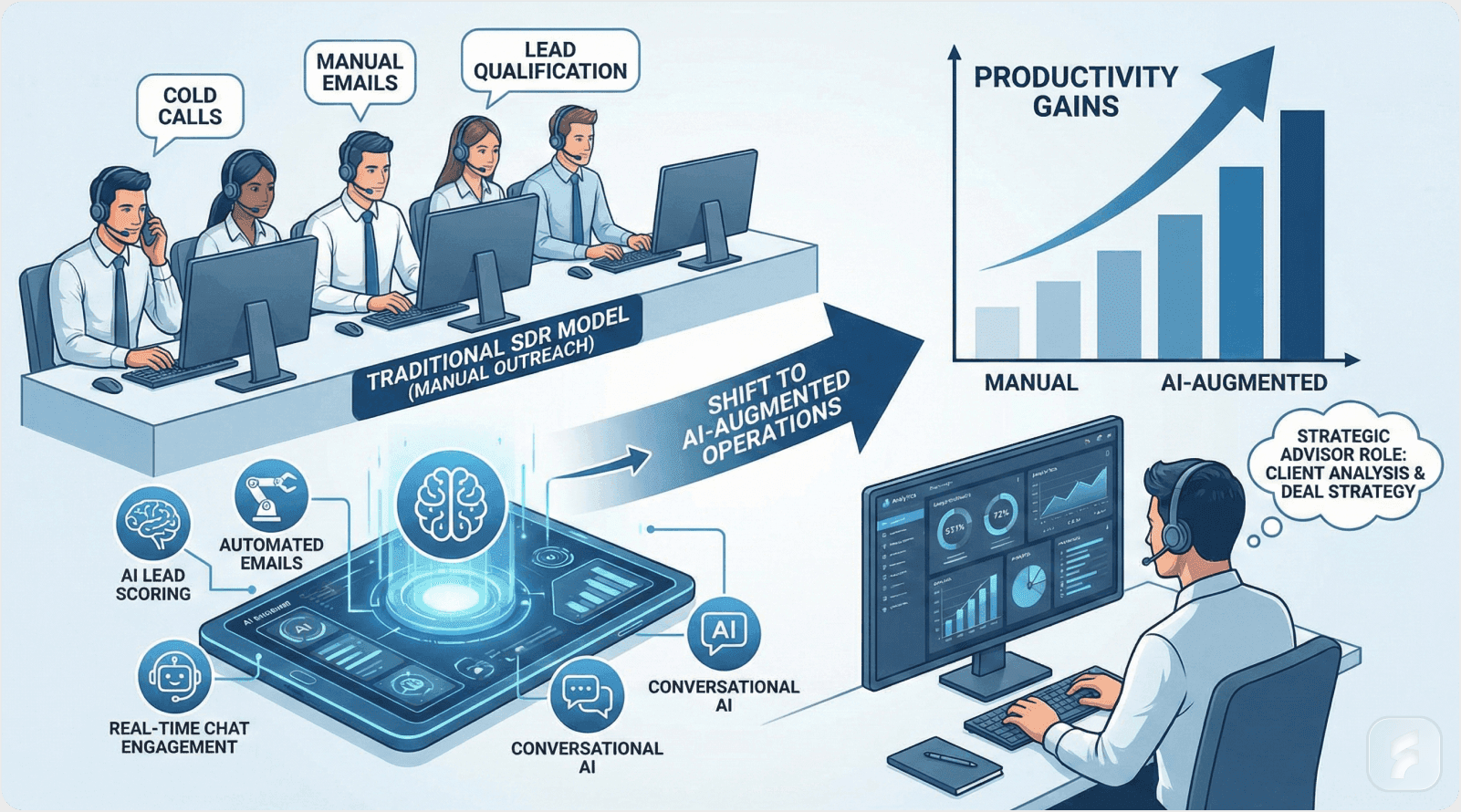
The Foundation: SDR-Centric Revenue Models
Traditional SaaS sales operations center on the Sales Development Representative (SDR) as the primary driver of pipeline generation. This model emerged in the early 2000s and became the standard architecture for B2B software companies.
The SDR function typically encompasses four core responsibilities. Lead generation through cold outreach forms the foundation, with representatives conducting email campaigns and phone-based prospecting. Lead qualification follows, requiring SDRs to assess prospect fit through discovery conversations. Relationship nurturing consumes significant bandwidth, involving multiple touchpoints across weeks or months. Finally, manual CRM hygiene—data entry, activity logging, and opportunity updates—occupies 20-30% of the average SDR's workday.
Statistical Reality: Research from The Bridge Group indicates that SDRs spend only 35% of their time on active selling activities, with the remaining 65% allocated to administrative tasks, research, and coordination.
The Cognitive Load Problem
Definition Block: Cognitive Load
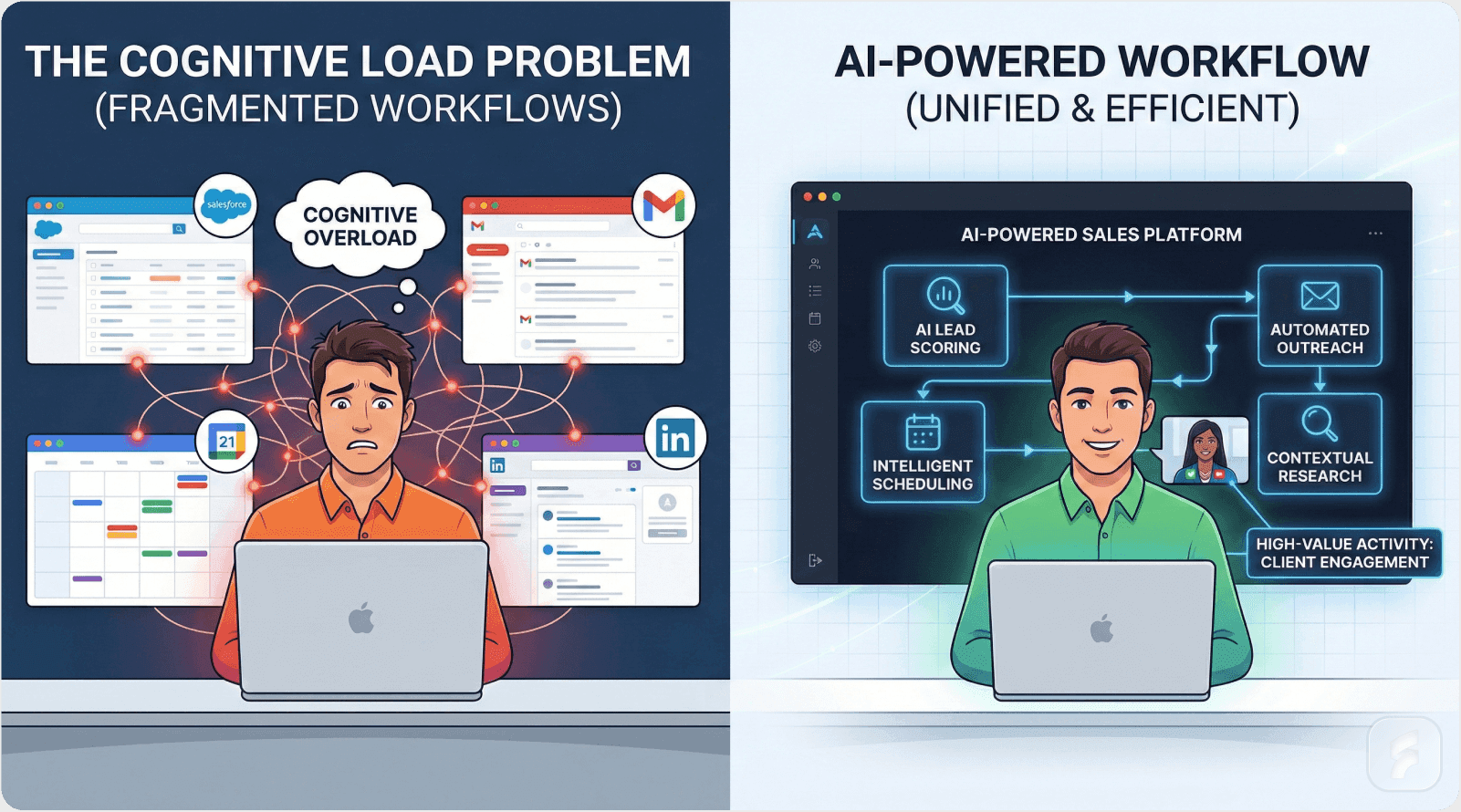
Cognitive load refers to the total mental effort required to complete a task. In sales contexts, high cognitive load from administrative work reduces capacity for strategic thinking and relationship building.
Traditional sales processes impose substantial cognitive burden on representatives. Each prospect interaction requires context switching between multiple systems—CRM platforms, email clients, calendar tools, and research databases.
This fragmentation creates what behavioral scientists call "interaction cost"—the cumulative mental and temporal expense of navigating disconnected workflows. According to research from the Nielsen Norman Group, high interaction costs correlate directly with decreased task completion rates and increased error frequency.
Expert Perspective: Dr. Susan Weinschenk, behavioral psychologist and author of "100 Things Every Designer Needs to Know About People," notes that "when cognitive load exceeds working memory capacity, performance degrades exponentially. Sales operations built on high-friction workflows are fundamentally limited by human cognitive constraints."
The Economic Pressure: CAC Inflation
Customer Acquisition Cost (CAC) has increased by an average of 60% over the past five years across SaaS segments, according to ProfitWell data. This inflation stems from multiple factors: increased competition for attention, ad platform saturation, and the rising cost of experienced sales talent.
Formula Block: CAC Calculation
CAC = (Sales Expenses + Marketing Expenses + Overhead) / New Customers Acquired
Traditional SDR models face inherent scalability constraints. Each representative has a finite capacity—typically 50-75 meaningful prospect interactions per week. Expanding pipeline requires proportional headcount growth, creating a linear cost structure in an environment demanding exponential efficiency gains.
Micro-Summary: Traditional SaaS sales architecture, while effective for two decades, now faces critical limitations: cognitive overload from fragmented workflows, declining SDR productivity ratios, and unsustainable CAC inflation. These structural constraints create the imperative for architectural transformation.
The AI Disruption: Fundamental Changes to Revenue Architecture
Machine Learning in Lead Intelligence
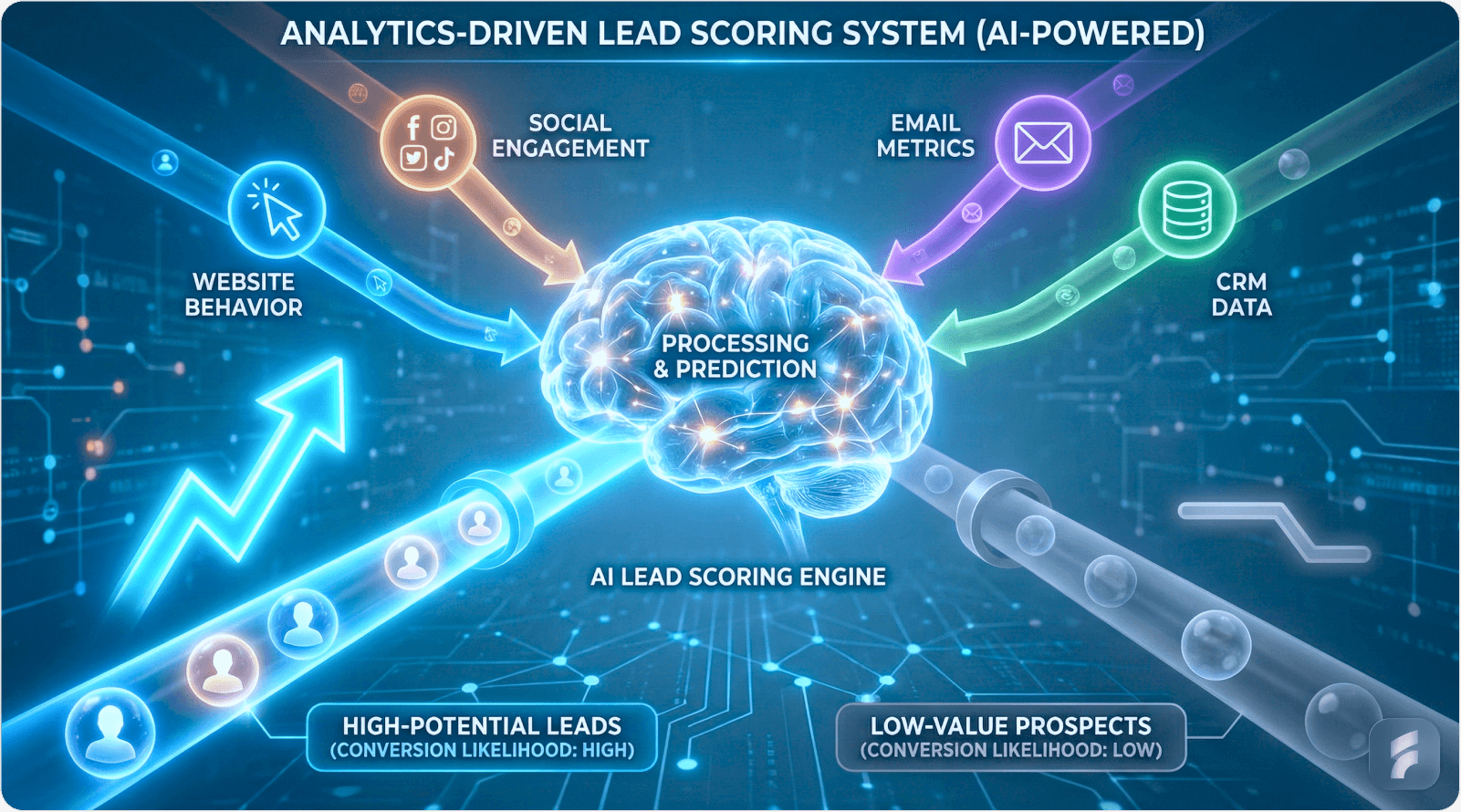
AI's first major impact on sales operations manifests through intelligent lead scoring systems. These platforms analyze hundreds of behavioral and firmographic signals simultaneously, identifying purchase intent patterns invisible to human observers.
Modern lead scoring algorithms process data across multiple dimensions. Website behavioral analytics track content consumption, feature exploration, and return visit patterns. Email engagement metrics monitor open rates, click behavior, and response timing. Social signals incorporate LinkedIn activity, job changes, and company announcements. CRM historical data identifies patterns from previous successful conversions.
Statistical Evidence: Companies implementing AI lead scoring report 30% improvements in conversion rates and 25% reductions in sales cycle length, according to Forrester Research findings.
How Machine Learning Models Predict Conversion
Technical Breakdown: Predictive Modeling
Machine learning models use supervised learning techniques to identify patterns in historical conversion data. The system trains on successful deals, learning which signal combinations correlate with eventual purchase decisions, then applies these patterns to score new prospects.
The sophistication of modern systems extends beyond simple rule-based scoring. Advanced platforms employ ensemble methods, combining multiple algorithms to improve prediction accuracy. Natural language processing analyzes email content and conversation transcripts to assess engagement quality beyond mere response rates.
Automated Engagement Systems
AI-powered engagement platforms represent the second major disruption vector. These systems handle real-time prospect interactions, qualifying intent, answering questions, and routing opportunities based on sophisticated decision trees.
Conversational AI has evolved substantially from early chatbot implementations. Modern systems understand context, maintain conversation continuity across multiple interactions, and adapt responses based on prospect behavior patterns.
Case Study: Drift's Conversational Marketing Platform
Drift pioneered AI-driven conversational marketing, replacing static web forms with real-time chat interfaces. Their platform engages website visitors instantly, qualifying intent through natural conversation flows.
Companies implementing Drift report an 80% reduction in response time and 35% increases in qualified meeting volume. The system handles routine qualification conversations, freeing human SDRs to focus on high-value strategic discussions.
Expert Analysis: David Cancel, CEO of Drift, explains: "The traditional model forces prospects to wait—submit a form, wait for follow-up, schedule a call. Modern buyers expect Amazon-like experiences: instant responses, immediate value. AI makes that economically feasible."
Personalization at Scale
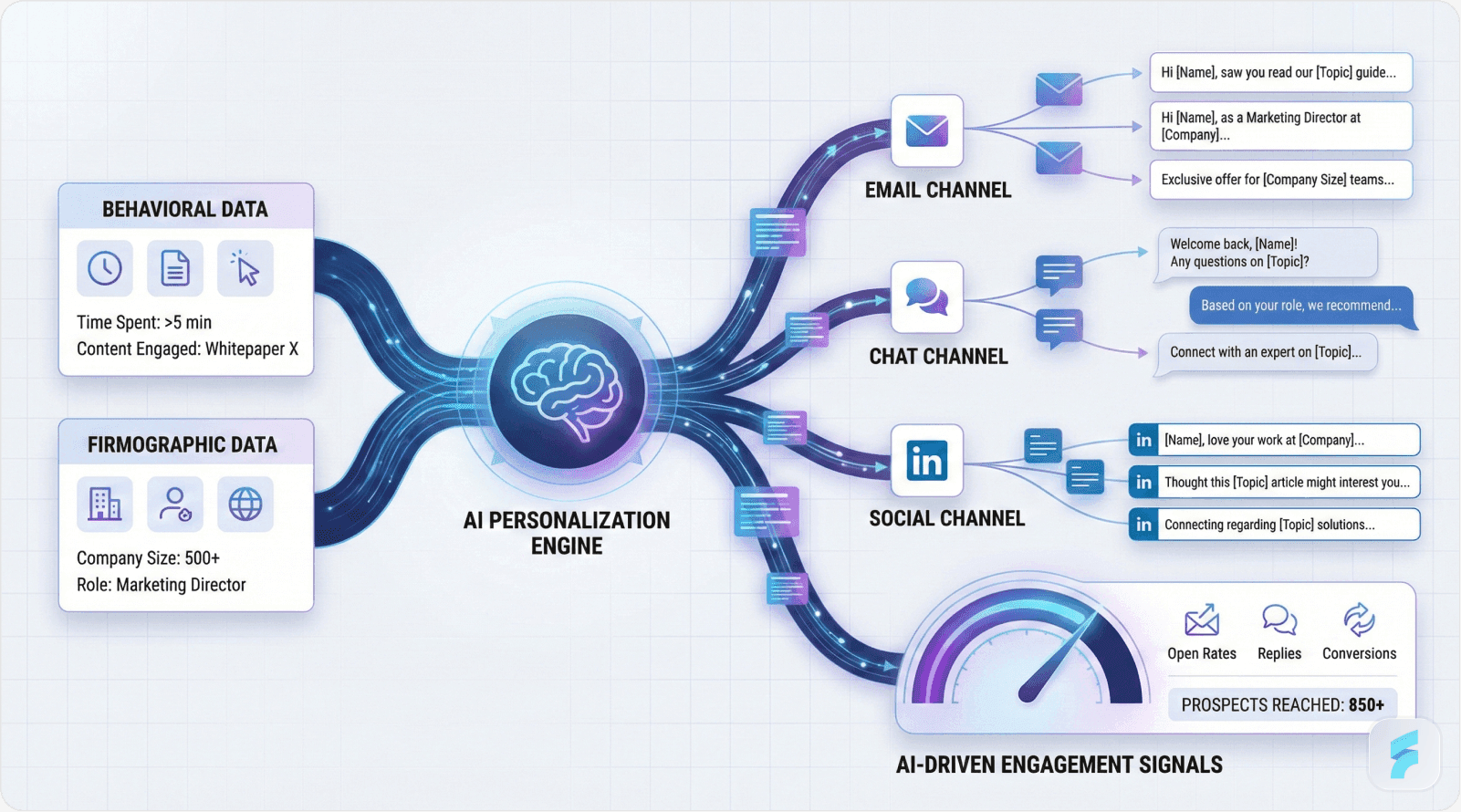
Perhaps AI's most transformative capability is enabling true personalization across thousands of simultaneous prospect relationships. Traditional SDR models force a trade-off between personalization depth and reach. AI systems eliminate this constraint.
Statistical Impact: Personalized email campaigns powered by AI generate 6x higher transaction rates compared to generic messaging, according to Epsilon research. The differential stems from contextual relevance—messages aligned with prospect needs, timing, and demonstrated interests.
Modern personalization engines analyze multiple data streams to craft contextually appropriate messages. Behavioral signals indicate current needs and pain points. Firmographic data informs industry-specific value propositions. Temporal patterns identify optimal outreach timing. Sentiment analysis guides tone and approach.
For comprehensive strategies on optimizing user experiences throughout the customer journey, explore our UX optimization services.
Micro-Summary: AI disrupts traditional sales through three primary mechanisms: intelligent lead scoring that identifies high-intent prospects with unprecedented accuracy, automated engagement systems that provide instant, contextual responses at scale, and personalization engines that eliminate the historical trade-off between depth and reach.
The Obsolescence Risk: Why Static Approaches Fail
The Velocity Imperative
Modern B2B buying behavior has fundamentally shifted. The average SaaS buyer now completes 57% of their decision journey before engaging with sales representatives, according to Gartner research. This self-service preference creates new requirements for sales operations.
Buyers expect immediate access to information, instant responses to questions, and frictionless evaluation experiences. Traditional SDR workflows, with their 24-48 hour response delays and manual qualification processes, create what UX researchers call "activation friction"—unnecessary barriers between prospect intent and value realization.
Definition Block: Activation Friction
Activation friction describes any element in a user journey that creates resistance to desired action completion. In sales contexts, high activation friction correlates with abandonment rates and conversion decay.
The Compounding Effect of Response Delays
Research from the Harvard Business Review demonstrates that response time dramatically impacts conversion probability. Companies responding to leads within five minutes are 100x more likely to convert them compared to those responding after 30 minutes.
This temporal sensitivity creates an impossible requirement for human-only SDR teams. Maintaining five-minute response rates across time zones, business hours, and peak demand periods requires substantial over-staffing. AI systems eliminate this constraint, providing instant engagement regardless of volume or timing.
The Competitive Displacement Risk
Organizations maintaining traditional sales architectures face accelerating competitive disadvantages. Competitors leveraging AI operate with fundamentally superior unit economics and customer experiences.
Statistical Evidence: Companies adopting AI sales tools gain market share at 2.5x the rate of those maintaining traditional approaches, according to Boston Consulting Group analysis. This differential compounds annually, creating widening performance gaps.
Real-World Example: HubSpot's Transformation
HubSpot's evolution illustrates the transition imperative. The company initially built its growth engine on traditional SDR teams, with hundreds of representatives conducting manual outreach and qualification.
As customer expectations shifted toward self-service and instant engagement, HubSpot recognized their traditional model's limitations. The company systematically integrated AI across their sales operations: chatbots for instant qualification, automated email sequences for nurturing, and intelligent routing for opportunity distribution.
The transformation yielded substantial results. Conversion rates increased 30% while customer acquisition costs decreased by 25%. Perhaps most significantly, SDR teams reported higher job satisfaction, freed from repetitive administrative tasks to focus on strategic consultation.
Expert Perspective: Dharmesh Shah, HubSpot CTO, reflects: "We didn't replace people with AI. We replaced mindless repetition with intelligence. Our sales team is more effective now because they spend time on what humans do best—building relationships and solving complex problems."
Professional UX audit services can identify similar friction points and optimization opportunities in your sales processes.
The Efficiency Erosion
Organizations clinging to manual processes experience progressive efficiency degradation. As competitors adopt AI, the relative productivity gap widens, forcing non-adopters to increase spending proportionally to maintain market position.
This creates a negative feedback loop. Higher CAC pressures margins, reducing investment capacity for modernization, further widening the efficiency gap. Companies trapped in this cycle face eventual displacement by more efficient competitors.
Formula Block: Efficiency Ratio
Sales Efficiency = New Annual Recurring Revenue / (Sales + Marketing Expenses)
Research from SaaS Capital indicates that companies with efficiency ratios below 1.0 struggle to achieve sustainable growth. AI adoption directly impacts this metric by reducing the denominator while maintaining or increasing the numerator.
Micro-Summary: Static sales approaches face three critical obsolescence risks: velocity misalignment with modern buyer expectations, competitive displacement by AI-adopting rivals operating with superior unit economics, and progressive efficiency erosion that compounds over time, creating unsustainable cost structures.
Implementation Framework: Architecting AI-Enhanced Sales Operations
Phase 1: Intelligent Lead Management
Successful AI integration begins with lead intelligence infrastructure. This foundational layer determines which prospects receive attention, in what priority order, and through which engagement channels.
Implementing Predictive Lead Scoring
Modern lead scoring systems analyze multidimensional signal arrays to predict conversion probability. Implementation requires several key components working in concert.
Technical Implementation Steps:
Data Integration: Connect all prospect touchpoint systems—website analytics, CRM, email platforms, product usage data, and social signals
Historical Analysis: Process 12-24 months of conversion data to establish baseline patterns and identify predictive signals
Model Training: Develop machine learning models using supervised learning techniques, typically gradient boosting or neural networks
Validation Testing: Test model predictions against holdout data sets to ensure accuracy and prevent overfitting
Deployment Integration: Embed scoring engine into existing sales workflows with real-time score updates
Case Study: Chorus.ai's Conversation Intelligence
Chorus.ai (now part of ZoomInfo) pioneered the application of AI to sales conversation analysis. Their platform transcribes sales calls, analyzes discussion patterns, and provides real-time coaching based on successful conversation frameworks.
Companies using Chorus.ai report 35% reductions in time spent on low-quality leads and 28% improvements in win rates. The system identifies which conversation patterns correlate with eventual deals, enabling SDRs to focus on high-value dialogues.
Statistical Impact: Organizations implementing conversation intelligence report that sales representatives reach quota 41% faster, according to research from Aberdeen Group.
The platform's natural language processing identifies critical signals: competitor mentions, pricing discussions, decision-maker involvement, and objection patterns. This intelligence enables sales leaders to intervene proactively and replicate successful approaches across teams.
Learn more about creating effective user experiences through our product design services.
Phase 2: Automated Outreach Orchestration
The second implementation phase focuses on automating repetitive outreach activities while maintaining personalization quality. Modern platforms like Outreach.io and SalesLoft provide sophisticated automation capabilities.
Multi-Channel Sequence Design
Effective automated outreach requires carefully orchestrated sequences across email, phone, social, and video channels. Each touchpoint should provide incremental value while respecting prospect preferences and engagement patterns.
Strategic Framework for Sequence Design:
Touchpoint 1: Educational content aligned with prospect role and industry
Touchpoint 2: Social proof showcasing relevant customer success stories
Touchpoint 3: Personalized insight based on company-specific research
Touchpoint 4: Direct value proposition with clear call-to-action
Touchpoint 5: Soft re-engagement focusing on alternative entry points
AI enhancement comes through dynamic optimization. The system monitors engagement patterns—which subject lines generate opens, which content assets drive responses, which sending times correlate with engagement—and continuously refines approach.
Statistical Evidence: Automated sequences with AI optimization generate 50% faster response times and 20-30% higher conversion rates compared to manual outreach, according to Close.com research.
Personalization Engine Architecture
Technical Term: Dynamic Content Assembly
Dynamic content assembly refers to AI systems that construct personalized messages by selecting relevant content blocks based on prospect attributes, behavioral signals, and engagement history, creating unique communications at scale.
Modern personalization extends far beyond simple mail-merge name insertion. Sophisticated systems analyze prospect digital footprints—LinkedIn activity, company news, technology stack, competitive landscape—to craft genuinely relevant outreach.
The economic impact is substantial. Personalized outreach converts at 6x the rate of generic messaging while requiring minimal incremental effort once systems are properly configured.
Phase 3: Real-Time Engagement Infrastructure
The third implementation phase addresses instant prospect engagement through AI-powered conversational systems. This capability has become table-stakes for competitive SaaS sales operations.
Conversational AI Deployment
Platforms like Drift and Intercom enable sophisticated website engagement that qualifies prospects, answers questions, and routes opportunities in real-time.
Implementation Considerations:
Conversation Flow Design: Map common prospect questions, objections, and qualification criteria into decision trees
Integration Architecture: Connect conversational AI to CRM, calendaring, and product systems for seamless data flow
Escalation Logic: Define rules for routing conversations to human SDRs based on intent signals and complexity
Continuous Learning: Implement feedback loops where human intervention improves AI responses over time
Case Study: Intercom's Operator Bot
Intercom's Operator bot demonstrates the sophistication possible with modern conversational AI. The system handles common support questions, qualifies sales inquiries, and books meetings based on natural language understanding.
Companies implementing Operator report 33% increases in qualified meeting volume and 67% reductions in response time. The system maintains context across multiple interactions, providing continuity even as conversations span days or weeks.
Expert Analysis: Des Traynor, Intercom co-founder, explains: "The goal isn't to trick people into thinking they're talking to humans. It's to provide instant value regardless of when they need it. AI lets us be responsive 24/7 without burning out our team."
Discover how our UX audit services can optimize your conversational interfaces for maximum engagement.
Phase 4: CRM Intelligence Layer
The final implementation phase embeds AI directly into customer relationship management workflows, providing intelligent guidance and automation throughout the sales cycle.
Predictive Pipeline Management
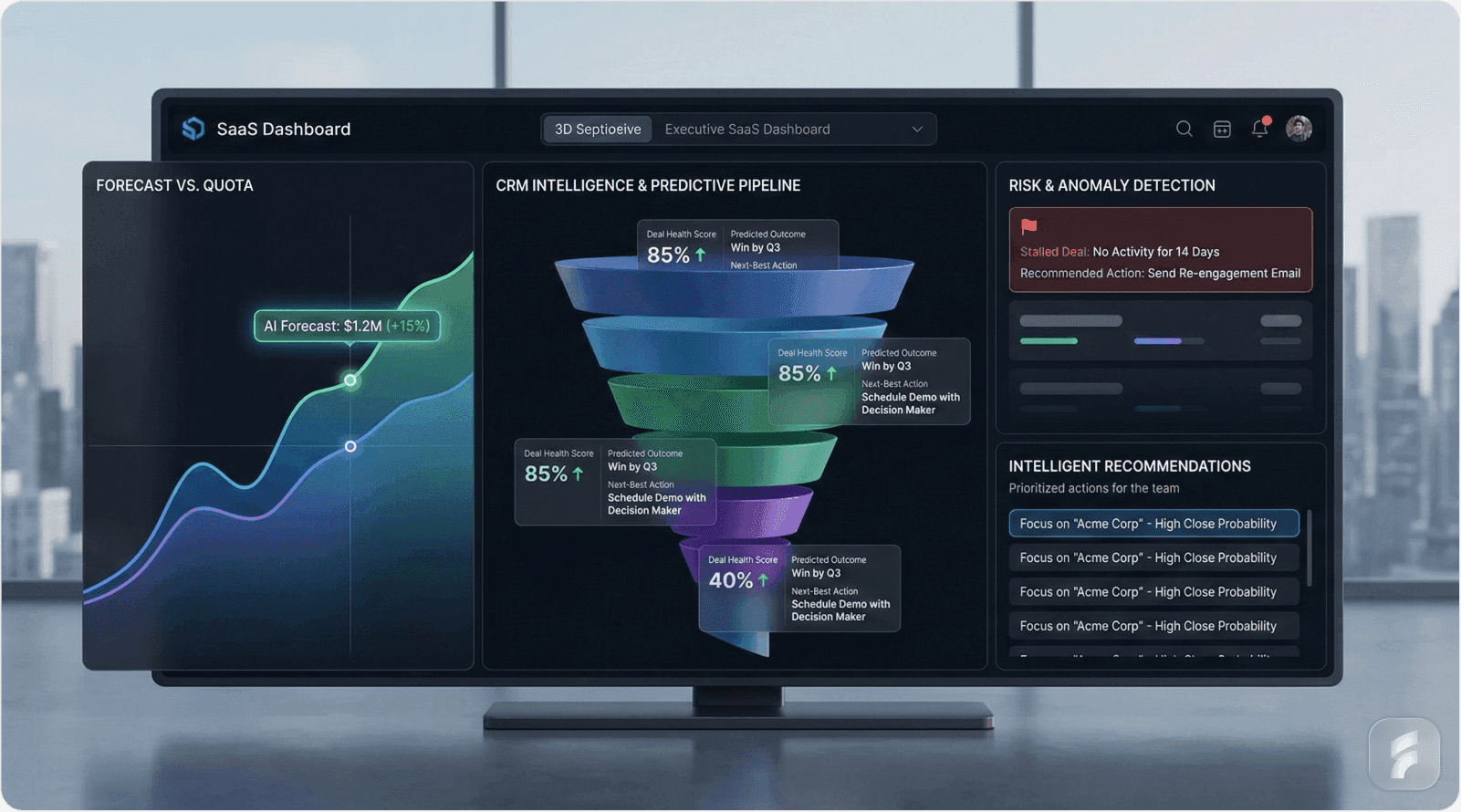
AI-enhanced CRM systems like Salesforce Einstein and HubSpot analyze deal progression patterns to forecast outcomes and recommend optimal next actions.
Intelligence Capabilities:
Deal Health Scoring: Assess probability of deal closure based on activity patterns, stakeholder engagement, and historical conversion data
Next-Best-Action Recommendations: Suggest specific activities—which stakeholders to contact, what content to share, when to follow up—based on successful deal patterns
Forecasting Accuracy: Provide statistical forecasts of quarterly results based on pipeline composition and historical conversion rates
Anomaly Detection: Flag deals exhibiting unusual patterns that may indicate risk or opportunity
Case Study: Salesforce Einstein Analytics
Salesforce Einstein applies machine learning across the entire CRM dataset, identifying patterns and providing predictive insights. The platform analyzes millions of data points to determine which factors most influence deal outcomes.
Companies using Einstein report 20% reductions in customer acquisition costs and 26% improvements in forecast accuracy. Sales representatives receive specific, actionable guidance rather than generic best practices.
Statistical Impact: AI-powered CRM systems reduce administrative time by 14.5 hours per sales representative per week, according to McKinsey research. This recovered time redirects to strategic activities with higher revenue impact.
Intelligent Task Automation
Beyond analytics, modern CRMs automate routine tasks that traditionally consumed substantial SDR bandwidth. Automated data entry captures email interactions, call details, and meeting notes without manual input. Smart scheduling identifies optimal meeting times across multiple calendars. Follow-up automation sends contextually appropriate messages based on meeting outcomes and deal stage.
Micro-Summary: Successful AI implementation follows a four-phase framework: intelligent lead management establishes predictive scoring infrastructure, automated outreach orchestrates personalized multi-channel sequences, real-time engagement deploys conversational AI for instant prospect interaction, and CRM intelligence layers embed guidance and automation throughout the sales cycle.
Advanced Applications: Frontier AI Capabilities
Forecasting and Revenue Intelligence
AI's application to sales forecasting represents a significant advance over traditional pipeline analysis. Modern platforms like Clari aggregate data across multiple systems to provide unprecedented forecast accuracy.
Technical Architecture: Revenue Intelligence Systems
Revenue intelligence platforms integrate CRM, email, calendar, and conversational data to create comprehensive views of deal health. Machine learning models identify patterns across thousands of deals to predict outcomes with statistical confidence intervals.
Clari's platform exemplifies this sophistication. The system analyzes not just CRM opportunity data, but email sentiment, meeting frequency, stakeholder involvement, and competitive signals to assess deal risk and probability.
Statistical Performance: Companies using Clari report 97% forecast accuracy compared to 75% with traditional CRM-only approaches. This precision enables better resource allocation and more reliable financial planning.
Deal Risk Identification
AI systems identify risk signals that human sales managers often miss. Sudden engagement drop-offs, absence of champion activity, or delayed decision-making patterns trigger proactive intervention protocols.
Expert Perspective: Andy Byrne, CEO of Clari, notes: "The best salespeople have intuition about deal health. AI democratizes that intuition, giving every rep access to pattern recognition across millions of deals. It's not replacing judgment—it's enhancing it with data most people can't mentally process."
Sentiment Analysis and Conversation Optimization
Natural language processing enables real-time analysis of sales conversations, identifying emotional tone, objection patterns, and buying signals. This capability transforms coaching and skill development.
Gong.io pioneered this category, analyzing sales calls to identify winning behaviors. The platform determines which questions, talk ratios, and discussion topics correlate with successful outcomes.
Statistical Finding: Top-performing sales representatives spend 43% of conversation time asking questions and listening, compared to 31% for average performers, according to Gong research. AI analysis reveals these patterns and provides specific coaching guidance.
Behavioral Pattern Recognition
Definition Block: Talk-to-Listen Ratio
The talk-to-listen ratio measures the proportion of conversation time a sales representative speaks versus listens. Research consistently shows ratios around 40:60 (rep:prospect) correlate with highest conversion rates.
Advanced systems identify micro-patterns: successful pricing discussions, effective objection handling, competitive positioning strategies. These insights, extracted from thousands of conversations, provide specific improvement pathways for developing representatives.
Competitive Intelligence Automation
AI systems monitor competitor mentions, pricing discussions, and feature comparisons across sales interactions, providing real-time competitive intelligence.
This automated gathering reveals competitive positioning opportunities and objection handling strategies. Sales teams gain insight into what competitors emphasize, what prospects value, and where differentiation opportunities exist.
Micro-Summary: Frontier AI applications extend beyond basic automation to advanced capabilities: revenue intelligence systems providing unprecedented forecast accuracy through multi-source analysis, conversation optimization platforms identifying winning behavioral patterns across thousands of interactions, and competitive intelligence automation extracting strategic insights from routine sales conversations.
The Human-AI Collaboration Model
Redefining the SDR Role
AI integration doesn't eliminate sales roles—it fundamentally redefines them. The future SDR operates as a strategic advisor augmented by AI capabilities rather than a manual processor of routine tasks.
Role Evolution Framework:
Previous Focus: Cold outreach, manual qualification, data entry, activity logging
AI-Augmented Focus: Strategic consultation, complex deal navigation, relationship building, executive engagement
This shift elevates the role from transactional to consultative. AI handles routine pattern recognition and process execution, while humans address situations requiring empathy, creativity, and strategic thinking.
Statistical Impact: SDRs in AI-augmented environments report 71% higher job satisfaction and 44% longer tenure, according to research from The Bridge Group. The shift toward strategic work improves both performance and retention.
Skills for the AI-Augmented Era
Future sales professionals require different competencies than their predecessors. Technical proficiency with AI tools becomes foundational. Strategic thinking and consultative selling increase in importance. Emotional intelligence and relationship building remain distinctly human capabilities.
Expert Perspective: Trish Bertuzzi, founder of The Bridge Group, explains: "AI is doing what it should—handling repetitive, rule-based work. This frees sales professionals to do what humans excel at: understanding complex business problems, building trusted relationships, and crafting creative solutions."
Cognitive Load Reduction Through Automation
Mental Model: Cognitive Offloading
Cognitive offloading refers to using external tools to reduce mental effort required for tasks. In sales contexts, AI systems offload routine decision-making and information retrieval, preserving cognitive capacity for strategic activities.
Traditional sales workflows impose substantial cognitive burden. Representatives constantly switch between systems, remember follow-up tasks, track conversation history, and maintain updated prospect research. This mental overhead reduces capacity for strategic thinking.
AI systems dramatically reduce cognitive load by handling information management, task tracking, and routine decision-making. Representatives access complete prospect context instantly, receive proactive reminders for follow-ups, and benefit from intelligent recommendations based on comprehensive data analysis.
The result is higher-quality prospect interactions. Research from Stanford HCI shows that reduced cognitive load correlates with improved creative problem-solving and strategic thinking capability.
The Augmentation Mindset
Successful AI integration requires organizational mindset shifts. Rather than viewing AI as a replacement threat, high-performing sales organizations adopt an augmentation perspective.
Cultural Transformation Elements:
Transparency: Clearly communicate AI's role in supporting, not replacing, sales professionals
Training Investment: Provide comprehensive education on AI tool capabilities and optimal usage patterns
Feedback Loops: Create mechanisms for sales teams to improve AI systems based on field experience
Success Metrics: Establish KPIs that reward quality over quantity, emphasizing AI-human collaboration effectiveness
Organizations successfully navigating this transition report higher adoption rates and faster performance improvements. The key is framing AI as a competitive advantage for individual representatives rather than a productivity surveillance mechanism.
Micro-Summary: The human-AI collaboration model redefines sales roles from manual processors to strategic advisors, reduces cognitive load through intelligent automation, and requires organizational mindset shifts toward augmentation rather than replacement. This transformation elevates sales work while improving both performance and professional satisfaction.
Implementation Challenges and Solutions
Data Quality Prerequisites
AI systems are only as effective as the data underlying them. Organizations with fragmented, incomplete, or inaccurate data face significant implementation challenges.
Common Data Quality Issues:
Duplicate Records: Multiple CRM entries for the same prospect or account
Incomplete Profiles: Missing key firmographic or behavioral data
Stale Information: Outdated contact details, job titles, or company information
Inconsistent Formatting: Varied data entry conventions preventing system-wide analysis
Addressing these issues requires systematic data hygiene initiatives. Modern data enrichment platforms like Clearbit and ZoomInfo automatically update and supplement CRM records with accurate, current information.
Statistical Reality: Companies implementing AI on clean, comprehensive data achieve 3.2x higher ROI compared to those with poor data quality, according to Forrester Research.
Data Integration Architecture
Technical Term: Unified Customer Data Platform
A unified customer data platform (CDP) aggregates prospect and customer information from multiple systems—CRM, marketing automation, product analytics, support tickets—into a single, consistent profile enabling comprehensive AI analysis.
Successful AI implementation requires integrated data architecture. Siloed systems prevent the comprehensive analysis necessary for accurate predictions and intelligent recommendations.
Change Management and Adoption
Technology alone doesn't drive transformation—people do. Organizations face adoption challenges as sales teams adjust to new workflows and AI-augmented processes.
Adoption Barriers:
Perceived Threat: Concern that AI will eliminate jobs or reduce autonomy
Learning Curve: Initial productivity decrease while mastering new tools
Trust Deficit: Skepticism about AI recommendations and accuracy
Process Disruption: Resistance to changing established workflows
Successful implementations address these barriers through comprehensive change management programs. Transparent communication about AI's supportive role reduces threat perception. Hands-on training with clear success metrics demonstrates value. Early win identification and celebration builds momentum.
Expert Analysis: According to McKinsey research on technology adoption, organizations investing in change management achieve 33% higher success rates compared to those focusing solely on technical implementation.
Privacy and Compliance Considerations
AI systems processing prospect and customer data must comply with privacy regulations including GDPR, CCPA, and industry-specific requirements.
Compliance Framework Elements:
Data Minimization: Collect only information necessary for legitimate business purposes
Purpose Limitation: Use data only for explicitly stated, consent-based purposes
Access Controls: Implement role-based permissions preventing unauthorized data access
Retention Policies: Automatically delete data after defined retention periods
Audit Trails: Maintain comprehensive logs of data access and processing activities
Organizations must ensure AI vendors provide robust data protection capabilities and comply with relevant regulations. Vendor security assessments should evaluate data handling practices, encryption standards, and compliance certifications.
Cost-Benefit Analysis
AI implementation requires significant investment—software licensing, integration development, training programs, and ongoing optimization. Organizations must carefully evaluate expected returns.
ROI Calculation Framework:
AI Investment ROI = (Efficiency Gains + Revenue Improvements - Implementation Costs) / Implementation Costs
Typical payback periods range from 6-18 months depending on organization size and implementation scope. Early wins often come from efficiency improvements—reduced manual work, faster response times—while revenue impact accumulates over longer periods.
Statistical Benchmarks: Organizations successfully implementing AI sales tools report median ROI of 320% over three years, according to Boston Consulting Group research.
Micro-Summary: Successful AI implementation requires addressing four critical challenges: establishing data quality prerequisites through systematic hygiene and integration efforts, managing organizational change through transparent communication and comprehensive training, ensuring privacy and compliance through robust data governance frameworks, and conducting rigorous cost-benefit analysis to justify investment and track returns.
Future Trajectory: Next-Generation Sales Intelligence
Generative AI in Sales Operations
The emergence of large language models like GPT-4 and Claude introduces unprecedented capabilities for sales automation. These systems generate human-quality content, conduct sophisticated research, and provide conversational assistance.
Emerging Applications:
Proposal Generation: Automatically create customized proposals based on prospect requirements and successful templates
Research Synthesis: Analyze prospect companies, identifying relevant pain points, competitive landscape, and decision-maker priorities
Email Composition: Draft personalized outreach messages incorporating company-specific insights and value propositions
Objection Handling: Provide real-time suggestions for addressing prospect concerns based on successful historical approaches
Early adopters report dramatic efficiency improvements. Sales representatives using generative AI for proposal creation reduce document preparation time by 70% while improving customization quality.
Expert Perspective: Reid Hoffman, LinkedIn co-founder and AI investor, predicts: "Generative AI will be to knowledge work what the assembly line was to manufacturing. The productivity gains will be measured in multiples, not percentages."
Autonomous Sales Agents
Future development points toward increasingly autonomous AI agents capable of managing entire prospect relationships with minimal human intervention.
Technical Vision: Agent Architecture
Autonomous sales agents combine multiple AI capabilities—natural language processing, decision-making algorithms, learning systems—into integrated entities that can execute complex, multi-step sales processes independently while escalating to humans only for strategic decisions.
These agents would handle initial outreach, qualification conversations, objection addressing, and basic negotiation. Human sales professionals would engage primarily for complex strategic discussions, executive-level relationships, and creative problem-solving.
This vision remains several years from full realization, but directional progress is clear. Each capability breakthrough—better language understanding, improved reasoning, more accurate context retention—advances toward this future state.
Predictive Market Intelligence
AI systems are beginning to analyze broader market signals—economic indicators, technology trends, regulatory changes, competitive movements—to identify opportunities before they become obvious.
Application Examples:
Expansion Timing: Identify optimal moments for upsell conversations based on customer growth signals and industry trends
Market Entry: Determine when prospects enter buying cycles based on technology adoption patterns and organizational changes
Risk Prediction: Anticipate churn risk by analyzing engagement patterns, support interactions, and market dynamics
These capabilities transform sales from reactive to proactive, enabling representatives to engage prospects at precisely the right moment with contextually relevant value propositions.
Micro-Summary: Future sales intelligence evolves toward generative AI creating sophisticated sales content automatically, autonomous agents managing routine prospect relationships independently, and predictive market intelligence identifying opportunities through comprehensive signal analysis before traditional indicators emerge.
Conclusion: The Imperative for Transformation
The transformation of SaaS sales operations through AI represents not merely technological evolution but fundamental architectural change. Organizations maintaining traditional SDR-centric models face accelerating competitive disadvantages as AI-adopting rivals achieve superior unit economics, faster response times, and more personalized customer experiences.
The data is unambiguous. Companies integrating AI into sales operations report 40-60% productivity improvements, 30% conversion rate increases, and 25% customer acquisition cost reductions. These advantages compound over time, creating widening performance gaps between adopters and laggards.
Yet transformation requires more than technology deployment. Success demands comprehensive data quality establishment, thoughtful change management addressing organizational concerns, rigorous compliance frameworks protecting customer privacy, and strategic implementation following proven phased approaches.
The role of sales professionals evolves rather than disappears. AI handles routine pattern recognition, process execution, and administrative burden, elevating human representatives to strategic advisors focused on relationship building, complex problem-solving, and consultative engagement—activities leveraging distinctly human capabilities of empathy, creativity, and strategic thinking.
Forward-looking organizations recognize AI not as threat but as enabler. The technology augments human capabilities, reduces cognitive load, and democratizes expertise previously available only to top performers. Sales teams empowered with AI tools report higher job satisfaction, longer tenure, and improved performance.
The question facing SaaS sales leaders is not whether to adopt AI but how quickly to execute transformation before competitive disadvantages become insurmountable. Organizations beginning comprehensive assessment, establishing data foundations, and initiating pilot implementations position themselves for sustainable competitive advantage in an increasingly AI-driven sales landscape.
The future belongs to organizations successfully blending human judgment with machine intelligence, creating sales operations that deliver personalized experiences at scale while maintaining the relationship depth and strategic insight that only human professionals provide.
For expert guidance on optimizing your entire customer experience, from first contact through conversion, explore our comprehensive services at Saasfactor or discover more insights on our blog.
Glossary: Key Terms in AI Sales Operations
Activation Friction: Unnecessary barriers in the user journey creating resistance to desired actions. High activation friction (response delays, complex processes, form-heavy interactions) correlates with prospect abandonment and conversion decay.
Cognitive Load: Total mental effort required to complete a task. Sales operations with high cognitive load through fragmented workflows and administrative burden reduce capacity for strategic thinking and relationship building.
Conversation Intelligence: AI platforms that transcribe, analyze, and provide insights on sales conversations. These systems identify successful patterns, objection handling strategies, and coaching opportunities by processing thousands of interactions.
Customer Acquisition Cost (CAC): Total expense to acquire a new customer, calculated by dividing combined sales and marketing expenses by new customers acquired. AI adoption typically reduces CAC through improved efficiency and conversion rates.
Dynamic Content Assembly: AI systems that construct personalized messages by selecting relevant content blocks based on prospect attributes, behavioral signals, and engagement history, creating unique communications at scale.
Interaction Cost: Cumulative mental and temporal expense of navigating disconnected workflows and completing tasks across multiple systems. High interaction costs reduce task completion rates and increase error frequency.
Lead Scoring: Assigning numerical values to prospects based on conversion likelihood using firmographic data, behavioral signals, and engagement patterns. AI-powered scoring analyzes hundreds of signals simultaneously for greater accuracy than rule-based systems.
Mental Model: Internal representation of how something works, shaping expectations and behavior. In sales technology, alignment between system design and users' mental models facilitates intuitive interaction and faster proficiency development.
Predictive Analytics: Statistical techniques using historical data, machine learning, and algorithms to forecast future outcomes. In sales, predicts deal closure probability, identifies churn risk, and forecasts revenue with statistical confidence intervals.
Revenue Intelligence: Platforms integrating CRM, email, calendar, and conversational data to provide complete visibility into deal health and pipeline dynamics. These systems apply machine learning to identify patterns across thousands of deals.
Sales Efficiency Ratio: Metric calculating new annual recurring revenue divided by combined sales and marketing expenses. Ratios above 1.0 indicate sustainable growth economics; lower ratios suggest unsustainable customer acquisition costs.
Sentiment Analysis: Natural language processing identifying emotional tone, attitude, and opinion in text or speech. In sales, assesses prospect engagement quality, identifies objection patterns, and guides conversation strategy.
Talk-to-Listen Ratio: Proportion of conversation time a sales representative speaks versus listens. Research shows ratios around 40:60 (representative:prospect) correlate with highest conversion rates, as prospects feel heard.
Unified Customer Data Platform (CDP): Infrastructure aggregating prospect and customer information from multiple systems (CRM, marketing automation, product analytics, support) into single, consistent profiles enabling comprehensive AI analysis.
Usability Debt: Accumulated cost of suboptimal user experience design decisions. In sales operations, manifests as cumbersome workflows, excessive system switching, and unintuitive interfaces reducing productivity over time.
References and Authoritative Sources
Research Institutions and Consulting Firms
McKinsey & Company - Upgrading Software Business Models to Thrive in the AI Era
Harvard Business Review - The Short Life of Online Sales Leads
The Bridge Group - Inside Sales Metrics and Compensation Report
Boston Consulting Group - Winning in AI: How Leaders Are Capturing Value
Gartner Research - The Future of Sales and B2B Buyer Behavior
Forrester Research - The AI in Sales Enablement Landscape
Aberdeen Group - Sales Enablement: Close the Performance Gap
Nielsen Norman Group - The Definition of User Experience and Interaction Cost
Stanford Human-Computer Interaction Lab - Cognitive Load Theory and User Interface Design
ProfitWell - SaaS Customer Acquisition Cost Benchmarks and Trends
SaaS Capital - 2024 SaaS Survey Results and Efficiency Metrics
AI Sales Technology Platforms
HubSpot - Inbound Marketing and Sales Automation Best Practices
Drift - Conversational Marketing and Sales Performance Metrics
Intercom - Modern Customer Engagement and Support Automation
Chorus.ai (ZoomInfo) - Sales Coaching and Conversation Analytics
Gong.io - Revenue Intelligence and Sales Conversation Insights
Salesforce - Einstein AI for CRM and Sales Automation
Clari - Revenue Operations and Forecast Management Platform
Outreach.io - Sales Engagement and Automation Platform
SalesLoft - Sales Engagement Platform and Cadence Management
Clearbit - B2B Data Enrichment and Lead Intelligence
Industry Publications
Forbes - Why Your SaaS Company Should Modernize Its Sales Process
Close.com - AI and the Future of Sales Development Representatives
Epsilon Research - The Power of Personalization in Marketing and Sales