

Last Update:
Dec 14, 2025
Share

Product Design = Strategy. UX Design = Optimization.
Product designers shape product direction, market fit, and long-term roadmap, while UX designers refine interactions and remove friction in existing flows.Hiring the wrong role delays growth by 6–9 months.
SaaS founders often confuse these roles, leading to misaligned capabilities and slowed PMF achievement.Product Designers think in systems, not screens.
They balance business viability, user needs, and technical constraints—making them crucial from Seed to Series A.UX Designers unlock conversion and retention.
Targeted UX improvements increase conversion by 35–50 percent and dramatically reduce user friction and support costs.Role clarity accelerates feature delivery and consistency.
Clear separation of product vs UX responsibilities results in 42 percent faster delivery and higher user satisfaction.Hiring sequence depends on your SaaS growth stage.
Pre-PMF teams need a strategic product designer first, while scaling teams need UX specialists to optimize funnels and adoption.Design ROI compounds over time.
UX investments return up to $100 for every $1 spent, while strong product design increases revenue growth by 32 percent.Future roles will be AI-augmented and more specialized.
Expect growth in conversation design, design systems, accessibility, and growth design as AI handles production-level tasks.Effective design–product partnerships outperform siloed workflows.
Joint discovery, shared decision rights, and structured collaboration reduce failed features by 64 percent.Clear success metrics prevent mis-hires and designer frustration.
Companies often fail by hiring without defining success criteria for product or UX roles.
The hiring decision between product designers and UX designers represents one of the most consequential choices facing scaling SaaS companies. According to recent industry data, 73% of SaaS founders report confusion about when to hire which role, leading to costly misalignments between team capabilities and business needs.
This distinction matters more than semantics. Research from the Interaction Design Foundation shows that companies with clearly defined design roles experience 42% faster feature delivery and 31% higher user satisfaction scores compared to organizations with ambiguous design responsibilities.
For growing SaaS teams navigating Series A to Series C stages, understanding the nuanced differences between product design and UX design directly impacts activation rates, retention curves, and ultimately, revenue growth. The wrong hire at the wrong stage can delay product-market fit by 6-9 months, according to data from First Round Capital's portfolio analysis.
Understanding Product Design: The Strategic Layer
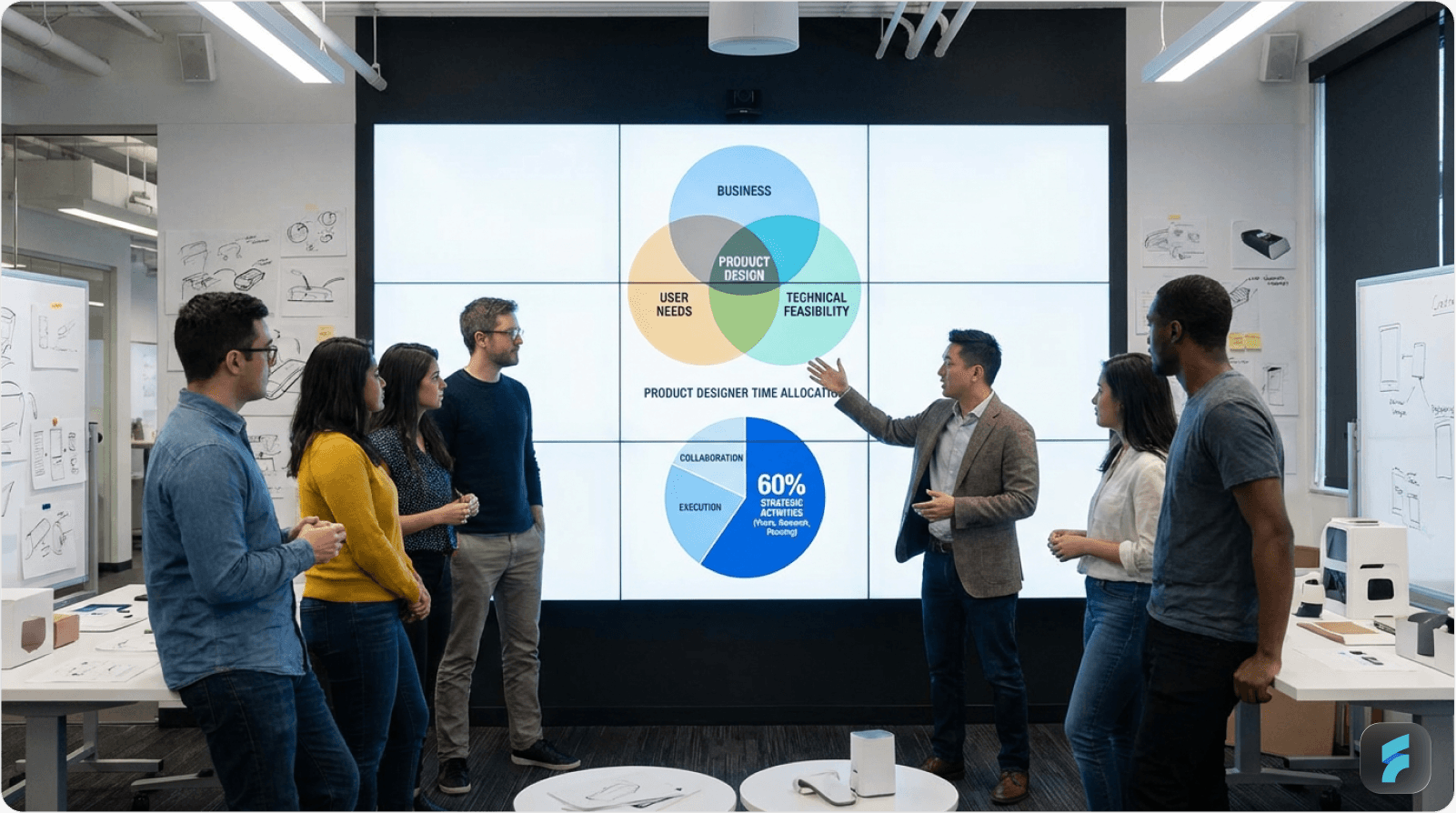
Product design encompasses the complete lifecycle of feature development, from market research and competitive analysis through implementation and post-launch optimization. Product designers operate at the intersection of business strategy, user needs, and technical feasibility.
The Scope of Product Design Work
A product designer's responsibility extends beyond interface creation. They conduct market validation studies, define product roadmaps in collaboration with product managers, and establish design systems that scale across multiple product lines.
The Nielsen Norman Group identifies product designers as "full-stack designers" who manage:
Strategic product vision and positioning
User research and behavioral analysis
Information architecture and user flow mapping
Visual interface design and prototyping
Collaboration with engineering on implementation
Post-launch metrics analysis and iteration planning
Research from Gartner indicates that organizations employing product designers report 38% higher feature adoption rates, primarily because these designers consider the entire user journey rather than isolated touchpoints.
Core Competencies and Mental Models
Product designers think in systems rather than screens. Dr. Don Norman, founder of the Nielsen Norman Group, states: "Great product designers understand that every feature exists within an ecosystem of user behaviors, business constraints, and technical realities."
Their mental models incorporate:
Business viability analysis: Understanding unit economics, customer acquisition cost, and lifetime value implications of design decisions
Cross-functional orchestration: Managing dependencies between marketing, sales, engineering, and customer success
Strategic prioritization: Balancing innovation with incremental improvements based on impact forecasting
According to MIT's Human-Computer Interaction Lab, product designers spend approximately 60% of their time on strategic activities and 40% on execution, compared to the inverse ratio often seen in pure UX roles.
When Product Design Drives Maximum Impact
Product design becomes essential during specific growth phases. Companies between $1M-$10M ARR typically experience the highest return on product design investment, as validated by data from OpenView Partners' SaaS benchmarking study.
Key scenarios requiring product design expertise:
Expanding into new market segments or verticals
Building platform features or API products
Designing multi-sided marketplaces
Creating freemium-to-paid conversion funnels
Developing mobile applications that complement web products
A Stanford Graduate School of Business study found that SaaS companies prioritizing product design during expansion phases achieved 2.3x higher net revenue retention compared to those focusing solely on feature development.
Micro-Summary: Product design operates at the strategic level, combining business acumen with design execution. Product designers own the complete product lifecycle, from market validation through post-launch optimization, making them ideal for companies in expansion mode or building complex, multi-faceted products.
Decoding UX Design: The Experience Specialists
UX design (user experience design) focuses specifically on optimizing how users interact with existing products or features. UX designers are specialists in reducing cognitive load, minimizing interaction cost, and creating intuitive navigation patterns.
The Specialized Domain of UX Design
While product design spans strategy to execution, UX design concentrates on the experiential layer. UX designers excel at identifying and eliminating friction points that impede user success.
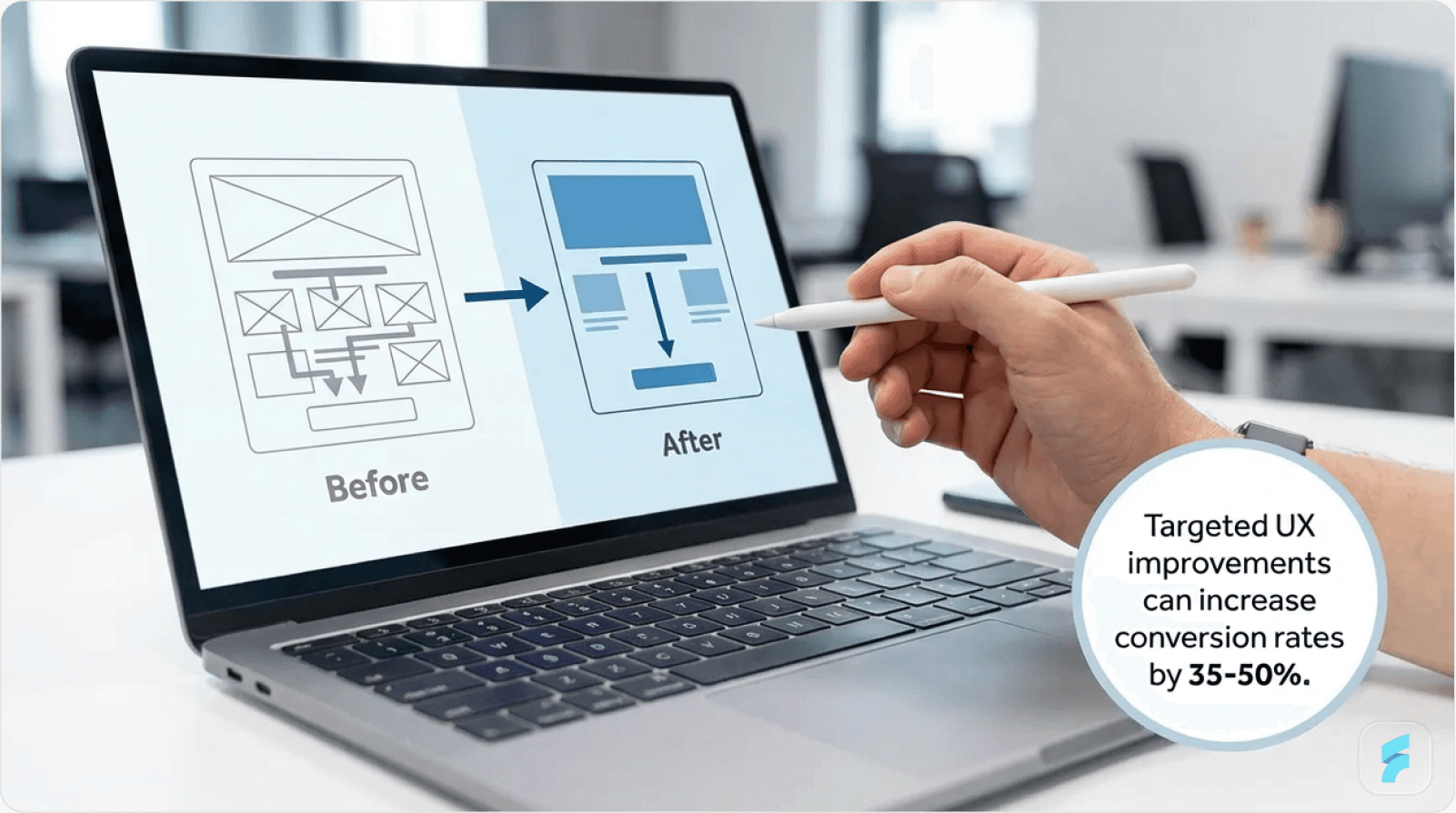
The Baymard Institute's research shows that targeted UX improvements can increase conversion rates by 35-50% without changing product functionality, highlighting the specialized value UX designers provide.
Core UX Design Activities
UX designers dedicate their expertise to:
Usability testing and friction point identification
User flow optimization and path analysis
Interaction pattern design and micro-interaction refinement
Accessibility compliance and inclusive design practices
A/B testing design and variant analysis
Heuristic evaluation using established frameworks
Jakob Nielsen, co-founder of Nielsen Norman Group, emphasizes: "UX designers are the architects of user satisfaction, systematically removing barriers between user intent and user success."
According to research from Forrester, companies investing in dedicated UX design see ROI improvements of $100 for every $1 spent, primarily through reduced support costs and increased user retention.
The UX Design Methodology
UX designers employ systematic frameworks for identifying and resolving user friction. The most prevalent methodologies include:
Heuristic Evaluation Framework: Assessing interfaces against established usability principles such as error prevention, recognition over recall, and aesthetic minimalism.
Cognitive Walkthrough Process: Simulating user task completion to identify points where mental models diverge from interface expectations.
Friction Scoring Systems: Quantifying interaction cost by measuring clicks, scrolls, form fields, and cognitive decisions required to complete key workflows.
Research from the Human Factors and Ergonomics Society demonstrates that organizations using structured UX methodologies reduce user error rates by 67% compared to those relying on intuition-based design.
High-Value UX Design Scenarios
UX design delivers maximum impact when products face specific user experience challenges. Data from Productboard's 2024 Product Excellence Report identifies these critical scenarios:
Declining activation rates or trial-to-paid conversion
High support ticket volume related to product confusion
Low feature adoption despite strong product-market fit
Mobile experience lag compared to web performance
Onboarding completion rates below industry benchmarks
UX optimization becomes essential when quantitative metrics reveal friction but the strategic product direction remains sound.
A comprehensive UX audit typically uncovers 15-30 high-impact improvements that can be implemented without significant engineering resources, according to data from Maze's user research platform.
Micro-Summary: UX design specializes in optimizing existing user experiences through systematic friction reduction. UX designers excel at improving conversion rates, reducing user errors, and increasing satisfaction with established products, making them critical when metrics indicate experience problems rather than strategic gaps.
The Critical Distinctions: Beyond Job Titles
Understanding the operational differences between product designers and UX designers requires examining their day-to-day focus, decision-making authority, and collaboration patterns.
Time Allocation and Focus Areas
Research from InVision's Design Maturity Model reveals stark differences in how these roles allocate time:
Product Designer Time Distribution:
25% strategic planning and roadmap definition
20% user research and market analysis
30% interface design and prototyping
15% cross-functional collaboration
10% metrics analysis and iteration planning
UX Designer Time Distribution:
10% strategic input and feature scoping
35% usability testing and user research
35% interaction design and flow optimization
15% documentation and design system contribution
5% A/B test design and analysis
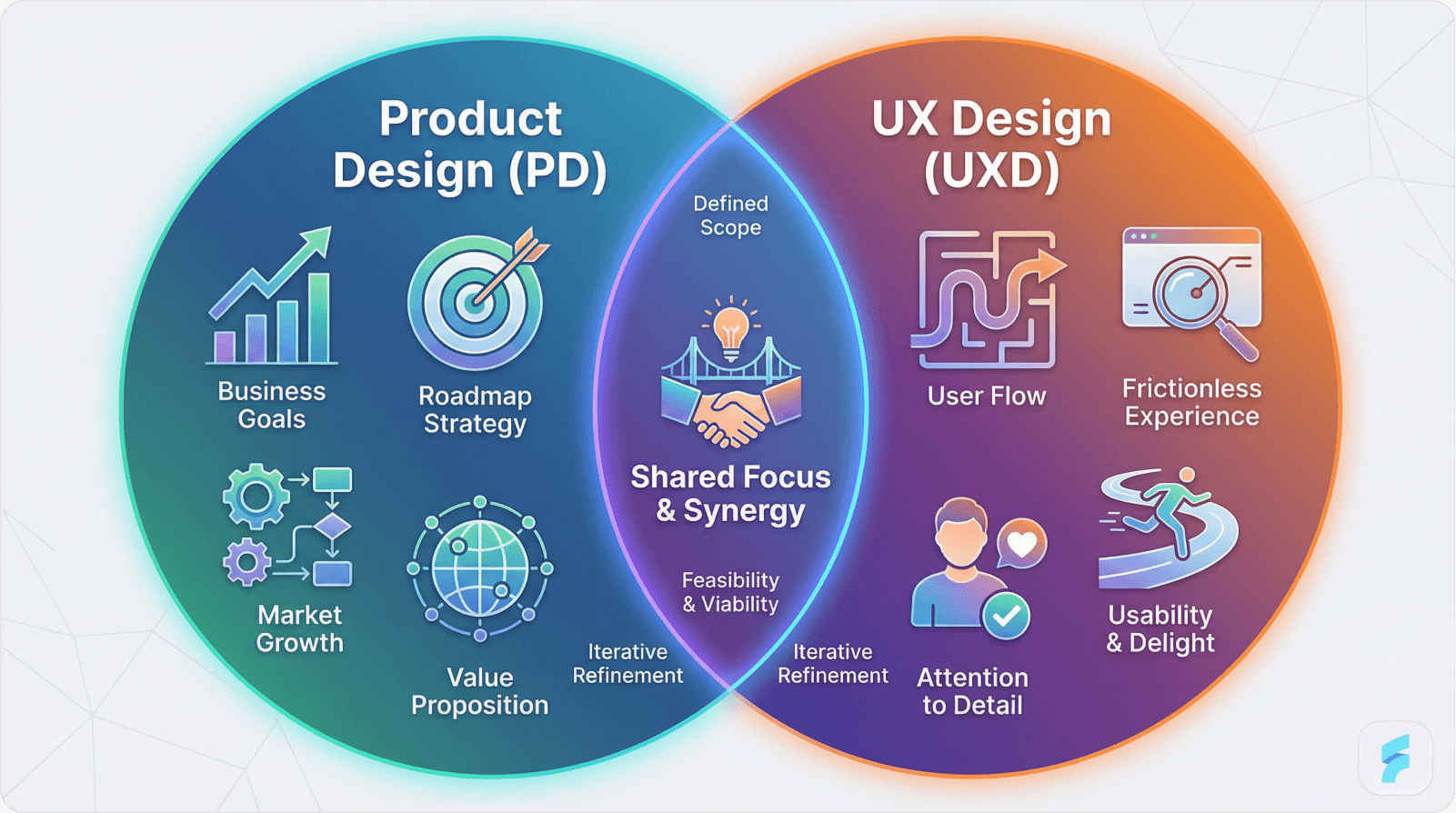
These allocation patterns reflect fundamentally different value propositions. Product designers function as strategic partners to product management, while UX designers serve as tactical execution specialists.
Decision-Making Authority and Scope
The authority gradient between these roles significantly impacts organizational dynamics. Harvard Business Review's analysis of high-performing product teams identifies decision rights as a key differentiator.
Product designers typically hold decision-making authority over:
Feature prioritization within design capacity constraints
Design system architecture and component libraries
User research methodology and insight synthesis
Cross-product experience consistency standards
Design-engineering trade-off negotiations
UX designers generally exercise authority within:
Specific feature interaction patterns and micro-interactions
Usability test planning and participant recruitment
Accessibility compliance implementation
A/B test variant design and hypothesis formation
Local optimization within established design frameworks
Dr. Julie Zhuo, former VP of Design at Facebook, notes:
"Product designers operate with strategic autonomy while UX designers operate with tactical autonomy—both are crucial, but they address different organizational needs."
Collaboration Models and Stakeholder Engagement
The stakeholder map differs substantially between these roles, affecting information flow and influence patterns within organizations.
Product designers engage regularly with:
Executive leadership on product vision
Product managers on roadmap prioritization
Engineering leads on technical feasibility
Marketing teams on go-to-market positioning
Customer success on user feedback synthesis
UX designers primarily collaborate with:
Individual feature teams on specific implementations
Engineering teams on interaction details
QA teams on edge case handling
Other designers on pattern library consistency
User researchers on testing protocols
According to McKinsey's research on design-led organizations, companies that structure these collaboration patterns effectively achieve 32% faster time-to-market and 56% higher employee satisfaction within design teams.
Skills Overlap and Distinctive Capabilities
While both roles share foundational design skills, their specialized capabilities diverge significantly. The Interaction Design Association's competency framework identifies these patterns:
Shared Core Competencies (90%+ overlap):
Visual design fundamentals and typography
Prototyping tools proficiency (Figma, Sketch, Adobe XD)
Basic user research techniques
Design thinking methodologies
Stakeholder presentation and communication
Product Designer Distinctive Skills:
Business model analysis and unit economics
Competitive intelligence and market positioning
Product roadmap development and prioritization
Cross-platform design strategy
Design system architecture at scale
UX Designer Distinctive Skills:
Advanced usability testing methodologies
Accessibility standards (WCAG, Section 508)
Behavioral psychology and cognitive load theory
Quantitative data analysis and statistics
Information architecture at component level
Research from IBM's Enterprise Design Thinking framework shows that organizations recognizing these distinctions reduce design-related project delays by 41% through appropriate role assignment.
Micro-Summary: Product designers and UX designers differ fundamentally in time allocation, decision authority, stakeholder engagement, and specialized skills. Product designers operate strategically with broad organizational influence, while UX designers optimize tactically with deep execution expertise. Understanding these distinctions prevents capability gaps and role ambiguity.

Hiring Decision Framework: Matching Role to Growth Stage
The optimal hiring sequence between product designers and UX designers correlates strongly with company stage, team size, and product maturity. Data from Y Combinator's Design Program provides clear guidance.
Pre-Product Market Fit (Seed to Series A)
Companies with fewer than 20 employees and unvalidated product-market fit require strategic flexibility over specialized optimization. Research from First Round Capital shows that 78% of successful early-stage startups hired product designers before specialized UX roles.
Why Product Design First:
During validation stages, companies need designers who can:
Rapidly test multiple product hypotheses
Pivot features based on market feedback
Work autonomously with minimal specialized support
Bridge communication gaps between founders and early engineers
A study by Andreessen Horowitz found that early-stage companies hiring product designers reached product-market fit 4.3 months faster on average than those hiring specialists prematurely.
The ideal first design hire profile: A product designer with 5-8 years of experience, ideally including early-stage startup exposure, capable of establishing foundational design systems while maintaining strategic agility.
Post-PMF Scaling (Series A to Series B)
Once product-market fit is validated and the company reaches 20-100 employees, specialization becomes valuable. According to OpenView Partners' benchmarking data, this inflection point typically occurs between $3M-$15M ARR.
The Case for UX Specialization:
As user bases expand, systematic friction points emerge that require dedicated attention. Metrics indicating UX hiring urgency include:
Activation rates declining despite feature additions
Support ticket volume growing faster than user base
Trial-to-paid conversion stagnating
Feature adoption rates below 30% after 90 days
Mobile NPS trailing web NPS by more than 10 points
Intercom's Product Strategy Group research shows that companies adding specialized UX designers during this phase improve activation rates by 23% within six months while maintaining feature velocity.
The Dual-Track Approach:
Many successful SaaS companies at this stage employ both roles:
1-2 product designers focused on new feature development and strategic initiatives
1 UX designer dedicated to optimizing existing flows and reducing friction
This structure, validated by data from Sequoia's portfolio companies, allows strategic innovation while systematically improving core user experiences.
Expansion and Platform Phase (Series B+)
Companies exceeding 100 employees and $15M ARR typically build specialized design teams with clear role delineation. According to Battery Ventures' research, optimal team composition at this stage includes:
Product designers: 40-50% of design team
UX designers: 30-40% of design team
Design system specialists: 10-15% of design team
User researchers: 10% of design team
Atlassian's Head of Design Research, Dr. Maria Giudice, states:
"At scale, design specialization isn't optional—it's the only way to maintain quality while increasing output."
Structural Considerations for Enterprise SaaS:
Companies building enterprise products face unique constraints:
Longer sales cycles requiring more sophisticated product positioning
Complex permission systems and role-based access patterns
Integration requirements with existing enterprise tools
Accessibility and compliance obligations (SOC 2, GDPR, HIPAA)
These factors favor earlier investment in specialized UX design, particularly around enterprise-specific patterns like advanced filtering, bulk operations, and administrative workflows.
Explore comprehensive product design services tailored to your growth stage.
Budget Allocation Guidelines
Compensation data from Levels.fyi and Carta's benchmarking platform reveals important cost considerations:
Market Rate Ranges (US, 2024):
Product Designer (5-8 years): $140K-$190K base
Senior Product Designer (8-12 years): $180K-$240K base
UX Designer (5-8 years): $120K-$160K base
Senior UX Designer (8-12 years): $150K-$200K base
Budget-constrained startups should note that product designers command 15-25% premiums due to their broader skill sets and strategic capabilities.
Micro-Summary: Hiring sequence should match growth stage—product designers first for pre-PMF companies, specialized UX designers during scaling, and balanced teams post-Series B. Stage, budget, and product complexity all influence optimal team composition, with strategic needs taking precedence early and optimization specialization emerging later.
Team Structures That Actually Work
Design team organization dramatically impacts velocity, quality, and designer satisfaction. Research from the Nielsen Norman Group's Design Operations study identifies three dominant models.
The Centralized Design Team Model
In this structure, all designers report to a single design leader who allocates resources across product initiatives. This model dominates early-stage companies (70% prevalence below 50 employees) and mature enterprises maintaining design consistency across multiple products.
Advantages of Centralization:
Consistent design language across products
Efficient resource allocation based on priority
Strong design culture and skill development
Clear career progression pathways
Centralized design system governance
Disadvantages:
Potential disconnect from product strategy
Slower decision-making due to approval layers
Risk of designers becoming "order takers"
Limited product domain expertise development
Spotify's former VP of Design, Rochelle King, notes: "Centralized design works beautifully until the organization reaches about 200 people—then the coordination overhead becomes prohibitive."
Data from DesignOps Handbook shows centralized teams achieve 15% higher design consistency scores but 22% slower feature delivery compared to embedded models.
The Embedded Designer Model
Embedded structures place designers directly within cross-functional product teams, reporting to product or engineering leadership with dotted-line reporting to design leadership.
This model dominates mid-stage companies (65% prevalence at 100-500 employees) and organizations prioritizing velocity over consistency.
Advantages of Embedding:
Deep product domain knowledge development
Faster decision-making and reduced approval cycles
Stronger relationships with engineering and product
Higher designer agency and autonomy
Better alignment with product metrics and goals
Disadvantages:
Design language fragmentation across teams
Reduced collaboration between designers
Inconsistent quality standards
Difficult career development for designers
Duplicated effort across teams
Research from Pragmatic Institute shows embedded designers ship features 31% faster but require 40% more design system remediation work to maintain consistency.
The Hybrid Matrix Model
Sophisticated organizations often employ hybrid structures where designers are embedded in product teams while maintaining strong connections to centralized design leadership.
This model becomes prevalent post-Series B (55% of companies above 500 employees adopt variants of this approach) and requires mature design leadership to execute effectively.
Key Characteristics:
Designers physically sit with product teams
Design leadership maintains influence over hiring, promotion, and skill development
Regular design team syncs maintain cultural cohesion
Centralized design systems team supports embedded designers
Clear escalation paths for design quality issues
Airbnb's design team structure, detailed by VP of Design Alex Schleifer, demonstrates this model: "Our designers are full members of product teams but we invest heavily in design community building and centralized craft elevation."
According to InVision's Design Maturity research, hybrid models achieve 24% higher designer satisfaction scores and 18% better design quality ratings compared to pure centralized or embedded approaches.
Role Distribution Within Teams
Regardless of organizational structure, successful design teams maintain specific role ratios validated by industry benchmarking:
Recommended Designer-to-Engineer Ratios:
Early stage (pre-PMF): 1 designer per 6-8 engineers
Growth stage (post-PMF): 1 designer per 8-10 engineers
Enterprise stage: 1 designer per 10-12 engineers
These ratios, sourced from Sequoia Capital's talent benchmarking data, balance design quality with operational efficiency.
Product Designer to UX Designer Ratios:
Seed to Series A: 100% product designers (1-2 total)
Series A to Series B: 60% product, 40% UX (3-7 total)
Series B+: 50% product, 35% UX, 15% specialists (8+ total)
Cross-Functional Collaboration Patterns
High-performing design teams establish clear interaction protocols with adjacent functions. Research from McKinsey's design practice identifies these critical patterns:
Design-Product Management Interface:
Weekly strategic alignment sessions
Shared ownership of roadmap prioritization
Joint customer research participation
Collaborative OKR definition
Mutual veto rights on major feature decisions
Design-Engineering Interface:
Embedded attendance at sprint planning
Design system component library maintenance
Regular technical feasibility consultations
Pair design-development on complex interactions
Shared on-call rotation for design bug fixes
Google's HEART framework for measuring UX demonstrates how design-engineering collaboration directly impacts user success metrics when structured appropriately.
Micro-Summary: Team structure significantly impacts design effectiveness. Centralized models optimize consistency, embedded models prioritize velocity, and hybrid models balance both. Role ratios and collaboration patterns should evolve with company stage, with clear interfaces between design, product, and engineering functions established early.
Real-World Application: When Each Role Drives Value
Examining specific scenarios illuminates when product designers versus UX designers deliver maximum impact. These examples, derived from case studies across SaaS verticals, provide actionable guidance.
Scenario 1: Building a New Product Line
A B2B analytics platform at $8M ARR decides to launch a customer data platform (CDP) as a second product line, targeting a different buyer persona and use case.
Why Product Design Leads:
This scenario requires:
Market research to validate CDP positioning
Competitive analysis of existing CDP solutions
Information architecture for complex data modeling interfaces
Integration strategy with existing analytics product
Go-to-market collaboration with sales and marketing
A product designer can orchestrate the complete launch, from concept validation through beta release. According to research from Product Coalition, new product lines led by product designers achieve 47% higher Day 30 retention compared to those designed without strategic design involvement.
The product designer would:
Conduct 15-20 customer discovery interviews
Build low-fidelity prototypes for market testing
Design the core workflow and primary user journeys
Establish design principles for the new product line
Collaborate with engineering on technical architecture
Define success metrics and instrumentation requirements
ROI Expectation: Product designer investment yields 3-4x return through faster time-to-market, higher initial retention, and reduced post-launch iteration cycles.
Scenario 2: Optimizing Onboarding Conversion
A project management SaaS at $15M ARR experiences stagnant trial-to-paid conversion (18%) despite strong product-market fit and high user engagement post-activation.
Why UX Design Leads:
This scenario requires:
Systematic friction point identification through user testing
Funnel analysis to identify specific drop-off points
A/B testing of alternative onboarding flows
Micro-interaction optimization in critical workflows
Accessibility improvements for broader user success
A UX designer applies systematic methodologies to diagnose and resolve conversion barriers. Research from Reforge's Growth Series shows that focused UX optimization projects improve conversion by 25-40% within 8-12 weeks.
The UX designer would:
Conduct moderated usability tests with 12-15 trial users
Analyze session recordings to identify confusion patterns
Map the complete onboarding journey with friction scoring
Design and test 3-4 alternative onboarding variants
Optimize form fields, microcopy, and interaction patterns
Implement progressive disclosure to reduce cognitive load
ROI Expectation: UX designer investment yields 8-12x return through improved conversion economics without engineering-intensive feature development.
For comprehensive onboarding optimization, consider professional UX audit services that identify high-impact improvements.
Scenario 3: Platform Migration and Redesign
An enterprise SaaS company at $45M ARR plans a complete platform migration from legacy architecture to a modern tech stack, requiring UI modernization across 50+ screens.
Why Both Roles Working in Tandem:
This scenario demands:
Strategic information architecture redesign (Product Designer)
Systematic usability improvement across all workflows (UX Designer)
Design system creation for long-term consistency (Both)
Change management for existing user base (Product Designer)
Detailed interaction pattern documentation (UX Designer)
According to research from Forrester, large-scale migration projects with dedicated product and UX design resources achieve 51% higher user satisfaction scores post-launch compared to engineering-led migrations.
Division of Responsibilities:
Product Designer owns:
Overall platform vision and design strategy
Information architecture and navigation system redesign
Cross-product consistency and design system architecture
Stakeholder management and executive communication
Phased rollout strategy and change management planning
UX Designer owns:
Screen-by-screen usability optimization
Detailed interaction pattern design and documentation
Usability testing across all major workflows
Accessibility compliance verification
Edge case handling and error state design
Scenario 4: Mobile Application Development
A desktop-first SaaS at $20M ARR decides to launch iOS and Android applications after customer requests indicate mobile access as a top feature request.
Why Product Design Leads Initially, UX Follows:
Mobile application development requires strategic decisions about feature scope, navigation patterns, and cross-platform consistency—all product design strengths.
The product designer would:
Define mobile-first use cases and core feature set
Design platform-specific navigation patterns (iOS vs Android)
Establish mobile design system and component library
Coordinate with engineering on offline functionality
Plan synchronization strategy with web application
Once core mobile experiences are established, UX design becomes critical for:
Touch target optimization and gesture design
Mobile-specific usability testing
Performance optimization for various device types
Accessibility for mobile screen readers
Context-aware design for mobile usage patterns
Research from App Annie shows mobile applications with dedicated UX optimization achieve 34% higher retention at Day 30 compared to direct web-to-mobile ports.
Micro-Summary: Product designers drive maximum value when building new products, entering new markets, or making strategic architectural decisions. UX designers deliver highest impact when optimizing established products, improving conversion funnels, or reducing systematic friction. Complex initiatives often benefit from both roles working in carefully orchestrated collaboration.
The Financial Case: Design Investment ROI
Understanding the return on design investment helps justify hiring decisions and set appropriate expectations. Research from the Design Management Institute provides rigorous quantitative evidence.
Quantifiable Impact Metrics
The Design Value Index, tracking design-led companies over 10 years, reveals that organizations with strong design practices outperform the S&P 500 by 219%. While correlation doesn't equal causation, additional research isolates specific design contributions.
Product Design ROI Indicators:
McKinsey's research on design impact identifies measurable outcomes from product design investment:
32% higher revenue growth compared to industry peers
56% higher total shareholder returns over five-year periods
41% faster time-to-market for new products
28% reduction in development costs through better upfront planning
For a $10M ARR SaaS company hiring a senior product designer at $180K total compensation, the expected first-year impact includes:
2-3 successful feature launches (vs 1-2 without dedicated design)
15-20% improvement in feature adoption rates
$250K-$500K in incremental ARR through better positioning and UX
UX Design ROI Indicators:
Forrester's Total Economic Impact studies on UX design investment demonstrate specific returns:
$100 returned for every $1 invested in UX (10,000% ROI)
50% reduction in development rework through usability testing
65% decrease in user error rates after systematic optimization
83% increase in conversion rates for optimized funnels
For the same $10M ARR company hiring a senior UX designer at $150K total compensation, expected first-year impact includes:
20-30% improvement in key conversion funnels
$200K-$400K in incremental ARR through conversion optimization
25-35% reduction in support ticket volume
15-20 high-impact improvements to existing features
Opportunity Cost Considerations
Beyond direct financial returns, design investment prevents costly mistakes and competitive erosion. Research from Pragmatic Institute quantifies these hidden costs:
Cost of Poor Product Design:
$500K-$2M wasted on building features users don't need
6-12 month delays in achieving product-market fit
30-40% higher customer acquisition costs due to poor positioning
Competitive vulnerability during extended build-iterate cycles
Cost of Poor UX Design:
35-45% higher customer churn due to activation failures
$100K-$300K annually in support costs for confusing workflows
25-30% lower feature adoption despite engineering investment
Brand damage and negative word-of-mouth from frustrated users
Dr. Susan Weinschenk, behavioral psychologist and author, notes:
"Organizations often calculate design hiring costs but ignore the compounding costs of design debt—which grows exponentially if left unaddressed."
Scaling Economics and Design Leverage
As companies grow, design leverage increases non-linearly. Research from InVision's Design Maturity Model shows:
Design Impact by Company Stage:
$1-5M ARR: Design contributes 15-20% of value creation
$5-25M ARR: Design contributes 25-35% of value creation
$25M+ ARR: Design contributes 30-45% of value creation
This escalating impact occurs because design decisions at scale affect more users, more revenue, and more downstream dependencies.
A design system improvement at a $50M ARR company might:
Impact 500,000 active users simultaneously
Reduce engineering maintenance costs by $400K annually
Accelerate feature development by 20-30%
Improve brand consistency across 15+ products
Investment Timing and Compounding Returns
Like technical debt, design debt compounds over time. Companies delaying design investment face steeper remediation costs later.
According to research from the Standish Group:
Design changes in concept phase cost $1
Design changes in development phase cost $10
Design changes post-launch cost $100
Design changes after user habits form cost $1,000
This 1:10:100:1,000 ratio explains why early-stage design investment delivers disproportionate returns despite higher upfront costs.
Micro-Summary: Design investment delivers measurable ROI ranging from 10,000% for UX optimization to 219% outperformance for design-led companies. Product design prevents costly strategic errors while UX design improves conversion economics. Design impact scales non-linearly with company growth, making early investment especially valuable due to compounding returns and avoided design debt.
Common Hiring Mistakes and How to Avoid Them
Even sophisticated companies make predictable errors when building design teams. Understanding these patterns prevents costly missteps.
Mistake 1: Hiring UX Designers Before Product Designers
Approximately 40% of early-stage startups make this error, according to First Round Capital's post-mortem analysis. The symptoms include:
Beautiful interfaces that don't address market needs
High-fidelity designs without strategic validation
Designer frustration due to lack of product clarity
Repeated design rework as strategy evolves
Misalignment between design output and business goals
Why This Happens: Founders often prioritize "making things look good" over strategic design thinking, especially when coming from technical backgrounds.
The Fix: For companies pre-PMF or below $3M ARR, prioritize product design hiring. If budget allows only one designer, hire a product designer with strong visual skills rather than a specialized UX designer.
Mistake 2: Expecting One Designer to Fill Both Roles
Job descriptions requiring "product designer with deep UX specialization" or "UX designer with product strategy skills" proliferate despite being fundamentally contradictory. Research from Glassdoor shows these "unicorn" postings receive 47% fewer qualified applicants.
Why This Happens: Budget constraints and misunderstanding of role specialization lead companies to seek impossible combinations.
The Fix: Accept that exceptional product designers have adequate (not exceptional) UX skills and vice versa. Hire for the primary need, then supplement with contractors or junior roles for secondary needs.
Julie Zhuo, author of "The Making of a Manager," advises: "Hire for the 80% need, not the 20% gap. That gap is where specialists, freelancers, or future hires belong."
Mistake 3: Ignoring Design Leadership Until Too Late
Companies often hire 4-6 individual contributor designers before establishing design leadership, creating coordination chaos and quality inconsistency. Data from IDEO's organizational research shows this threshold emerges around 3-4 designers.
Why This Happens: Design leadership costs more than IC designers, and early-stage companies defer the expense.
The Fix: Hire a design leader (Design Manager, Director of Design, or Head of Design) once reaching 3-4 designers or $10-15M ARR, whichever comes first.
The design leader should:
Own design hiring and team building
Establish design systems and standards
Manage design-product-engineering interfaces
Develop designer career paths and skill development
Represent design in executive decision-making
Mistake 4: Unclear Success Metrics for Design Roles
Many companies hire designers without defining how success will be measured, leading to misaligned expectations and performance issues. Research from Lattice shows design roles have 35% higher rates of "unmet expectations" compared to engineering roles.
Why This Happens: Design impact feels subjective, and companies struggle to establish clear metrics.
The Fix: Define role-specific OKRs during hiring:
Product Designer OKRs:
Successfully launch X new features with >Y% adoption within 90 days
Achieve Z% improvement in core conversion funnels
Maintain <W% engineering rework rate on designed features
Contribute X user research insights per quarter
UX Designer OKRs:
Improve specific funnel conversion by X%
Reduce support tickets related to UX issues by Y%
Complete Z usability tests and implement findings
Achieve W% accessibility compliance across product
Mistake 5: Neglecting Portfolio Quality Over Process
Companies often hire based on impressive visual portfolios while ignoring process rigor, leading to designers who create beautiful but strategically misaligned work.
Why This Happens: Visual portfolios are easy to evaluate while design thinking is harder to assess.
The Fix: Structure interviews to evaluate:
How candidates approach problem definition (not just solution creation)
Their research methodology and user insight synthesis
How they handle constraints and trade-offs
Collaboration and communication patterns
How they measure success and iterate
Ask candidates to present case studies emphasizing process over final deliverables. According to research from Toptal, process-focused interviewing reduces mis-hires by 58%.
Micro-Summary: Common hiring mistakes include premature UX specialization, seeking unicorn candidates, delaying design leadership, lacking success metrics, and over-indexing on visual portfolios. Avoiding these errors requires matching role to stage, accepting specialization trade-offs, establishing leadership early, defining clear metrics, and evaluating process rigor alongside visual craft.
Building Effective Design-Product Partnerships
The relationship between design and product management determines execution velocity and quality. Research from Marty Cagan's Silicon Valley Product Group identifies partnership models that work.
The Collaborative Discovery Model
In high-performing product organizations, designers and product managers work as true partners during discovery phases, before engineering involvement. This model, prevalent in companies like Stripe, Figma, and Notion, dramatically improves feature success rates.
Key Characteristics:
Joint ownership of user research and problem definition
Parallel exploration of customer needs and technical feasibility
Shared accountability for feature success metrics
Co-creation of roadmap priorities and timing
Mutual veto power over half-baked ideas
Research from Teresa Torres, product discovery coach, shows collaborative discovery reduces failed features by 64% compared to sequential handoff models.
Practical Implementation:
Weekly design-product sync meetings with structured agendas:
Review customer feedback and support ticket trends (15 min)
Discuss research findings and emerging insights (20 min)
Align on upcoming roadmap priorities (15 min)
Address cross-functional dependencies (10 min)
Bi-weekly user research sessions attended by both design and product, ensuring shared context and insight interpretation.
The Design Sprint Methodology
Google Ventures' Design Sprint framework provides structured collaboration for solving specific problems in compressed timeframes. Over 500 companies have documented success with this approach, according to Jake Knapp's research.
Design Sprint Structure:
Monday: Map the problem and choose target
Tuesday: Sketch competing solutions
Wednesday: Decide on best solution
Thursday: Build high-fidelity prototype
Friday: Test with target users
The key innovation: Forcing design-product-engineering alignment through structured co-creation rather than sequential handoffs.
Companies using regular design sprints (monthly or quarterly) report:
45% faster time-to-decision on complex problems
38% higher confidence in solution direction
52% reduction in post-launch iteration cycles
Decision Rights and Escalation Paths
Ambiguity about who decides what creates friction in design-product relationships. Successful organizations establish clear decision frameworks inspired by RACI models (Responsible, Accountable, Consulted, Informed).
Product Manager Primary Decision Areas:
Feature prioritization and roadmap sequencing
Resource allocation across competing initiatives
Go-to-market timing and launch strategy
Success metrics and instrumentation requirements
Trade-off decisions when facing constraints
Product Designer Primary Decision Areas:
Design system architecture and component design
User research methodology and insight synthesis
Interaction patterns and information architecture
Visual language and design consistency standards
Usability testing approach and participant selection
Joint Decision Areas (requiring consensus):
Problem definition and opportunity sizing
Feature scope and MVP definition
User journey and experience flow
A/B testing strategy and variant design
Post-launch iteration priorities
When disagreements arise, effective teams use structured escalation:
Design and PM attempt resolution through discussion (80% of cases resolve here)
Present both perspectives to broader team for input (15% of cases)
Escalate to design leadership and product leadership jointly (4% of cases)
Elevate to executive level with joint recommendation (1% of cases)
Communication Patterns That Build Trust
Research from Google's Project Aristotle on team effectiveness identifies psychological safety as the single strongest predictor of high performance. For design-product partnerships, this translates to specific communication behaviors.
High-Trust Behaviors:
Sharing work-in-progress early, before polish
Admitting uncertainty or knowledge gaps openly
Challenging ideas respectfully without attacking individuals
Assuming positive intent when disagreements emerge
Celebrating wins jointly and owning failures together
Atlassian's Team Playbook recommends regular "health monitor" check-ins where design-product pairs evaluate their working relationship across dimensions like:
Shared understanding of priorities (1-5 scale)
Communication frequency and quality (1-5 scale)
Balanced decision-making participation (1-5 scale)
Psychological safety and trust (1-5 scale)
Teams scoring below 3.5 on any dimension schedule dedicated time to address the gap.
Micro-Summary: Effective design-product partnerships require collaborative discovery, structured decision rights, clear escalation paths, and trust-building communication patterns. Joint ownership of problem definition, parallel exploration, and shared accountability for outcomes characterize high-performing partnerships, while sequential handoffs and ambiguous decision rights undermine effectiveness.
The Future of Design Roles in SaaS
Design role evolution accelerates as AI, automation, and market maturity reshape expectations. Understanding emerging trends helps future-proof hiring strategies.
AI-Augmented Design and Changing Skill Demands
Generative AI tools like Midjourney, Stable Diffusion, and GPT-4 already automate significant portions of traditional design work. Research from Adobe's Future of Creativity report indicates:
60% of visual design tasks become AI-automatable by 2026
35% of UX research and testing processes leverage AI assistance
25% of code implementation occurs through AI-human collaboration
What This Means for Design Roles:
Product designers increasingly focus on:
AI prompt engineering and output curation
Strategic design decisions requiring business context
Complex problem framing and opportunity identification
Cross-functional orchestration and stakeholder management
UX designers shift toward:
AI-assisted usability testing and insight synthesis
Specialized accessibility and inclusive design
Behavioral psychology application and cognitive load optimization
Ethical AI interaction design and bias mitigation
Dr. Ben Shneiderman, pioneer in human-computer interaction, predicts:
"Designers who master AI collaboration will be 10x more productive than those who resist it, similar to how CAD software transformed architecture."
The Rise of Specialized Design Roles
As products mature and companies scale, design specialization continues to fragment. Emerging specialized roles include:
Conversation Designers: Focusing on chatbot interactions, voice interfaces, and AI agent experiences. According to Nielsen Norman Group, companies with dedicated conversation designers achieve 43% higher AI feature satisfaction.
Design System Designers: Dedicated to component libraries, design tokens, and cross-platform consistency. Research from InVision shows mature design systems reduce feature development time by 34%.
Accessibility Specialists: Ensuring WCAG compliance and inclusive design practices. With increasing regulatory pressure, companies like Microsoft and Salesforce now employ dedicated accessibility design teams.
Growth Designers: Blending UX design with conversion optimization, experimentation, and growth marketing. Reforge's Growth Series data shows companies with dedicated growth design roles achieve 28% higher activation rates.
Design Ops Managers: Managing design tools, workflows, processes, and team efficiency. Nielsen Norman Group research indicates mature DesignOps practices improve designer productivity by 40%.
Platform Design Evolution
The proliferation of platforms creates new design challenges requiring specialized knowledge:
Multi-device design: Spanning web, mobile, tablet, watch, and emerging AR/VR interfaces
API-first design: Creating developer-facing experiences and documentation
Integration design: Orchestrating experiences across Zapier, webhooks, and partner ecosystems
AI-native design: Embedding intelligence throughout products rather than as separate features
Companies like Figma, Notion, and Airtable demonstrate how platform thinking changes design requirements—favoring product designers who understand technical architecture over UX specialists focused on individual touchpoints.
Compensation Trends and Market Dynamics
Design talent markets continue evolving. Data from levels.fyi and Glassdoor reveals:
2024-2025 Trends:
Product designer salaries increasing 8-12% year-over-year
UX designer salaries growing 5-7% year-over-year
Specialized roles (growth design, design systems) commanding 15-25% premiums
Remote design roles equalizing compensation across geographies
The widening gap between product designer and UX designer compensation reflects market recognition of strategic value versus execution specialization.
Market Saturation in Junior Roles:
Entry-level design roles face increasing competition, with bootcamp graduates and career switchers flooding the market. According to LinkedIn's 2024 Workforce Report:
340% increase in design bootcamp graduates since 2020
120% growth in applications per junior design role
35% decrease in entry-level design hiring rates
This creates a "barbell" market where:
Senior designers (7+ years) remain in high demand with multiple opportunities
Junior designers (0-3 years) face significant competition and fewer opportunities
Mid-level designers (3-7 years) represent the optimal hiring sweet spot
Geographic Distribution and Remote Work
Remote-first design work fundamentally alters hiring strategies. Research from GitLab's Remote Work Report shows:
72% of design roles now available remotely (up from 34% in 2019)
45% of companies hire designers outside their headquarters' timezone
28% of design teams operate fully distributed with no central office
For growing SaaS companies, this creates opportunities:
Access to global talent pools without relocation
20-40% compensation savings hiring in lower-cost regions
Ability to maintain 24-hour design coverage across timezones
However, distributed design teams face challenges:
Reduced spontaneous collaboration and creative brainstorming
Timezone coordination complexity for synchronous activities
Onboarding friction for new designers joining remotely
Design culture maintenance without physical co-location
Micro-Summary: Design roles continue fragmenting into specialized functions as AI automates routine tasks and products increase in complexity. Product designers focus increasingly on strategy while UX designers specialize in specific domains like accessibility or growth. Remote work expands talent pools but creates new coordination challenges. Senior designers remain in high demand while junior roles face market saturation.
Implementation Guide: Your Next Steps
Translating insights into action requires systematic planning. This framework guides design team building regardless of current stage.
For Pre-PMF Companies (Seed Stage, <$1M ARR)
Immediate Actions:
Hire one senior product designer (5-8 years experience) as your first design role
Establish basic design tools (Figma, Miro, Maze for testing)
Involve the designer in customer development interviews from day one
Set clear expectations: focus on speed and learning over polish
Allocate 60% designer time to new feature development, 40% to research
Success Metrics:
Feature launch velocity (target: 1-2 significant features per month)
Research insights generated (target: 5-10 validated insights per quarter)
Design-engineering collaboration quality (qualitative assessment)
Red Flags to Watch:
Designer creating high-fidelity mockups without user validation
Significant rework cycles indicating insufficient upfront research
Designer frustrated by lack of strategic clarity (sign of process gap)
For Post-PMF Growth Companies (Series A-B, $1M-$15M ARR)
Immediate Actions:
Audit current design capabilities using the framework above
Identify your critical need: strategic design (hire product designer) or optimization (hire UX designer)
If you already have 2+ designers, hire or promote a design lead
Establish design-product collaboration rhythms (weekly syncs, bi-weekly research)
Implement basic design systems to improve consistency
Success Metrics:
Feature adoption rates (target: >40% of users trying new features within 30 days)
Conversion funnel performance (target: 10-20% improvement on key funnels)
Design quality consistency (qualitative assessment via user testing)
Designer satisfaction and retention (target: >4.0/5.0 on engagement surveys)
Common Challenges:
Tension between feature velocity and design quality (requires explicit trade-off discussions)
Unclear design-product decision rights (implement decision framework from earlier section)
Design system adoption lag by engineering (requires dedicated eng-design pairing)
For Scaling Companies (Series B+, $15M+ ARR)
Immediate Actions:
Build balanced design team: 50% product designers, 35% UX designers, 15% specialists
Establish design leadership reporting directly to product or executive leadership
Invest in design operations (DesignOps) to manage tools, processes, workflows
Create specialized tracks: design systems, research, strategy, craft
Implement design maturity assessment using InVision's model
Success Metrics:
Design system adoption (target: >80% of components from shared library)
Design-contributed revenue impact (track designs' influence on conversion, adoption, retention)
Designer productivity (target: reduction in time-to-first-user-test by 30%)
Cross-functional collaboration effectiveness (NPS from product and engineering teams)
Strategic Considerations:
Whether to centralize or embed designers (or hybrid approach)
Design headcount planning in ratio to engineering headcount
Design career ladder and compensation framework
Design voice in executive strategy and decision-making
The 30-60-90 Day Design Onboarding Plan
Effective designer onboarding accelerates impact and reduces early attrition. Research from Sapling HR shows structured onboarding improves 12-month retention by 58%.
First 30 Days - Immersion:
Customer research: sit in on 10-15 customer calls or interviews
Product deep-dive: use the product extensively, identify friction points
Competitive analysis: evaluate 5-7 competitor products
Stakeholder interviews: meet key partners in product, engineering, marketing
Documentation review: study existing research, designs, roadmap
Quick wins: ship 2-3 small improvements to build credibility
Days 31-60 - Contribution:
Own first significant feature: lead design from concept to launch
Conduct independent research: run 3-5 user tests or interviews
Establish workflows: define how you'll collaborate with product and engineering
Design system contribution: add components or improve existing patterns
Present findings: share research insights with broader team
Days 61-90 - Integration:
Strategic input: contribute to roadmap planning and prioritization
Mentorship: begin supporting junior designers if applicable
Process improvement: identify and implement one process enhancement
Metrics baseline: establish success metrics for your role
Reflection: document lessons learned and areas for growth
Budget Planning for Design Team Growth
CFOs and finance teams require clear budget models for design hiring. Use this framework for annual planning:
Fully-Loaded Cost Per Designer:
Base salary: per market rates above
Benefits: 20-30% of base (healthcare, 401k, etc.)
Tools and software: $3-5K per designer annually (Figma, Miro, UserTesting, etc.)
Equipment: $2-3K per designer (laptop, monitor, peripherals)
Recruiting: 20-25% of base salary (one-time per hire)
Training and development: $2-5K per designer annually
Total Loaded Cost Example (Senior Product Designer, $180K base):
Base: $180,000
Benefits (25%): $45,000
Tools: $4,000
Equipment (amortized): $1,000
Training: $3,000
Total: ~$233,000 first year (subsequent years: ~$233K minus recruitment)
Hiring Velocity Targets: Based on company growth rates and designer-to-engineer ratios:
30% YoY growth: Add 1 designer per year (small base)
100% YoY growth: Add 2-3 designers per year
200%+ YoY growth: Add 4-6 designers per year
Plan 3-4 months lead time from requisition approval to hired designer starting work.
Micro-Summary: Implementation requires stage-appropriate actions, clear metrics, structured onboarding, and realistic budget planning. Pre-PMF companies should hire one senior product designer, growth companies should balance product and UX roles, and scaling companies should build specialized teams with dedicated leadership. Proper planning includes fully-loaded cost modeling and 3-4 month hiring lead times.
Glossary: Enterprise UX Terminology
Activation Milestone: A specific user action or set of actions indicating successful onboarding and initial value realization. Examples include completing first workflow, inviting team members, or generating first report. Activation typically measured within 7-14 days for enterprise SaaS.
Activity Stream: Chronological display of actions, updates, and changes within a system, showing who did what to which objects when. Essential for collaboration transparency in enterprise applications. Reduces status update meetings by 42% and clarification questions by 64% when implemented with clear actors, actions, and smart timestamps.
Adaptive Interface: User interface that dynamically adjusts layout, density, feature prominence, or information display based on usage patterns, preferences, or context. AI-powered adaptive interfaces improve task efficiency by 28% for frequent users by learning individual workflows and priorities.
Approval Workflow: Multi-stage process requiring authorization from designated stakeholders before completing actions. Common in enterprise software due to compliance, risk management, and governance requirements. Dedicated approval interfaces reduce cycle time by 47% compared to email-based approvals.
Bulk Operations: Ability to perform actions on multiple records simultaneously through multi-select, filtered operations, or spreadsheet-style editing. Essential for enterprise productivity—64% of enterprise workflows involve bulk operations on 10+ items. Well-designed bulk interfaces reduce time-to-complete by 72% for operations affecting 50+ records.
Cognitive Load: Mental effort required to use an interface or complete a task. Enterprise applications must carefully manage cognitive load through progressive disclosure, information hierarchy, and familiar patterns to avoid overwhelming users, particularly those accessing the system infrequently.
Command Palette: Keyboard-driven interface (typically invoked via Cmd/Ctrl+K) providing searchable access to all application functions and navigation. Power user favorite—34% of power users invoke 15+ times daily. Fuzzy search, contextual actions, and keyboard-only operation enable 4.2x faster navigation than mouse-driven alternatives.
Contextual Sidebar: Panel displaying detailed information about selected objects without navigating away from list views. Reduces context switching and click overhead. Keyboard-accessible sidebars increase usage by 67% among power users. Inline editing within sidebars reduces clicks by 73% for property updates.
Cross-Device Continuity: Ability to begin tasks on one device and seamlessly continue on another. Critical for enterprise users—67% of workflows span multiple devices. Implementation methods include cloud state synchronization, smart handoff notifications, URL-based state encoding, and email-to-self patterns.
Design System: Comprehensive collection of reusable components, patterns, design tokens, documentation, and governance ensuring consistency across enterprise applications. Mature systems reduce development time by 34%, prevent 62% of implementation errors, and improve consistency by 71% through design tokens.
Design Tokens: Platform-agnostic design variables (colors, spacing, typography, shadows, border-radius, animation timing) enabling cross-platform consistency. Named semantically (color-primary-500, spacing-lg) rather than hard-coded values (#3B82F6, 16px). Design tokens reduce platform-specific inconsistencies by 71%.
Faceted Filtering: Multi-dimensional filtering allowing users to refine datasets by selecting values across independent filter categories that can be combined. Reduces time-to-find by 54% in complex datasets. Essential for enterprise applications with rich data requiring precise querying without SQL knowledge.
Friction Point: Any interface element, interaction pattern, or workflow step impeding user progress toward goals. Examples: confusing navigation, excessive form fields, unclear error messages, slow performance, inconsistent patterns. UX design systematically identifies and eliminates friction through testing, analytics, and heuristic evaluation.
Heuristic Evaluation: Usability inspection method where evaluators examine interfaces against established principles: system status visibility, real-world match, user control, consistency, error prevention, recognition over recall, flexibility, aesthetic minimalism, error recovery, and documentation. Reduces user error rates by 67% when applied systematically.
Information Architecture (IA): Structural design of information organization, categorization, navigation, labeling, and search within applications. Good IA enables users to find information efficiently, build accurate mental models, and navigate without getting lost. Critical for enterprise applications with extensive feature sets.
Information Scent: Cues helping users predict whether links, categories, or interface elements will lead toward their goals. Strong scent (descriptive labels, clear hierarchy, logical grouping) reduces exploration overhead. Weak scent forces trial-and-error navigation, reducing efficiency by 52%.
Inline Expansion: Interaction pattern revealing additional details on demand within existing interface context through expandable rows, collapsible sections, or progressive disclosure panels. Reduces clicks by 47% while maintaining scanability. Preferred for supplementary information that only some users need.
Interaction Cost: Sum of mental and physical effort required to accomplish goals, measured in clicks, scrolls, page loads, form fields, reading time, cognitive decisions, and context switches. Each additional form field reduces mobile conversion by 4.3%. Lower interaction cost improves completion rates and satisfaction.
Keyboard Navigation: Ability to operate application entirely via keyboard without mouse/trackpad. Essential for accessibility (motor disabilities), power user efficiency (64% productivity gain with shortcuts), and enterprise contexts. Requires logical tab order, visible focus indicators, skip links, and no keyboard traps.
Mental Model: User's internal understanding of how systems work based on prior experiences, analogies, and learned patterns. Effective enterprise UX aligns interface behavior with existing mental models, reducing learning curves, errors, and training requirements. Misalignment increases cognitive load by 42%.
Multi-Select: Interaction enabling selection of multiple items for bulk operations. Methods include: checkboxes, Shift-click range selection, Cmd/Ctrl-click individual addition. Proper implementation reduces selection time by 68% for 50+ items compared to individual selection approaches.
Net Revenue Retention (NRR): Percentage of recurring revenue retained from existing customers including expansion minus churn and contraction. NRR >100% indicates growth from existing customers. Companies with superior enterprise UX achieve NRR of 115-125% vs. 95-105% for poor UX—directly attributable to higher adoption and satisfaction.
Perceived Performance: User's subjective experience of application speed, often more important than actual performance metrics. Techniques improving perceived performance: skeleton screens (34% improvement), progressive loading (42% better LCP), optimistic UI updates (67% improved responsiveness), inline loading states (29% reduced wait perception).
Permission-Based UI: Interface adapting feature visibility and functionality based on user roles and permissions. Average enterprise app has 23 distinct permission roles with granular access controls. Role-based interface adaptation reduces training time by 52% for new users. Clear indication of why features are unavailable reduces confusion by 43%.
Progressive Disclosure: Interaction pattern sequencing information and functionality across stages, revealing complexity gradually to reduce initial cognitive load while maintaining advanced feature access. Reduces novice cognitive load by 47% without slowing expert users. Implemented through layered IA, contextual expansion, and smart defaults.
Progressive Web App (PWA): Web application using modern APIs providing app-like experiences including offline functionality, push notifications, and home screen installation. For enterprise: eliminates app store delays (14 days faster deployment), enables automatic updates (82% reduction in version fragmentation), maintains cross-platform consistency (57% development cost reduction).
Role-Based Access Control (RBAC): Security model restricting system access based on user roles within organization. Determines which features users can access, which data they can view/modify, and which actions they can perform. Complexity creates UX challenges—43% of users report confusion about unavailable features due to poor permission communication.
Screen Reader: Assistive technology converting text and UI elements to speech or braille output for blind/low-vision users. Primary screen readers: JAWS (39%), NVDA (38%), VoiceOver (12%). Compatibility requires semantic HTML, ARIA labels, proper heading hierarchy, alt text, and logical tab order. Screen reader optimization improves task completion by 52%.
Skeleton Screen: Placeholder content mimicking page layout while actual content loads, providing visual feedback during loading states. Improves perceived performance by 34% despite identical actual load times. More effective than spinners or blank screens for reducing user anxiety and perceived wait time.
State Persistence: Maintaining user work, preferences, and context across sessions, interruptions, and device switches. Methods include auto-save (reduces data loss by 89%), draft management (increases multi-session completion by 56%), session recovery (reduces frustration by 72%), and cloud synchronization (prevents duplicate work by 52%).
System Usability Scale (SUS): Standardized 10-question survey measuring perceived usability, producing 0-100 scores. Scores >68 are above average, >80 excellent. Enables benchmarking and tracking improvement over time. Quarterly SUS measurement allows tracking progress—successful apps improve 8-12 points annually through systematic optimization.
Time to Interactive (TTI): Performance metric measuring duration from page load start until page becomes fully interactive—rendered content visible, event handlers registered, responds to interactions within 50ms. Critical user-centric metric. Enterprise apps average 4.8s TTI. Each 100ms delay reduces conversion by 7%.
Touch Target: Tappable interface element on touch devices. Minimum accessible size: 44x44px (iOS) or 48x48dp (Android). Spacing: minimum 8px separation between targets. Proper sizing reduces mobile interaction errors by 74% and user frustration by 67%. Critical for enterprise mobile applications.
User Flow: Sequence of screens/steps users traverse to complete tasks, from entry point to goal. Visualizing flows identifies friction points, drop-off locations, optimization opportunities. Each unnecessary step reduces completion by 5-7%. User flow mapping essential for complex enterprise workflows averaging 8.4 steps with 3.2 approval stages.
Virtual Scrolling: Performance optimization rendering only visible rows plus small buffers, recycling DOM elements as users scroll. Enables smooth 60fps performance with 100,000+ row datasets. Naive rendering degrades at 500+ rows. Essential for enterprise applications displaying large datasets (reports, logs, transaction histories).
WCAG (Web Content Accessibility Guidelines): International standards defining web accessibility across three levels: Level A (minimum—keyboard navigation, text alternatives, sufficient contrast, no keyboard traps), Level AA (target for enterprise—enhanced contrast 4.5:1, text resizability 200%, consistent navigation, clear focus indicators), Level AAA (enhanced—highest contrast 7:1, sign language, extended audio descriptions). Level AA compliance reduces legal risk by 71%.
Conclusion: Building Enterprise UX Excellence
Enterprise SaaS UX represents one of the most challenging and rewarding domains in design. The complexity cannot be eliminated—it reflects genuine business requirements, organizational workflows, and regulatory constraints that consumer applications never face.
However, complexity can be managed through thoughtful design that balances power with accessibility, efficiency with guidance, and flexibility with consistency. The most successful enterprise applications achieve this balance through systematic approaches: progressive disclosure revealing complexity gradually, role-based personalization serving diverse users appropriately, robust design systems ensuring consistency at scale, and comprehensive accessibility enabling universal usage.
According to McKinsey's research, companies investing in enterprise UX achieve 32% higher revenue growth, 56% higher total shareholder returns, and 41% faster time-to-market compared to peers neglecting design. These outcomes stem from higher user adoption, reduced support costs, improved retention, and competitive differentiation—all flowing from superior user experiences.
The path forward requires commitment from leadership, cross-functional collaboration between design, product, and engineering, systematic user research validating design decisions, and continuous measurement demonstrating impact. Enterprise UX is not a one-time project but an ongoing practice that compounds value over time.
Whether you're building enterprise software from scratch, scaling an existing product, or improving legacy applications, the principles and patterns outlined in this guide provide actionable direction. Start with understanding your users deeply, identify highest-impact friction points, implement systematically with measurement, and iterate based on evidence.
The future of work depends on well-designed enterprise software that empowers rather than frustrates, accelerates rather than hinders, and enables rather than constrains. By applying enterprise UX best practices, you contribute to that future while driving tangible business outcomes for your organization.
For personalized guidance on enterprise UX challenges specific to your product and organization, explore UX optimization services tailored to enterprise SaaS contexts.