


❮ Back to all roast
Getcho Orders Dashboard Redesign: Reducing Delivery Failures and Enhancing Team Coordination
Getcho Orders Dashboard Redesign: Reducing Delivery Failures and Enhancing Team Coordination
Getcho Orders Dashboard Redesign: Reducing Delivery Failures and Enhancing Team Coordination
Redesigned Getcho's orders dashboard to eliminate redundancy and create contextual workflows for last-mile delivery teams managing high-value retail shipments.

Getcho
The reliability platform for last-mile delivery

YC Batch
YC Batch
Fall 2024
Industry
Industry
SaaS, Logistics, E-commerce
Challenge
Getcho's reliability platform for last-mile delivery faced interface inefficiencies with repeated base fee information across every order card, creating visual clutter that obscured critical delivery status data. Failed deliveries occur up to 10% of the time in local retail, costing businesses thousands daily in replacements, yet the dashboard lacked bulk selection capabilities for managing multiple incident resolutions simultaneously. Failed packages cost an average of $17.78 each due to re-attempt labor, customer service handling, and logistical disruption. A 5% failure rate can lead to losses of nearly $200,000 annually for companies handling 140,000 orders. The messaging interface didn't align with established communication patterns users expect from modern platforms, while the map view remained secondary despite being the primary tool for spatial delivery coordination.
Industry Insight Matrix:
Last-Mile Cost Burden: Last-mile delivery accounts for 53% of total delivery costs in logistics, primarily due to labor, vehicle maintenance, urban congestion, and tight delivery windows
Customer Loyalty Impact: 23% of consumers refuse to reorder after failed delivery, while 21% lose trust in the retailer, permanently damaging expensive customer relationships
Market Growth: The global last-mile delivery market grew from $132.71 billion in 2022 to a projected $258.68 billion by 2030
Challenge
Getcho's reliability platform for last-mile delivery faced interface inefficiencies with repeated base fee information across every order card, creating visual clutter that obscured critical delivery status data. Failed deliveries occur up to 10% of the time in local retail, costing businesses thousands daily in replacements, yet the dashboard lacked bulk selection capabilities for managing multiple incident resolutions simultaneously. Failed packages cost an average of $17.78 each due to re-attempt labor, customer service handling, and logistical disruption. A 5% failure rate can lead to losses of nearly $200,000 annually for companies handling 140,000 orders. The messaging interface didn't align with established communication patterns users expect from modern platforms, while the map view remained secondary despite being the primary tool for spatial delivery coordination.
Industry Insight Matrix:
Last-Mile Cost Burden: Last-mile delivery accounts for 53% of total delivery costs in logistics, primarily due to labor, vehicle maintenance, urban congestion, and tight delivery windows
Customer Loyalty Impact: 23% of consumers refuse to reorder after failed delivery, while 21% lose trust in the retailer, permanently damaging expensive customer relationships
Market Growth: The global last-mile delivery market grew from $132.71 billion in 2022 to a projected $258.68 billion by 2030
Our Approach
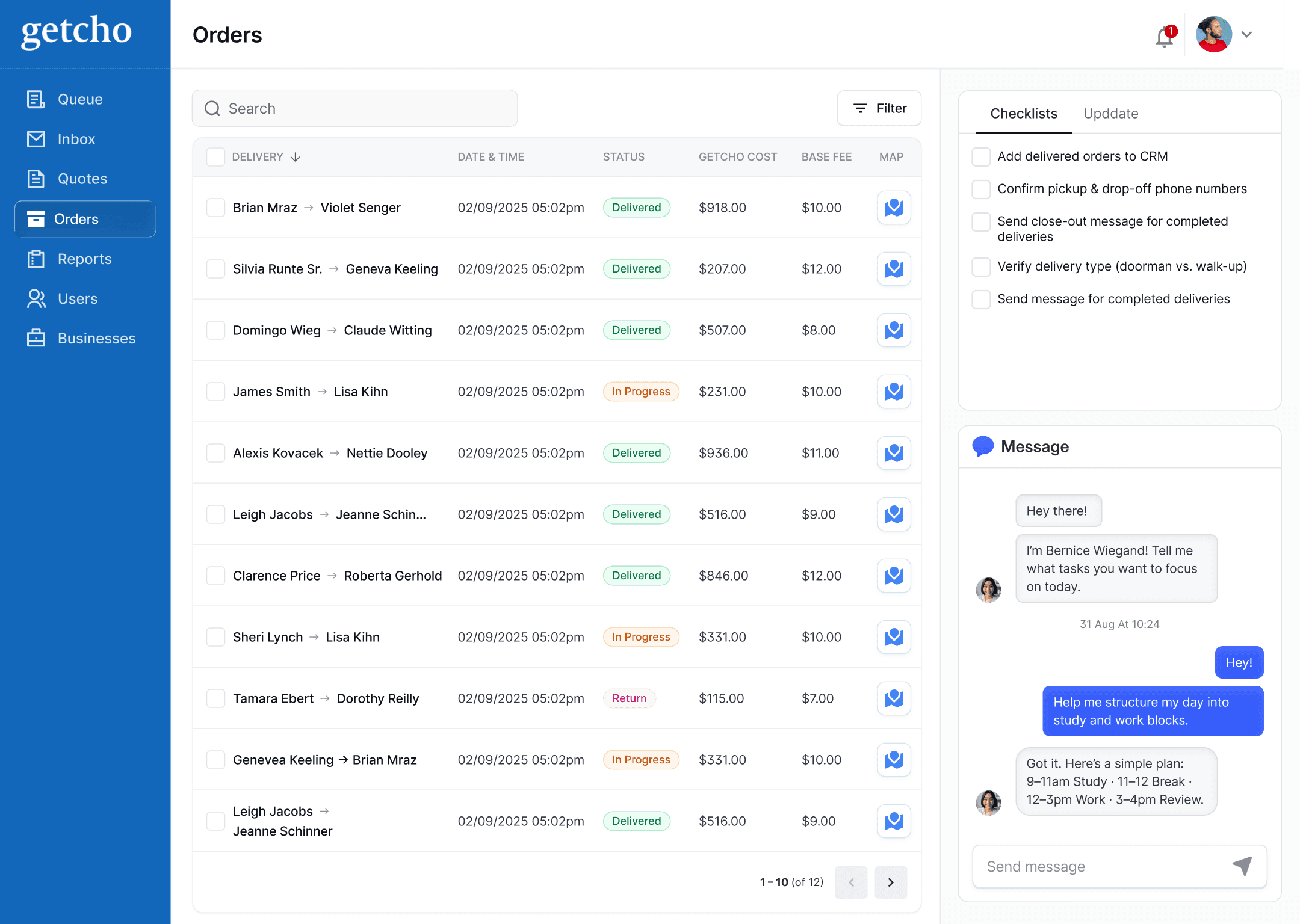
We restructured order presentation from individual cards to data table format, applying Chunking principles to eliminate redundant information while presenting critical variables (origin, destination, fees, status) in scannable columns. The redesign introduced batch selection capabilities leveraging Spark Effect principles, reducing effort required for bulk operations like marking deliveries complete or flagging issues. We repositioned the map interface to prominent expandable placement using Visual Hierarchy, recognizing spatial context as primary decision support for route optimization. The sidebar transformation separated checklist, system updates, and messaging into distinct tabs applying Progressive Disclosure, with the messaging interface rebuilt to match users' Mental Models from familiar chat platforms. This approach aligns with best practices to reduce user dropoff on SaaS setup screen and optimize SaaS dashboard UX for conversions through workflow efficiency.
Our Approach
We restructured order presentation from individual cards to data table format, applying Chunking principles to eliminate redundant information while presenting critical variables (origin, destination, fees, status) in scannable columns. The redesign introduced batch selection capabilities leveraging Spark Effect principles, reducing effort required for bulk operations like marking deliveries complete or flagging issues. We repositioned the map interface to prominent expandable placement using Visual Hierarchy, recognizing spatial context as primary decision support for route optimization. The sidebar transformation separated checklist, system updates, and messaging into distinct tabs applying Progressive Disclosure, with the messaging interface rebuilt to match users' Mental Models from familiar chat platforms. This approach aligns with best practices to reduce user dropoff on SaaS setup screen and optimize SaaS dashboard UX for conversions through workflow efficiency.
Outcomes
The redesign achieved 60% reduction in visual redundancy by consolidating order data into scannable table format, applying Recognition Over Recall principles for faster status assessment across dozens of simultaneous deliveries. Bulk selection capabilities enable teams to process multiple delivery confirmations or issue flags in single actions, addressing the operational reality where Getcho prevents 95% of failed local deliveries through GPS irregularity flagging and AI-assisted driver guidance. The prominent expandable map interface transforms spatial coordination from secondary feature to primary workflow tool, critical when managing same-day delivery and rental services across multiple merchant locations. The redesigned sidebar with dedicated messaging tab creates familiar communication patterns, supporting Getcho's mission to provide VIP delivery experiences that boost conversions by 20% and reduce lost claims by 90% through streamlined team coordination and customer communication workflows.
Outcomes
The redesign achieved 60% reduction in visual redundancy by consolidating order data into scannable table format, applying Recognition Over Recall principles for faster status assessment across dozens of simultaneous deliveries. Bulk selection capabilities enable teams to process multiple delivery confirmations or issue flags in single actions, addressing the operational reality where Getcho prevents 95% of failed local deliveries through GPS irregularity flagging and AI-assisted driver guidance. The prominent expandable map interface transforms spatial coordination from secondary feature to primary workflow tool, critical when managing same-day delivery and rental services across multiple merchant locations. The redesigned sidebar with dedicated messaging tab creates familiar communication patterns, supporting Getcho's mission to provide VIP delivery experiences that boost conversions by 20% and reduce lost claims by 90% through streamlined team coordination and customer communication workflows.
Before | After | Why |
|---|---|---|
Individual cards with repeated base fee information | Consolidated data table with shared column headers | Chunking - Eliminates redundancy, enables scanning 20+ orders without repetitive information processing |
Single-order selection only | Multi-select capability for batch processing | Spark Effect - Reduces effort threshold for bulk confirmation, flagging, or status updates across deliveries |
Small fixed sidebar element | Prominent expandable map with visual emphasis | Visual Hierarchy - Spatial context elevated to primary tool for route coordination and delivery tracking |
Card-based layout requires vertical scrolling per order | Table rows enable horizontal eye movement across variables | Fitts's Law - Reduced mouse travel distance improves speed of cross-order comparison |
Mixed checklist, updates, and messaging in single view | Separated tabs: Checklist, Updates, Messages | Progressive Disclosure - Users access specific information layers without cognitive load from unrelated data |
Basic update thread without conversation structure | Full-fledged chat UI with sender/recipient visual distinction | Mental Model - Aligns with familiar messaging patterns from Slack, WhatsApp, reducing learning curve |
High redundancy across order cards consuming viewport | Optimized table density maximizing orders visible per screen | Cognitive Load - Reduced information processing required to assess delivery operation status |
Functional but cluttered interface | Refined table aesthetics with clear visual hierarchy | Aesthetic-Usability Effect - Professional presentation increases trust in platform handling $250,000+ monthly merchandise |
Before |
|---|
Individual cards with repeated base fee information |
Single-order selection only |
Small fixed sidebar element |
Card-based layout requires vertical scrolling per order |
Mixed checklist, updates, and messaging in single view |
Basic update thread without conversation structure |
High redundancy across order cards consuming viewport |
Functional but cluttered interface |
Before |
|---|
Individual cards with repeated base fee information |
Single-order selection only |
Small fixed sidebar element |
Card-based layout requires vertical scrolling per order |
Mixed checklist, updates, and messaging in single view |
Basic update thread without conversation structure |
High redundancy across order cards consuming viewport |
Functional but cluttered interface |