


❮ Back to all roast
Optimizing Administrative Tasks: HealthSpark’s Dashboard Redesign for Better Patient Coordination
Optimizing Administrative Tasks: HealthSpark’s Dashboard Redesign for Better Patient Coordination
Optimizing Administrative Tasks: HealthSpark’s Dashboard Redesign for Better Patient Coordination
Redesigned HealthSpark's front desk dashboard to create temporal workflows and AI-enhanced patient context for independent physical therapists managing care delivery.

HealthSpark
Empowering Physical Therapists to Go Independent

YC Batch
YC Batch
Fall 2024
Industry
Industry
Healthcare, AI
Challenge
HealthSpark's AI-native business-in-a-box faced appointment organization challenges with generic "upcoming" categorization that didn't distinguish between today's immediate priorities and future bookings. Administrative requirements imposed by payers continue to significantly burden physical therapists, with 91% reporting that administrative tasks contribute to burnout. Documentation and admin tasks consume 49% of a provider's workday, costing practices an average of $125,000 in lost revenue per provider annually. The interface lacked AI-generated appointment briefs despite the platform's discovery call data, preventing therapists from preparing treatment approaches before patient arrival. Prior authorization requirements negatively impacted patients' clinical outcomes, according to 85% of survey respondents, with 30% waiting one to two weeks for approval.
Industry Insight Matrix:
National PT Shortage: 12,070 physical therapist FTE shortfall in 2022, projected to fluctuate between 3.3-8.2% through 2037
Operational Strain: 75% of practices hired additional administrative staff to manage payer burden, diverting resources from patient care and clinician compensation
Network Abandonment: 57% of practices discontinued participation with payer networks due to administrative complexity
Revenue Impact: Five-provider practices face estimated annual losses of $1.1M-$2.1M from documentation inefficiencies
Challenge
HealthSpark's AI-native business-in-a-box faced appointment organization challenges with generic "upcoming" categorization that didn't distinguish between today's immediate priorities and future bookings. Administrative requirements imposed by payers continue to significantly burden physical therapists, with 91% reporting that administrative tasks contribute to burnout. Documentation and admin tasks consume 49% of a provider's workday, costing practices an average of $125,000 in lost revenue per provider annually. The interface lacked AI-generated appointment briefs despite the platform's discovery call data, preventing therapists from preparing treatment approaches before patient arrival. Prior authorization requirements negatively impacted patients' clinical outcomes, according to 85% of survey respondents, with 30% waiting one to two weeks for approval.
Industry Insight Matrix:
National PT Shortage: 12,070 physical therapist FTE shortfall in 2022, projected to fluctuate between 3.3-8.2% through 2037
Operational Strain: 75% of practices hired additional administrative staff to manage payer burden, diverting resources from patient care and clinician compensation
Network Abandonment: 57% of practices discontinued participation with payer networks due to administrative complexity
Revenue Impact: Five-provider practices face estimated annual losses of $1.1M-$2.1M from documentation inefficiencies
Our Approach
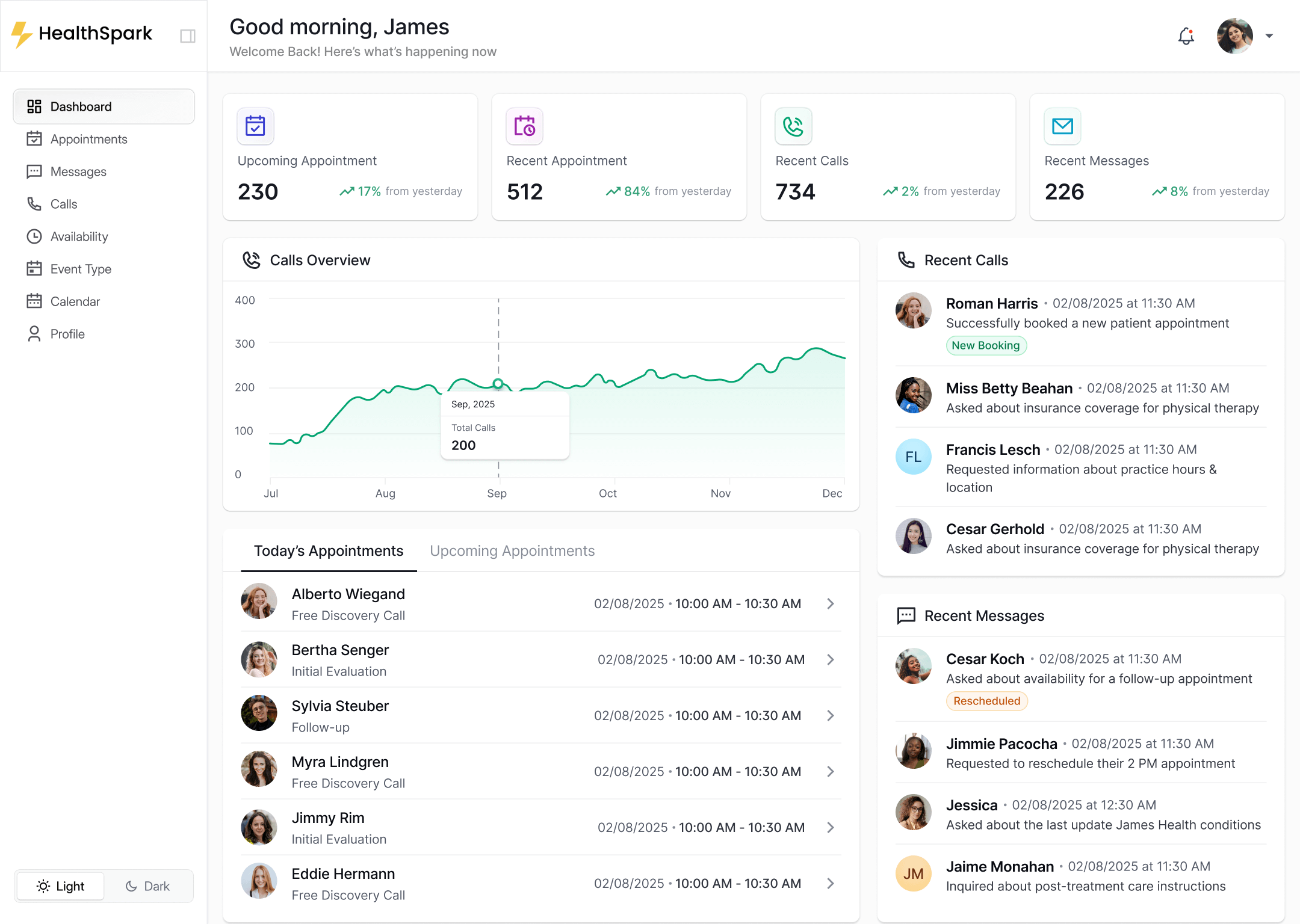
We restructured appointment organization into temporal categories applying Serial Position Effect principles: "Today's Appointments" for immediate focus, "Upcoming Appointments" for future planning, and "Recent Appointments" for follow-up documentation. The redesign introduced AI-generated appointment briefs leveraging discovery call transcripts, implementing Progressive Disclosure to provide patient context without overwhelming the interface. We enhanced communication panels with photo placeholders and message counts using Visual Hierarchy and Familiarity Bias, aligning with established messaging patterns therapists expect from consumer platforms. The addition of dark/light mode preferences applies Aesthetic-Usability Effect principles, creating professional polish that increases forgiveness for minor interface issues. This approach follows SaaS dashboard design principles and how to optimize SaaS onboarding screen UX by connecting AI capabilities directly to clinical workflows.
Our Approach
We restructured appointment organization into temporal categories applying Serial Position Effect principles: "Today's Appointments" for immediate focus, "Upcoming Appointments" for future planning, and "Recent Appointments" for follow-up documentation. The redesign introduced AI-generated appointment briefs leveraging discovery call transcripts, implementing Progressive Disclosure to provide patient context without overwhelming the interface. We enhanced communication panels with photo placeholders and message counts using Visual Hierarchy and Familiarity Bias, aligning with established messaging patterns therapists expect from consumer platforms. The addition of dark/light mode preferences applies Aesthetic-Usability Effect principles, creating professional polish that increases forgiveness for minor interface issues. This approach follows SaaS dashboard design principles and how to optimize SaaS onboarding screen UX by connecting AI capabilities directly to clinical workflows.
Outcomes
The redesign achieved immediate temporal focus through "Today's Appointments" prioritization, enabling therapists to concentrate on current patient load separate from future scheduling logistics. AI-generated appointment briefs transform discovery call data into actionable clinical preparation, addressing the platform's core value proposition of automating administrative infrastructure. The consolidated messaging interface with visual indicators creates familiar communication patterns while reducing context switching between patient coordination tasks. Enhanced visual polish through dark mode options and refined aesthetics leverages Aesthetic-Usability Effect to increase user satisfaction and platform stickiness. The temporal workflow structure supports HealthSpark's mission to give independent physical therapists the administrative capabilities of full clinics without overhead costs, enabling focus on the patient care that comprises 51% of their workday while AI handles the administrative burden that drives 91% of provider burnout.
Outcomes
The redesign achieved immediate temporal focus through "Today's Appointments" prioritization, enabling therapists to concentrate on current patient load separate from future scheduling logistics. AI-generated appointment briefs transform discovery call data into actionable clinical preparation, addressing the platform's core value proposition of automating administrative infrastructure. The consolidated messaging interface with visual indicators creates familiar communication patterns while reducing context switching between patient coordination tasks. Enhanced visual polish through dark mode options and refined aesthetics leverages Aesthetic-Usability Effect to increase user satisfaction and platform stickiness. The temporal workflow structure supports HealthSpark's mission to give independent physical therapists the administrative capabilities of full clinics without overhead costs, enabling focus on the patient care that comprises 51% of their workday while AI handles the administrative burden that drives 91% of provider burnout.
Before | After | Why |
|---|---|---|
Generic "Upcoming Appointments" mixing today and future dates | Separated tabs: Today's, Upcoming, Recent Appointments | Serial Position Effect - Temporal categorization aligns with provider mental model of immediate vs. future priorities |
No AI-generated patient context despite discovery call data | AI briefs summarizing patient problems and appointment context | Progressive Disclosure - Leverages existing AI transcripts to provide preparation without adding manual work |
Basic communication thread without visual hierarchy | Enhanced chat UI with photos, message counts, and visual distinction | Familiarity Bias & Mental Model - Aligns with messaging platforms therapists use daily (WhatsApp, Slack) |
Mixed past/present/future appointments in single view | Clear separation enabling different actions per timeframe | Cognitive Load - Providers review past for notes, present for prep, future for planning without mental filtering |
Simple recent calls list without context | Enhanced call history with visual indicators and quick navigation | Visual Hierarchy - Critical communication touchpoints elevated with consistent design language |
Therapists review discovery calls manually before sessions | Auto-generated summaries highlighting key patient information | Spark Effect - Reduced effort to access critical context increases likelihood of preparation |
Single light mode without customization | Dark/light mode toggle with refined visual design | Aesthetic-Usability Effect - Professional polish increases perceived reliability and user forgiveness |
Scattered appointment and communication management | Unified dashboard with clear information architecture | Recognition Over Recall - Consistent patterns reduce learning curve for independent therapists new to practice ownership |
Before |
|---|
Generic "Upcoming Appointments" mixing today and future dates |
No AI-generated patient context despite discovery call data |
Basic communication thread without visual hierarchy |
Mixed past/present/future appointments in single view |
Simple recent calls list without context |
Therapists review discovery calls manually before sessions |
Single light mode without customization |
Scattered appointment and communication management |
Before |
|---|
Generic "Upcoming Appointments" mixing today and future dates |
No AI-generated patient context despite discovery call data |
Basic communication thread without visual hierarchy |
Mixed past/present/future appointments in single view |
Simple recent calls list without context |
Therapists review discovery calls manually before sessions |
Single light mode without customization |
Scattered appointment and communication management |