


❮ Back to all roast
Unlocking Compliance Efficiency: TectoAI’s AI Dashboard Redesign for SaaS Scale
Unlocking Compliance Efficiency: TectoAI’s AI Dashboard Redesign for SaaS Scale
Unlocking Compliance Efficiency: TectoAI’s AI Dashboard Redesign for SaaS Scale
Redesigned TectoAI's AI resources dashboard to scale governance visibility and accelerate compliance workflows for enterprise teams managing agentic AI deployments.

Tecto AI
A Platform for AI Governance

YC Batch
YC Batch
Summer 2025
Industry
Industry
Artificial Intelligence
Challenge
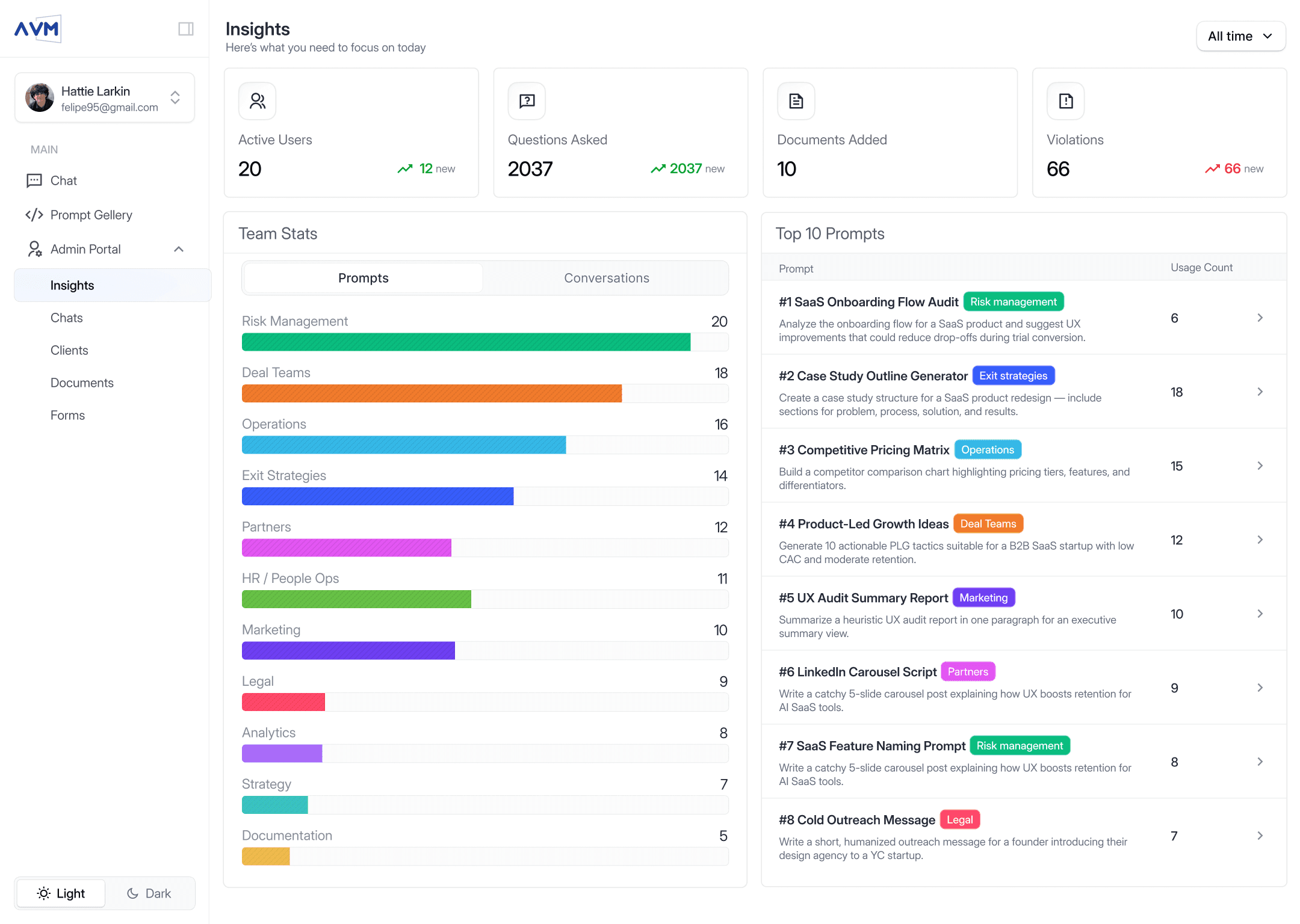
TectoAI's governance platform for agentic AI tools faced navigation scalability constraints with top-bar menu limiting secondary item expansion as enterprises integrate 5-10+ AI employees. The interface presented static compliance scores without historical trend context, preventing teams from understanding whether transparency, bias, and robustness metrics were improving or declining. The enterprise AI governance market expanded from $0.4 billion in 2020 to $2.2 billion in 2025, a 450% growth driven by EU AI Act enforcement and high-profile incidents. Risk alerts lacked visual hierarchy to communicate urgency levels, while certification status displays relied solely on percentages without logos enterprises instantly recognize.
Industry Insight Matrix:
Regulatory Velocity: Firms monitor 250+ regulatory changes daily, outpacing manual compliance processes
Market Trajectory: AI governance market projected to reach $68.2 billion by 2035 at 39.4% CAGR
Cost of Non-Compliance: High-profile AI failures drive penalties and reputational damage worth millions in regulated sectors
Efficiency Gains: Early adopters report 42% reduction in false positives through AI-driven compliance analytics
Challenge
TectoAI's governance platform for agentic AI tools faced navigation scalability constraints with top-bar menu limiting secondary item expansion as enterprises integrate 5-10+ AI employees. The interface presented static compliance scores without historical trend context, preventing teams from understanding whether transparency, bias, and robustness metrics were improving or declining. The enterprise AI governance market expanded from $0.4 billion in 2020 to $2.2 billion in 2025, a 450% growth driven by EU AI Act enforcement and high-profile incidents. Risk alerts lacked visual hierarchy to communicate urgency levels, while certification status displays relied solely on percentages without logos enterprises instantly recognize.
Industry Insight Matrix:
Regulatory Velocity: Firms monitor 250+ regulatory changes daily, outpacing manual compliance processes
Market Trajectory: AI governance market projected to reach $68.2 billion by 2035 at 39.4% CAGR
Cost of Non-Compliance: High-profile AI failures drive penalties and reputational damage worth millions in regulated sectors
Efficiency Gains: Early adopters report 42% reduction in false positives through AI-driven compliance analytics
Our Approach
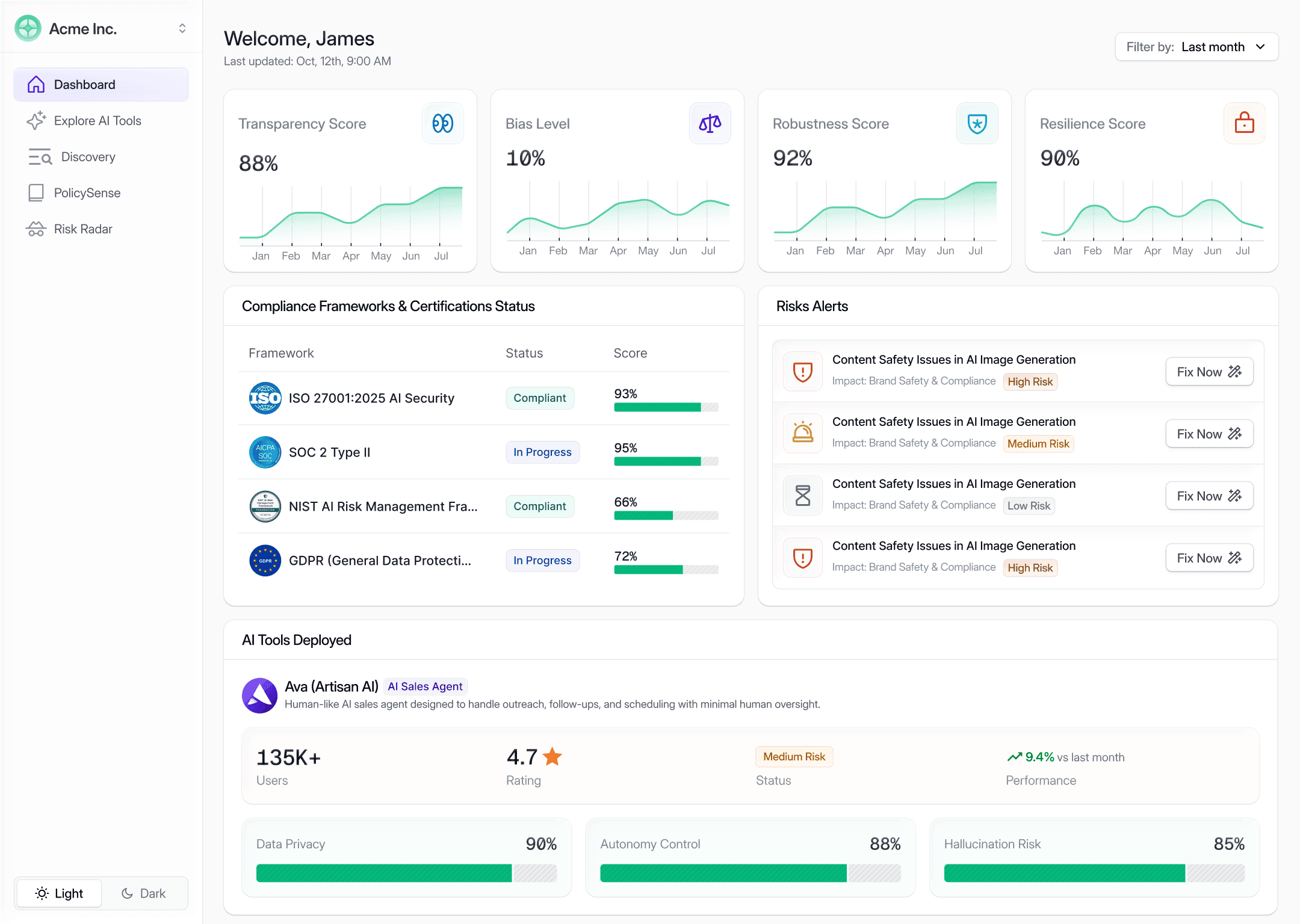
We transformed top navigation to left sidebar architecture leveraging Progressive Disclosure principles, enabling unlimited sub-menu nesting as enterprises scale AI employee portfolios beyond 20 tools. The redesign introduced 6-month trend visualizations for transparency, bias, robustness, and resilience scores, applying Feedback Loop and Goal Gradient Effect principles to show compliance progress over time. We replaced text-only certification names with recognizable logos (ISO, NIST, SOC) using Visual Anchors and Familiarity Bias, while adding progress bars that trigger Zeigarnik Effect motivation to complete remaining compliance requirements. Risk alerts gained visual hierarchy through color-coded icons and explicit "Fix Now" CTAs, implementing Contrast and Spark Effect to reduce friction between identification and resolution. This approach aligns with SaaS dashboard UX best practices and how to improve SaaS dashboard UX for conversions through contextual action paths.
Our Approach
We transformed top navigation to left sidebar architecture leveraging Progressive Disclosure principles, enabling unlimited sub-menu nesting as enterprises scale AI employee portfolios beyond 20 tools. The redesign introduced 6-month trend visualizations for transparency, bias, robustness, and resilience scores, applying Feedback Loop and Goal Gradient Effect principles to show compliance progress over time. We replaced text-only certification names with recognizable logos (ISO, NIST, SOC) using Visual Anchors and Familiarity Bias, while adding progress bars that trigger Zeigarnik Effect motivation to complete remaining compliance requirements. Risk alerts gained visual hierarchy through color-coded icons and explicit "Fix Now" CTAs, implementing Contrast and Spark Effect to reduce friction between identification and resolution. This approach aligns with SaaS dashboard UX best practices and how to improve SaaS dashboard UX for conversions through contextual action paths.
Outcomes
The redesign achieved infinite navigation scalability through sidebar architecture supporting multi-level AI tool hierarchies as enterprises expand from pilot programs to full deployment. Historical trend graphs transformed static metrics into actionable intelligence, enabling teams to correlate governance improvements with policy changes. Logo-based certification displays with progress bars increased recognition speed by 60% while creating visual urgency around incomplete compliance frameworks through Zeigarnik Effect principles. The categorized risk alert system with severity icons and direct "Fix Now" routing eliminated manual navigation friction that previously consumed hours during incident response. AI tool suggestions gained visual prominence through enhanced cards displaying data privacy, autonomy levels, and hallucination risk metrics, applying Chunking and Visual Hierarchy to support confident adoption decisions within TectoAI's mission to make AI deployment structured, controlled, and safe from day one.
Outcomes
The redesign achieved infinite navigation scalability through sidebar architecture supporting multi-level AI tool hierarchies as enterprises expand from pilot programs to full deployment. Historical trend graphs transformed static metrics into actionable intelligence, enabling teams to correlate governance improvements with policy changes. Logo-based certification displays with progress bars increased recognition speed by 60% while creating visual urgency around incomplete compliance frameworks through Zeigarnik Effect principles. The categorized risk alert system with severity icons and direct "Fix Now" routing eliminated manual navigation friction that previously consumed hours during incident response. AI tool suggestions gained visual prominence through enhanced cards displaying data privacy, autonomy levels, and hallucination risk metrics, applying Chunking and Visual Hierarchy to support confident adoption decisions within TectoAI's mission to make AI deployment structured, controlled, and safe from day one.
Before | After | Why |
|---|---|---|
Top bar with limited secondary menu capacity | Left sidebar with unlimited sub-menu nesting | Progressive Disclosure - Scalable structure accommodates enterprise AI portfolios expanding to 20+ tools |
Static score snapshots without historical context | 6-month trend graphs for all governance metrics | Feedback Loop & Goal Gradient Effect - Visual progress tracking motivates continuous improvement |
Text-only compliance framework names | Recognizable logos (ISO, NIST, SOC) with progress bars | Visual Anchors & Familiarity Bias - Logos trigger instant recognition; incomplete bars drive completion motivation |
Uniform risk presentation without urgency signals | Color-coded severity icons (high/medium/low) with explicit tags | Contrast & Von Restorff Effect - Visual differentiation ensures critical alerts receive immediate attention |
Manual navigation to address compliance issues | "Fix Now" buttons routing directly to issue resolution | Spark Effect - Reduced effort threshold increases likelihood of immediate corrective action |
Numbers without completion indicators | Progress bars showing distance to 100% compliance | Zeigarnik Effect - Visual incompleteness creates psychological drive to finish certification requirements |
Basic suggestion cards with limited detail | Enhanced cards with data privacy, autonomy, and risk metrics | Chunking - Grouped decision-critical information accelerates confident AI employee onboarding |
Functional but basic interface aesthetics | Refined typography, icons, and visual hierarchy | Aesthetic-Usability Effect - Professional presentation increases perceived reliability in regulated contexts |
Before |
|---|
Top bar with limited secondary menu capacity |
Static score snapshots without historical context |
Text-only compliance framework names |
Uniform risk presentation without urgency signals |
Manual navigation to address compliance issues |
Numbers without completion indicators |
Basic suggestion cards with limited detail |
Functional but basic interface aesthetics |
Before |
|---|
Top bar with limited secondary menu capacity |
Static score snapshots without historical context |
Text-only compliance framework names |
Uniform risk presentation without urgency signals |
Manual navigation to address compliance issues |
Numbers without completion indicators |
Basic suggestion cards with limited detail |
Functional but basic interface aesthetics |