

Last Update:
Table of Contents
No headings found in Blog Content.
Share


Post-launch UX fixes cost up to 100x more than those resolved during design.
Structured UX validation yields 9,900% ROI, with documented $100-to-$1 returns.
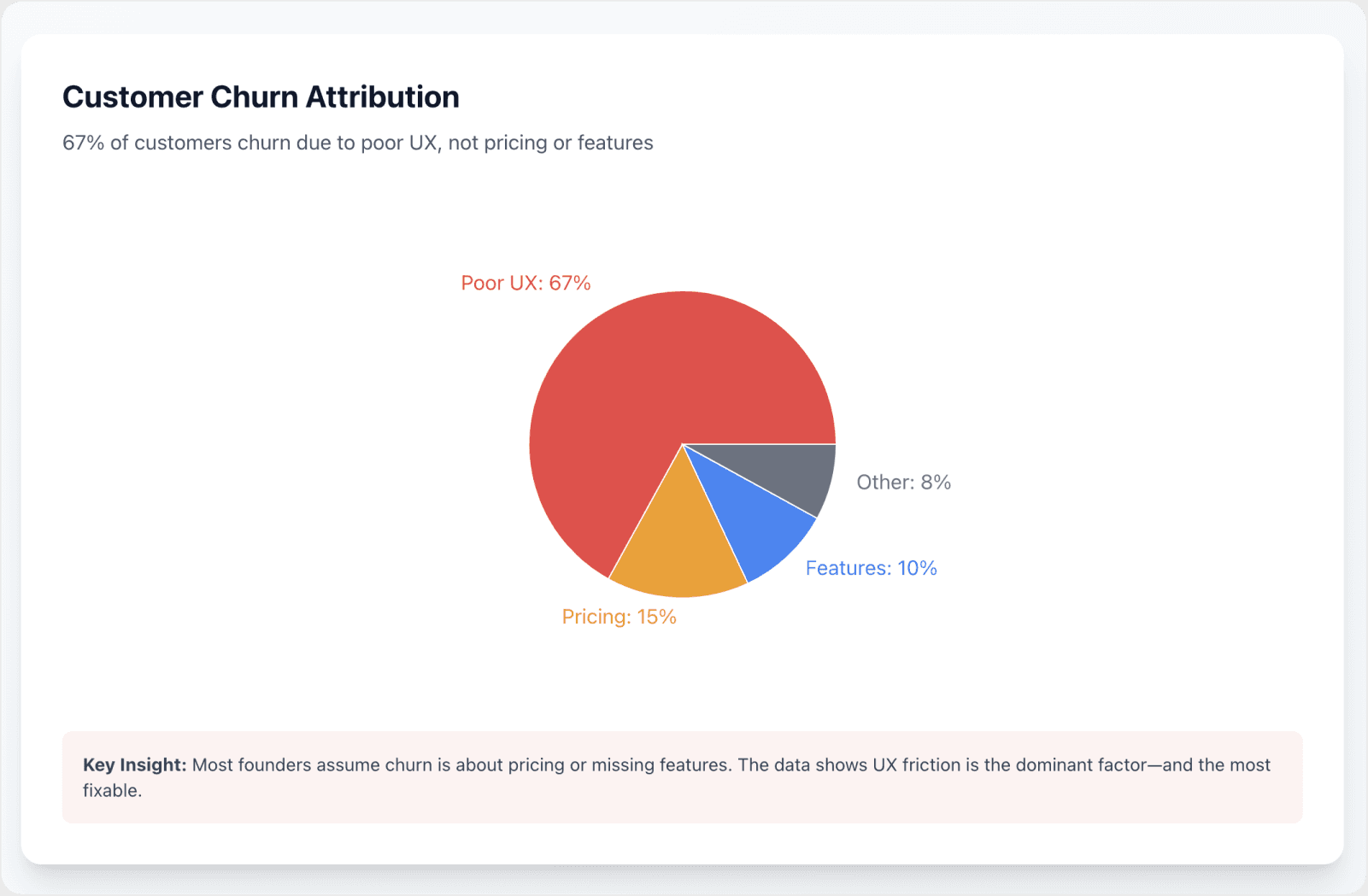
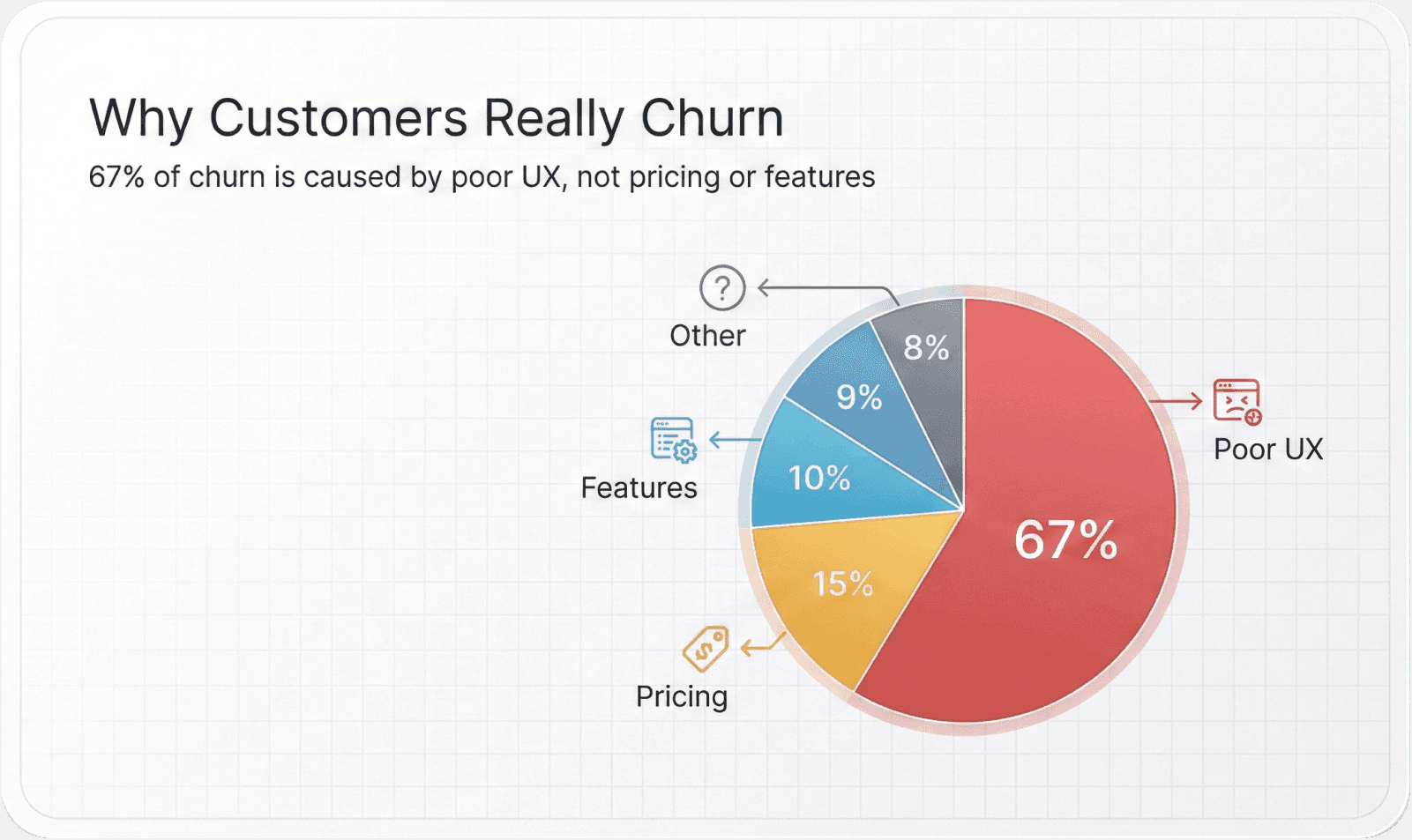
67% of churn is due to UX issues, not pricing or missing features.
Heuristic evaluations catch 30–50% of critical usability problems early at a fraction of post-launch costs.
Testing just 5 users per persona uncovers 85% of usability issues.
Poor onboarding creates silent churn, reducing retention and conversion rates.
Pre-launch testing cuts support tickets by 30% and boosts task success to 90%+.
Ongoing validation embeds UX into development, sustaining long-term growth.
Skipping UX validation risks $75K–$250K in costs and churn per project.
UX isn’t a luxury—it’s risk management that directly impacts revenue.
When founders assume they'll "know good UX when they see it," they're creating a measurable financial liability that compounds over time. The evidence is stark and unambiguous.
UX issues discovered after launch cost 100 times more to resolve than those caught during design. This isn't an estimate—it's a documented pattern across industries.
Meanwhile, proactive UX evaluation delivers an extraordinary 9,900% ROI while cutting customer churn by as much as 67%. These numbers come from comprehensive economic impact studies, not marketing claims.
Structured validation before shipping—combining expert heuristic evaluations with targeted user testing uncovers between 30% and 50% of critical usability problems. The cost represents a small fraction of what post-launch fixes demand.
This isn't a discretionary design exercise or a luxury reserved for consumer-facing products. It's a non-negotiable business imperative grounded in empirical data that applies equally to enterprise software, SaaS platforms, and consumer applications.
1. The Exponential Cost of Post-Launch UX Failures

The 100x Cost Multiplier
The Exponential Penalty Structure
The financial penalty for postponing UX validation escalates dramatically as a product moves through its lifecycle. This escalation follows a predictable mathematical pattern that we've observed across thousands of projects.
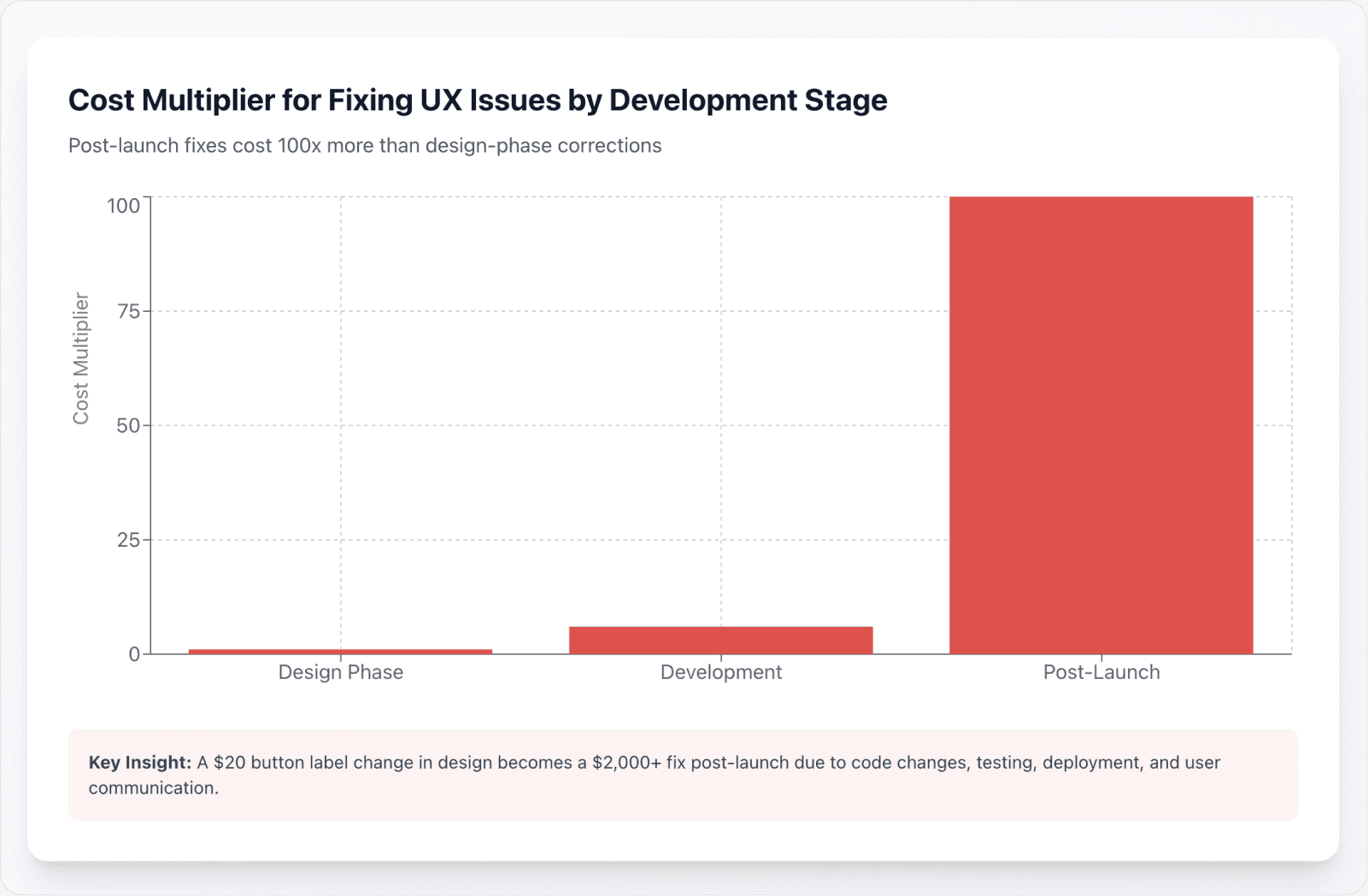
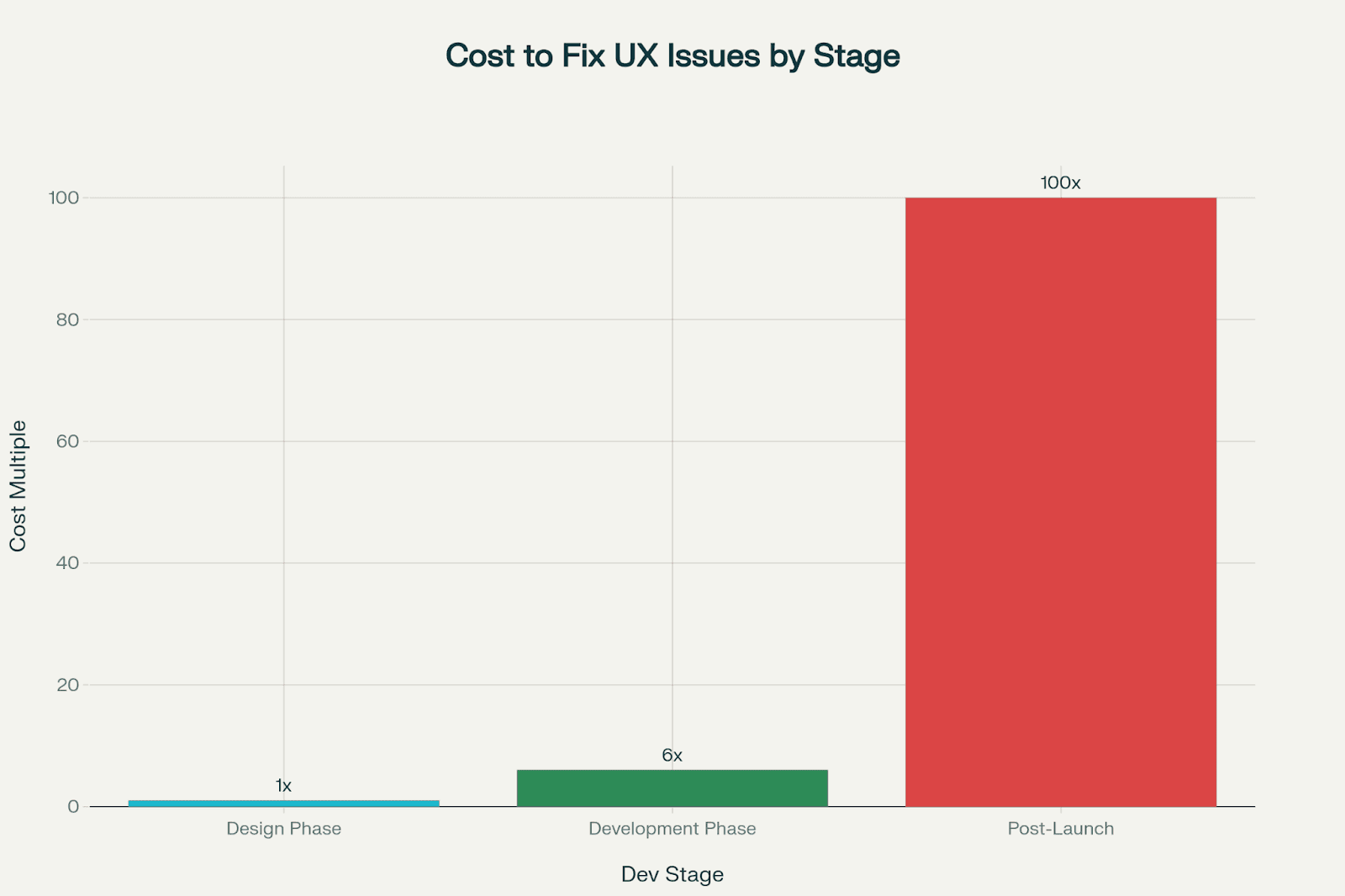
Research from the IBM Systems Sciences Institute reveals a sobering finding. Fixing a usability problem after product release costs 100 times more than addressing it during the design phase.
Even post-development fixes—those made after coding is complete but before launch—cost 6 times more than design-phase corrections. The multiplier effect isn't theoretical; it reflects real costs accumulated across multiple organizational layers.
What Drives the Cost Multiplier
This cost structure reflects far more than just code changes. We're talking about:
Support ticket escalations that consume team bandwidth
Emergency patches that disrupt development roadmaps
Brand reputation damage that increases acquisition costs
Considerable customer recovery efforts that require executive attention
A Simple Example of Cost Escalation
Consider a simple example: changing a button label during design might take ten minutes and cost twenty dollars in designer time.
Making that same change post-launch requires coordinating with engineering, pushing a code update through your deployment pipeline, testing across environments, notifying support teams, and potentially explaining the change to confused users. That twenty-dollar change becomes two thousand dollars or more.
Expert Perspective on Development Stage Costs
As Jakob Nielsen of the Nielsen Norman Group has noted, "The further along you move in the development process, the more expensive it becomes to make changes because each stage introduces new dependencies and technical constraints."
His research spanning four decades consistently demonstrates this exponential cost curve.
The 70% Design Issues Problem
When Most Issues Surface
Forrester research found that 70% of design issues are discovered after release—precisely when they become 10 times more expensive to fix. This timing creates a predictable financial drain that many organizations fail to anticipate or budget for adequately.
The Cost Range for UX Overhauls
The average cost of a full UX overhaul for legacy applications ranges from $75,000 to $150,000 or more. Post-launch support then consumes between 10% and 20% of total project budgets in an ongoing tax on development velocity.
For enterprise applications with complex workflows and multiple stakeholder groups, these figures escalate further. We're looking at costs exceeding $250,000 when we factor in organizational change management, user retraining programs, and phased rollouts designed to minimize business disruption.
Why Internal Teams Miss Problems
According to research from Stanford's Human-Computer Interaction Group, this phenomenon occurs because internal teams become blind to their own design assumptions.
What seems intuitive to a product team that has spent months building a feature often proves confusing to first-time users who lack that accumulated context.
Real-World Case: Enterprise SaaS Navigation Issues
One enterprise SaaS company we examined discovered critical navigation issues three months post-launch. Users couldn't locate essential features despite multiple onboarding emails.
The redesign cost $180,000 and required six months to implement across their customer base. Had they conducted usability testing with five users before launch, they would have discovered these issues for approximately $4,000.
Hidden Cost Categories
Beyond Direct Rework Costs
Poor UX generates cascading operational expenses that extend well beyond direct rework costs. These hidden categories often dwarf the visible redesign budget.
Support Cost Amplification
Support costs increase substantially when usability issues drive up service desk tickets. Users who can't figure out how to complete tasks naturally reach out for help.
In North American markets, support costs average in the mid-teens per ticket, meaning that a 30% reduction through better UX translates to substantial ongoing savings that compound monthly.
Development Efficiency Tax
Development teams experience their own efficiency tax. They spend between 25% and 40% of redesign budgets on prototyping iterations that could have been avoided through early validation.
This represents not just wasted money but wasted time—your most constrained resource.
The Brand Damage Multiplier
Perhaps most insidious is brand damage that manifests gradually. Research consistently shows that unhappy users share negative experiences at significantly higher rates than positive ones—often at a ratio of three to one.
This asymmetry directly increases customer acquisition costs through reduced conversion rates and higher advertising spend needed to overcome negative sentiment.
The Compounding Economics of Reputation
As Gartner analysts have observed:
"The cost of acquiring a new customer to replace one lost to poor UX can be five times higher than the cost of retention, creating a compounding economic problem that many organizations only recognize after significant revenue erosion."
Reputation Damage in Practical Terms
Think about reputation damage in practical terms. When twenty percent of your users encounter a frustrating checkout flow, four percent might complain publicly through reviews or social media.
Those complaints reach hundreds or thousands of potential customers, each requiring additional marketing investment to overcome the negative signal. The math compounds quickly.
Section Summary: The Cost Multiplier Effect
Post-launch UX fixes cost 100x more than design-phase corrections, with 70% of issues discovered after release. Hidden costs include support escalation, development inefficiency, and brand damage that compounds over time. Real cases demonstrate that $4,000 in pre-launch testing prevents $180,000+ in post-launch redesigns.
2. ROI of Pre-Ship UX Evaluation: The 9,900% Case

The Dollar-to-Hundred-Dollar Return
The Forrester ROI Finding
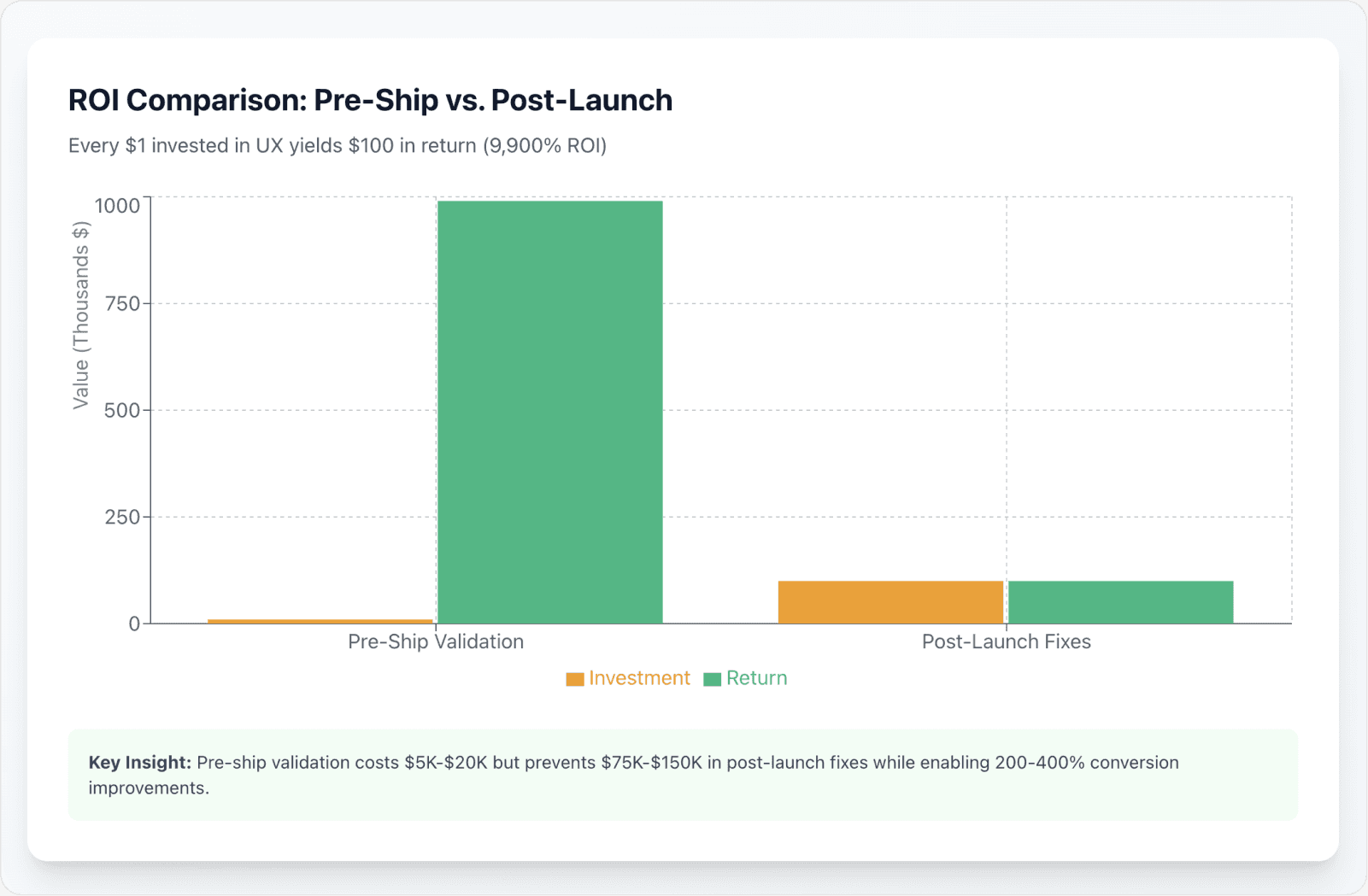
Forrester's commissioned research demonstrates that every $1 invested in UX yields $100 in return. This achieves a remarkable 9,900% ROI that few other business activities can match.
This isn't theoretical projection based on optimistic assumptions. It's grounded in real organizational outcomes measured across multiple industries and company sizes.
Measurable Business Outcomes
Companies implementing systematic UX evaluation report measurable, transformative results:
Well-crafted UX increases conversion rates by as much as 200%
Optimized designs achieve 400% improvements in specific user flows like checkout or signup
Design-led firms return 2.19 times the S&P 500 performance
Companies that prioritize UX consistently see 32% higher revenue growth compared to their peers
From Correlation to Causation
McKinsey research reinforces this finding across multiple studies. Their analysis shows that organizations with strong design practices outperform industry benchmarks across revenue growth, total returns to shareholders, and operating margin expansion.
The connection between user experience quality and business performance has moved from correlation to causation in recent longitudinal studies. We can now establish that improving UX drives revenue growth, not merely that successful companies happen to have good UX.
Expert Perspective on Design ROI
As design leaders at IDEO have noted, "The ROI of design isn't about making things pretty—it's about removing friction from value creation, which directly translates to conversion, retention, and expansion revenue."
The UserTesting Economic Impact
Documented Financial Returns
A Total Economic Impact™ study of UserTesting's platform revealed:
415% ROI over three years
$7.6 million net present value
Payback period of under six months
These numbers come from comprehensive financial analysis of actual customer deployments.
The Risk of Delayed Research
Study participants emphasized a stark reality that kept executives awake at night. Without timely UX research, they risked losing as much as 50% of customers who were eligible for new product offerings.
How Friction Compounds into Lost Revenue
The cognitive load and interaction costs that poor UX creates don't just frustrate users—they create measurable friction that directly translates to abandoned transactions and lost revenue.
Every additional form field, every confusing label, every unexpected behavior creates a small probability that users will give up.
These probabilities compound through your conversion funnel like interest on debt. If five usability problems each reduce conversion by fifteen percent, you're not losing fifteen percent of conversions—you're losing fifty-nine percent through multiplication of failure rates.
Validation from Harvard Business Review
Harvard Business Review has documented similar patterns across industries. Companies investing in systematic user research before launch consistently outperform those that rely on post-launch optimization alone, even when the latter spend substantially more on iterative improvements.
Real-World Case: Financial Services Support Reduction
One financial services company documented in the study reduced customer support calls by thirty-seven percent after implementing pre-launch usability testing.
That reduction saved $2.1 million annually in support costs alone, before accounting for improved conversion rates.
Cost Prevention vs. Cost Creation
Heuristic Evaluation Costs
Heuristic evaluations—structured expert reviews conducted against established usability principles—typically cost between $80 and $200 per hour for experienced agency expertise.
The hourly rate varies based on evaluator experience and geographic location, but the total cost remains predictable.
Usability Testing Investment
Usability testing generally consumes between 5% and 15% of total redesign budgets. This includes participant recruitment, incentive payments, facilitation time, analysis, and reporting.
The Combined Cost-Benefit Equation
Combined, these methods typically cost $5,000 to $20,000 for medium-sized projects. That investment represents less than 5% of the potential $75,000 to $150,000 post-launch overhaul cost.
The math is compelling and straightforward. Spending five thousand dollars to prevent seventy-five thousand dollars in future costs represents some of the most efficient risk mitigation available in product development.
Expert Perspective on UX Economics
As research from the Interaction Design Foundation has shown, "The cost structure of UX work inverts the typical software economics—early investment yields exponential returns, while deferred investment creates exponential costs."
Observed Pattern Across Product Launches
We've seen this pattern repeatedly in our analysis of product launches. Teams that invest two percent of their development budget in pre-launch UX validation consistently avoid spending twenty percent of that same budget on post-launch fixes and support escalations.
Section Summary: The 9,900% ROI Case
Every dollar invested in UX returns $100, with documented cases showing 415% ROI and payback under six months. Pre-launch validation costing $5,000-$20,000 prevents $75,000-$150,000 in post-launch overhauls. Companies that invest 2% of budgets in validation avoid spending 20% on post-launch fixes.
3. Customer Churn: The UX-First Driver
The 67% Churn Attribution
The Counterintuitive Finding
Here's a finding that contradicts common founder assumptions and reshapes how we think about retention. 67% of customers churn because of poor user experiences, not because of pricing or missing product features.
This data point fundamentally challenges the typical intuition that churn stems primarily from competitive pricing pressure or insufficient functionality. Founders naturally assume users leave for better alternatives or lower prices.
What the Data Actually Shows
The research reveals something different and more actionable. Voluntary churn—customers actively choosing to leave—directly correlates with UX friction points rather than feature gaps or cost considerations.
Expert Perspective on Churn Drivers
As retention specialists at Bain & Company have noted, "The assumption that customers leave for competitors overlooks the more common reality—they leave because the activation friction and cognitive load make it too difficult to extract value from the product they've already chosen."
Personal Behavior as a User
Think about your own behavior as a user. How often have you abandoned a tool not because it lacked features, but because using those features required too much effort?
The value was there, but the interaction cost exceeded your patience threshold.
Real-World Case: B2B SaaS Engagement Paradox
One B2B SaaS company analyzed their churn cohorts and discovered something surprising. Customers who churned had actually logged in more frequently than retained customers during their first month.
They were trying harder, not less hard. The problem wasn't lack of engagement—it was that their engagement consistently resulted in frustration rather than success.
The Effort-Loyalty Equation
Why Users Actually Leave
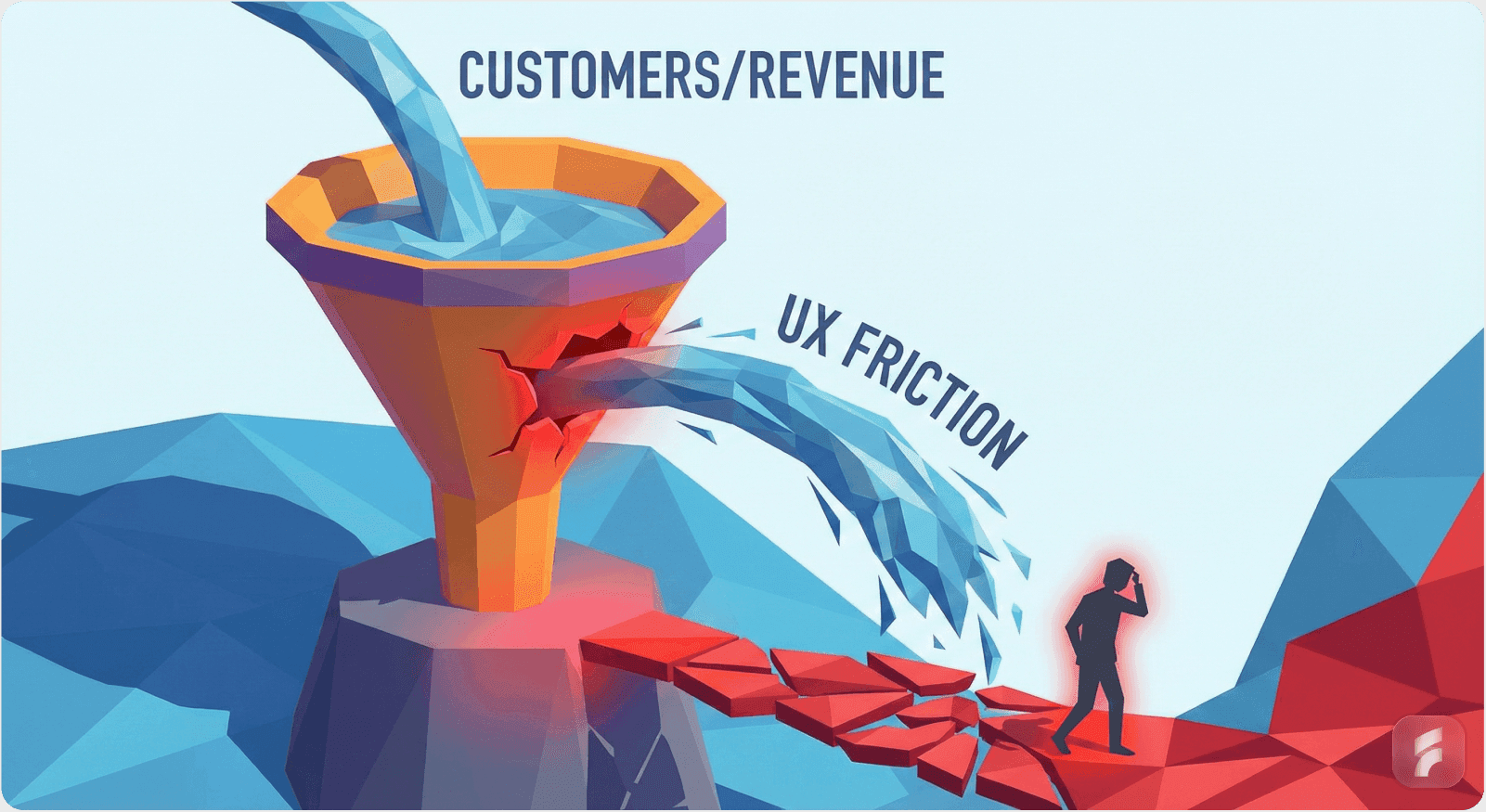
Users don't abandon products because they don't care about solving their problem. They leave because it's too hard to care—because the interaction cost exceeds their patience threshold at too many critical moments.
Common Friction Patterns
UX friction manifests in predictable patterns that we can identify and measure:
Confusing information architecture violates user mental models, creating navigation paths that seem logical to designers but mystifying to users
Multi-step setup processes increase time-to-value beyond reasonable limits, with each additional step creating another opportunity for users to question whether the effort is worth the potential benefit
Mismatched interaction patterns create unnecessary cognitive load at every turn—when your interface behaves differently from established conventions without clear benefit, users must constantly think about how to interact rather than focusing on their goals
Real-World Case: SaaS Monthly Churn Analysis
A documented SaaS company case study illustrated this dynamic clearly. The company experienced 8.2% monthly churn compared to the 6.77% industry average—a difference that translated to millions in lost annual recurring revenue.
Identifying the Root Cause
After implementing friction scoring tools and user feedback systems, they identified checkout UX issues that were driving abandonment. The problems weren't related to pricing or features.
They were rooted in mental model misalignment between how the company thought users would approach tasks and how users actually attempted them.
The Business Impact of the Fix
The company redesigned three pages based on testing with eight users. Monthly churn dropped to 5.9% within two quarters.
The revenue impact exceeded $4 million annually.
The Retention Economics
The 5x Acquisition Cost Premium
The business case for UX-driven churn reduction is straightforward and compelling when you examine the underlying economics of customer relationships.
Acquiring new customers costs 5 times more than retaining existing ones. This creates an immediate cost differential that overwhelmingly favors retention investment over acquisition spending.
The Profit Multiplier Effect
A 5% increase in retention boosts profits by between 25% and 95%, depending on your business model and customer lifetime value profile.
The wide range reflects differences in margin structure, but the direction is consistent across models.
Success Rate Disparities
The success rate disparity tells the story even more clearly:
Selling to existing customers succeeds between 60% and 70% of the time
Selling to new prospects succeeds just 5% to 20% of the time
Research on Retention Curves
Research from the Baymard Institute confirms that retention curves steepen dramatically when onboarding friction is reduced.
The first user experience disproportionately influences long-term retention rates, suggesting that early UX improvements yield compounding benefits.
Expert Perspective on First Session Impact
As customer success experts at Gainsight have observed:
"The retention game is won or lost in the first session—either users experience the 'aha moment' that hooks them, or they experience friction that primes them for eventual churn."
The Math for SaaS Businesses
Consider the math for a typical SaaS business. If you have ten thousand customers paying one hundred dollars monthly, a one percentage point reduction in monthly churn adds 1.2 million dollars to annual revenue.
That's not new sales—that's money you keep by reducing friction.
Section Summary: UX as Primary Churn Driver
67% of customers churn due to poor UX, not pricing or features. Common friction patterns include confusing architecture, multi-step processes, and mismatched interactions. Real cases show that fixing UX issues can reduce churn from 8.2% to 5.9%, generating $4M+ in annual revenue impact. Retention costs 5x less than acquisition.
4. Heuristic Evaluation Effectiveness: Early Problem Detection
The 30-50% Problem Coverage
The Coverage Range Explained
Heuristic evaluations systematically identify between 30% and 50% of the usability problems that would be found in concurrent usability testing.
This percentage might sound modest, but it represents extraordinary value when you consider the cost differential.
Discount Usability Engineering
This approach—termed "discount usability engineering" by Jakob Nielsen—provides exceptional ROI by catching high-severity issues before you invest in user recruitment and testing infrastructure.
What Expert Evaluators Find
Expert evaluators applying Nielsen's ten usability heuristics can surface major problems in information hierarchy, interaction cost, and mental model misalignment before a single test participant enters the room.
When Heuristic Evaluation Works Best
The Nielsen Norman Group has documented that heuristic evaluation works particularly well for identifying violations of established UX principles:
Consistency problems
Error prevention gaps
Recognition-versus-recall issues that experienced practitioners can spot reliably
The Compiler Analogy
Think of heuristic evaluation as a first filter that catches the most obvious problems. You wouldn't send code to users without running it through a compiler first.
Heuristic evaluation serves a similar function for UX—it catches errors that violate known principles before exposing them to users.
Real-World Case: Mobile App Heuristic Review
One mobile app we analyzed had seventeen heuristic violations identified in four hours of expert review. Fixing these issues cost approximately $8,000 in design and development time.
Had these same issues reached users, the support costs alone would have exceeded $50,000 in the first quarter based on ticket volume projections.
The Top Issue Hit Rate
Consistent Detection Rates
Expert evaluators using established heuristics consistently demonstrate impressive detection rates that have been validated across hundreds of studies:
They find 100% of the top 10 most common usability issues
They find 75% of the 20 most common issues across typical digital products
Why This Matters for Early Validation
This predictive power makes heuristic evaluation particularly valuable for early-stage validation.
The method allows teams to address low-hanging fruit systematically before investing in more resource-intensive user testing. You're essentially frontloading the problem-discovery process to catch the most predictable failures first.
Expert Perspective on Problem Detection
As usability researcher Rolf Molich has noted:
"Heuristic evaluation doesn't find everything, but it reliably finds the things that will make the most users fail—and those are the problems that cost the most to leave unfixed."
Pattern Recognition at Work
The pattern recognition that expert evaluators develop over years allows them to spot violations quickly.
A navigation structure that will confuse users, a form that will generate errors, a workflow that violates expectations—experienced practitioners identify these patterns the way an editor spots grammatical errors.
The False Positive Myth
The 34% Discrepancy
Research shows that 34% of issues identified in heuristic evaluation aren't found in usability tests with five to twenty users.
Some practitioners cite this as evidence of false positives, but that interpretation misses important nuance.
Long-Tail Issues, Not False Positives
These aren't necessarily false positives at all. They represent what we call long-tail issues—problems encountered by fewer than 6% of users that still pose measurable business risks at scale.
Statistical Validation at Scale
With fifty or more users, detection rates for these edge cases increase substantially. This confirms that expert evaluation often surfaces real problems that simply don't appear in small sample testing due to statistical probability.
Expert Perspective on Low-Frequency Problems
As usability researchers at Stanford have noted:
"Dismissing low-frequency issues as false positives overlooks the reality that even rare problems compound into significant costs when multiplied across thousands or millions of users."
The 3% Problem at Scale
Consider an issue that affects three percent of users. In a usability test with five participants, there's only a fourteen percent chance that even one participant encounters it.
But in production with one hundred thousand users, three thousand people experience the problem. If five percent of those contact support, that's one hundred fifty tickets addressing a problem you dismissed as a false positive.
Optimal Evaluation Structure
Time Investment Per Evaluator
Effective heuristic evaluations require between one and three hours per evaluator using a two-pass methodology.
Evaluators first familiarize themselves with the interface to understand its purpose and scope. They then conduct a detailed review against each heuristic, documenting violations with severity ratings.
Why the Two-Pass Approach Works
This structured approach prevents the evaluator from getting distracted by minor issues while missing critical problems.
Optimal Team Size
Teams typically need three to five evaluators to balance cost and coverage effectively:
Single-evaluator reviews miss too many issues due to individual blind spots
Beyond five evaluators, you get diminishing returns as newly discovered issues become increasingly rare
Total Cost Calculation
The total cost ranges from $2,400 to $12,000 (three to five evaluators multiplied by six hours at $80 to $200 per hour).
This sits far below the $50,000 to $100,000 cost of post-launch enterprise redesign that addresses the same problems after they've created user friction in production.
Expert Perspective on Risk Assessment
As Don Norman, author of "The Design of Everyday Things," has observed, "The cost of heuristic evaluation is so low relative to the cost of user-facing problems that the decision to skip it represents an almost irrational risk preference."
Section Summary: Heuristic Evaluation ROI
Expert heuristic evaluations identify 30-50% of usability problems at $2,400-$12,000 cost, catching 100% of top 10 most common issues. The method prevents $50,000-$100,000 in post-launch fixes. Three to five evaluators provide optimal cost-coverage balance using Nielsen's established principles.
5. User Testing: The Sample Size Science
The Nielsen-Landauer Formula
The Five-User Principle
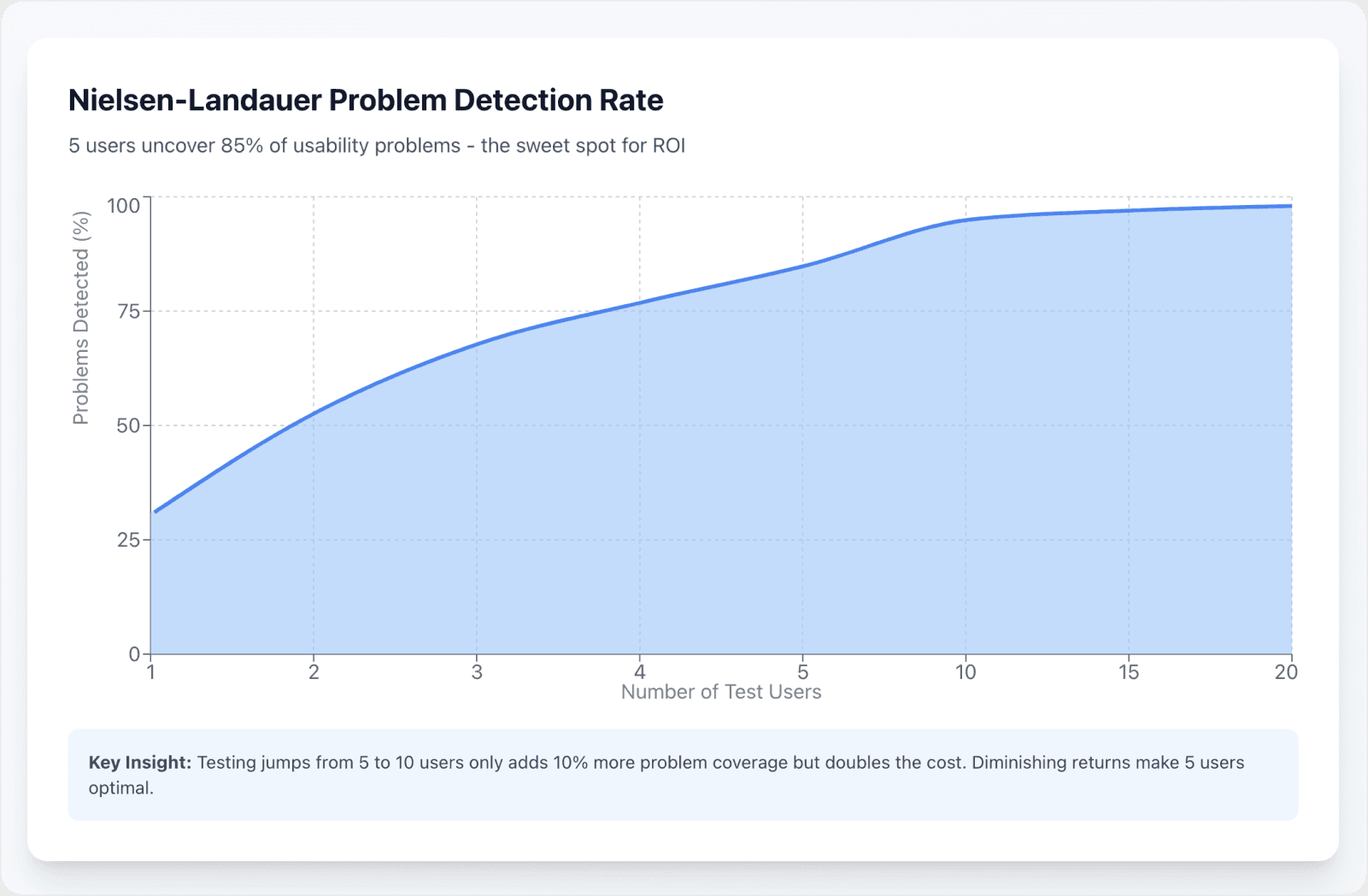
Jakob Nielsen's foundational research demonstrates that 5 users per segment uncover approximately 85% of usability problems in a typical digital product.
This finding has become one of the most cited principles in UX research.
The Mathematical Foundation
The formula assumes a 31% problem-discovery rate per user, meaning each participant reveals roughly one-third of existing issues.
This might seem low until you understand the mathematics of problem detection.
Validation Across Studies
The mathematical model has been validated across hundreds of studies spanning multiple decades and diverse product categories. It remains one of the most reliable guidelines in UX research methodology.
Why Problem Detection Clusters
The principle works because usability problems tend to cluster in predictable ways:
The most severe issues affect multiple users
Edge cases appear less frequently
As you test additional users, you encounter diminishing returns where new participants increasingly report problems you've already documented
The Debugging Analogy
Think of it like debugging code. The first test run often reveals multiple crashes and errors. Subsequent runs find fewer new issues because you've fixed the most common problems.
The same pattern applies to usability testing—early participants surface the big issues that affect most users.
Expert Perspective on Sample Size
As Nielsen himself has noted, "Elaborate usability tests are a waste of resources. The best results come from testing no more than five users and running as many small tests as you can afford."
The Statistical Validation
Faulkner's Empirical Results
Laura Faulkner's empirical validation of Nielsen's formula shows the distribution of problem detection with five users follows a predictable pattern that holds across diverse testing scenarios:
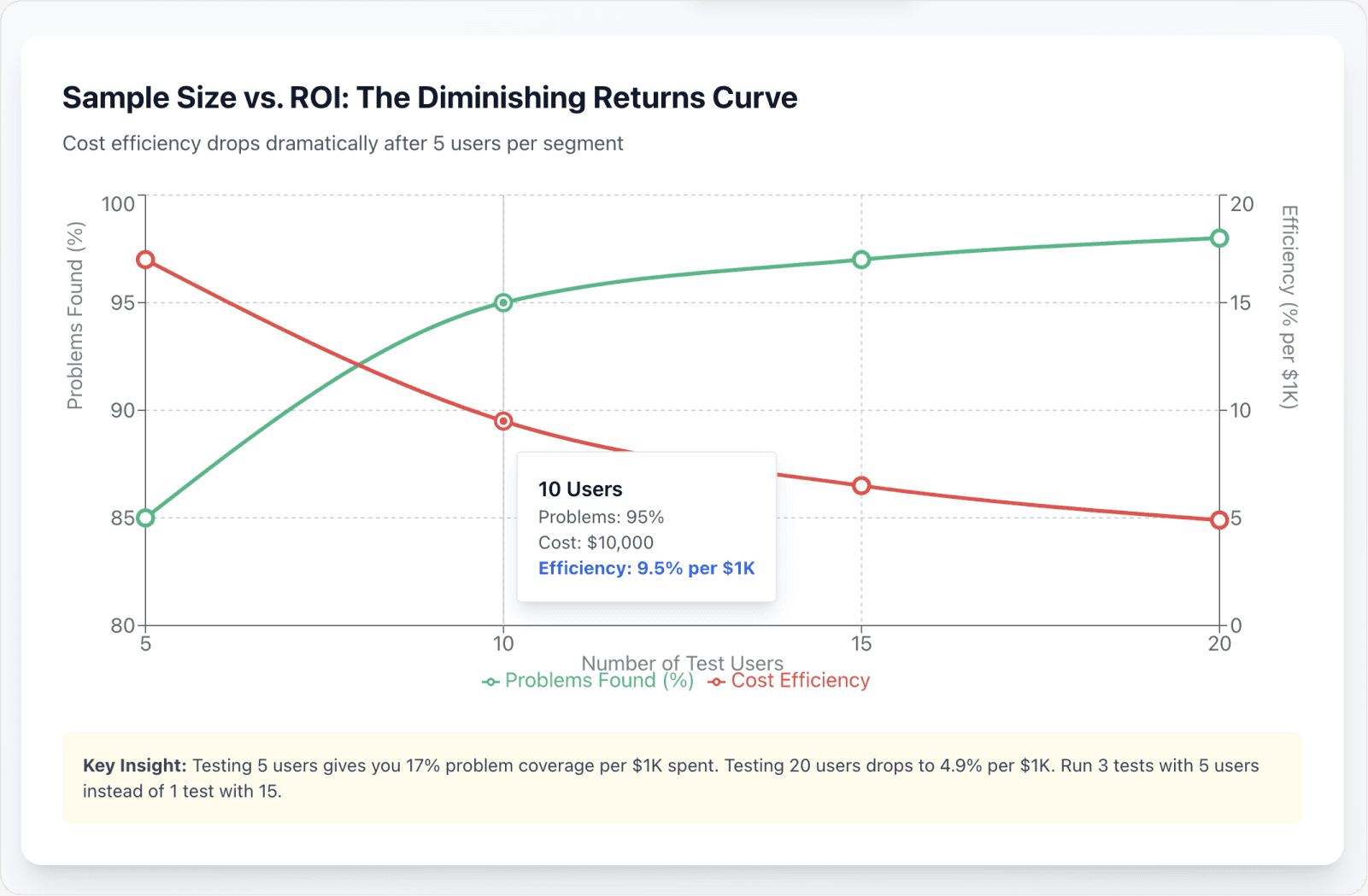
Mean detection rate: 85.55% of known problems
Minimum detection: 55% in worst-case scenarios
Maximum detection: 100% in optimal scenarios
This range reflects real-world variability in how representative your recruited users are.
Diminishing Returns at Scale
Increasing sample size yields diminishing returns that follow a logarithmic curve rather than a linear progression:
10 users: 94.69% mean detection (adding only 9 percentage points over 5 users)
15 users: 97.05% mean detection (adding another 2 percentage points for triple the sample)
20 users: 98.4% mean detection (approaching but never quite reaching complete coverage)
Expert Perspective on Cost-Effectiveness
As researchers at Carnegie Mellon's Human-Computer Interaction Institute have noted, "These diminishing returns mean that doubling your sample size from five to ten users only adds about nine percentage points of additional problem coverage, raising serious questions about cost-effectiveness for most projects."
Practical Implications for Testing Strategy
The practical implication is clear. If you have a limited budget for user research—and who doesn't—you're better off running three tests with five users each across three development cycles than running one test with fifteen users.
Iterative testing with small samples catches more problems and allows course corrections.
Segment-Specific Testing
The Per-Segment Rule
The "five users" rule applies per user persona or segment, not across your entire user base. This distinction is critical for products serving multiple distinct user populations.
Calculating Total Sample Needs
Products with multiple distinct user segments require proportional testing investment:
Two personas: need 10 users total (5 per segment)
Three personas: need 15 users total (5 per segment)
Why Segment Testing Matters
This ensures coverage of segment-specific mental models and task flows that heuristic evaluation might miss.
Different user groups often approach the same interface with fundamentally different expectations, background knowledge, and workflows.
Real-World Example: Dual-Segment Products
A project management tool, for example, serves both individual contributors and team managers. These segments have different goals, different feature priorities, and different mental models for how work should be organized.
Testing only individual contributors would miss critical issues that managers encounter.
Expert Perspective on Segment Diversity
As research from the Baymard Institute has shown, "Segment-specific usability problems often remain hidden until you test with actual representatives of each segment, because the friction points stem from context and expectations that designers may not anticipate."
Real-World Case: Enterprise Dashboard Failure
We worked with an enterprise software company that tested their new dashboard with five users, all from their largest customer segment. They felt confident based on the strong results.
Post-launch, they discovered that users from smaller organizations couldn't understand the hierarchy at all—their mental models didn't include the organizational structures the interface assumed. Testing with segment diversity would have revealed this disconnect.
Cost-Benefit Optimization
Budget Allocation for Testing
For a medium-sized project, usability testing represents between $5,000 and $20,000, or roughly 5% to 15% of the total redesign budget.
This percentage makes testing accessible for most development efforts.
Detailed Cost Breakdown
Testing with five to ten users costs approximately $3,000 to $8,000 when you factor in:
Recruitment expenses
Participant incentives
Facilitation time
Analysis effort
The bulk of cost typically comes from recruiting the right participants and analyzing results thoroughly.
What You're Preventing
This investment prevents the $60,000 to $120,000 average cost of post-launch redesign that legacy applications often require when fundamental usability problems surface only after deployment.
Expert Perspective on Testing ROI
As UX research leaders at Google have observed, "The ROI of user testing isn't about the problems you find—it's about the problems you prevent from reaching production, where each one costs exponentially more to address."
Opportunity Cost Consideration
The cost structure becomes even more favorable when you consider opportunity cost. Development time spent building features that users can't figure out how to use represents sunk investment.
Testing validates that development effort will translate to actual user success, not just shipped code.
Section Summary: User Testing Sample Size Science
Testing 5 users per segment uncovers 85% of usability problems, with diminishing returns beyond that point. Multiple segments require proportional samples (2 segments = 10 users). Investment of $3,000-$8,000 prevents $60,000-$120,000 in post-launch redesign costs. Iterative small-sample testing outperforms single large-sample tests.
6. The Gap Between Functional and Usable: Quantified
The Technical-Usability Divergence
The 70% Cart Abandonment Finding
70% of e-commerce carts are abandoned due to UX issues rather than technical failures.
This statistic illustrates a critical distinction that many technical founders miss or underestimate.
Functionality vs. Usability
Functionality confirms that features work as coded—buttons click, forms submit, calculations compute correctly.
Usability confirms that users can actually succeed in accomplishing their goals without excessive effort, confusion, or error.
The Disconnect in Practice
A checkout flow might execute flawlessly from a technical perspective while simultaneously creating so much cognitive load that users abandon the process before completion.
Every field executes properly, but the sequence violates user expectations about what information should be required when.
What Drives Cart Abandonment
Research from the Baymard Institute has documented that the majority of cart abandonment stems from:
Unexpected costs revealed too late in the process
Complicated checkout processes with too many steps
Forced account creation when users prefer guest checkout
These are all UX design decisions rather than technical bugs.
Expert Perspective on Modern Product Challenges
As e-commerce consultant Luke Wroblewski has noted:
"The hardest problems in digital products aren't technical anymore—they're the human problems of understanding what users expect, how they think, and where their patience runs out."
Real-World Case: Technically Perfect but Unusable Checkout
Consider a real example. One retailer we studied had a checkout form that worked perfectly from a technical standpoint. Every field validated correctly, the payment processing never failed, and error messages appeared when appropriate.
Yet fifty-three percent of users abandoned at checkout—well above the industry average. Testing revealed that users didn't understand why they needed to create an account before seeing shipping costs.
Both pieces of information were required by the backend system, but the sequence violated user expectations. Reordering the flow without changing any functionality reduced abandonment by thirty-two percent.
The Activation Chasm
Silent Churn from Poor Onboarding
Poor onboarding creates silent churn that many organizations never properly measure or attribute to UX problems. Users simply disappear from your funnel without clear signals about why.
Time-to-Value Correlation
Data shows that users who struggle with initial setup rarely return. The time-to-value metric directly correlates to retention rates across product categories and user segments.
The Step-by-Step Abandonment Tax
UX testing consistently reveals that every additional step in setup reduces completion rates by between 20% and 30%.
This creates an activation chasm where technically functional products fail to activate users because the interaction cost of getting started exceeds their motivation threshold.
Compound Probability Effects
These probabilities compound through your onboarding flow like failure rates in complex systems. If you have five steps, each reducing completion by twenty-five percent, you don't retain seventy-five percent of users—you retain twenty-four percent.
The mathematics of sequential friction work against you.
Expert Perspective on First Session Impact
As retention experts at Reforge have documented, "The first session experience disproportionately predicts long-term engagement patterns, making activation friction one of the highest-leverage areas for UX optimization and one of the most expensive areas to get wrong."
Real-World Case: SaaS Onboarding Reduction
One SaaS company reduced their onboarding from seven steps to three by questioning which information they truly needed immediately versus what they could collect gradually.
Activation rates jumped from thirty-one percent to sixty-seven percent—more than doubling the number of users who reached their "aha moment" and experienced core product value.
The Measurable Business Impact
Conversion Rate Improvements
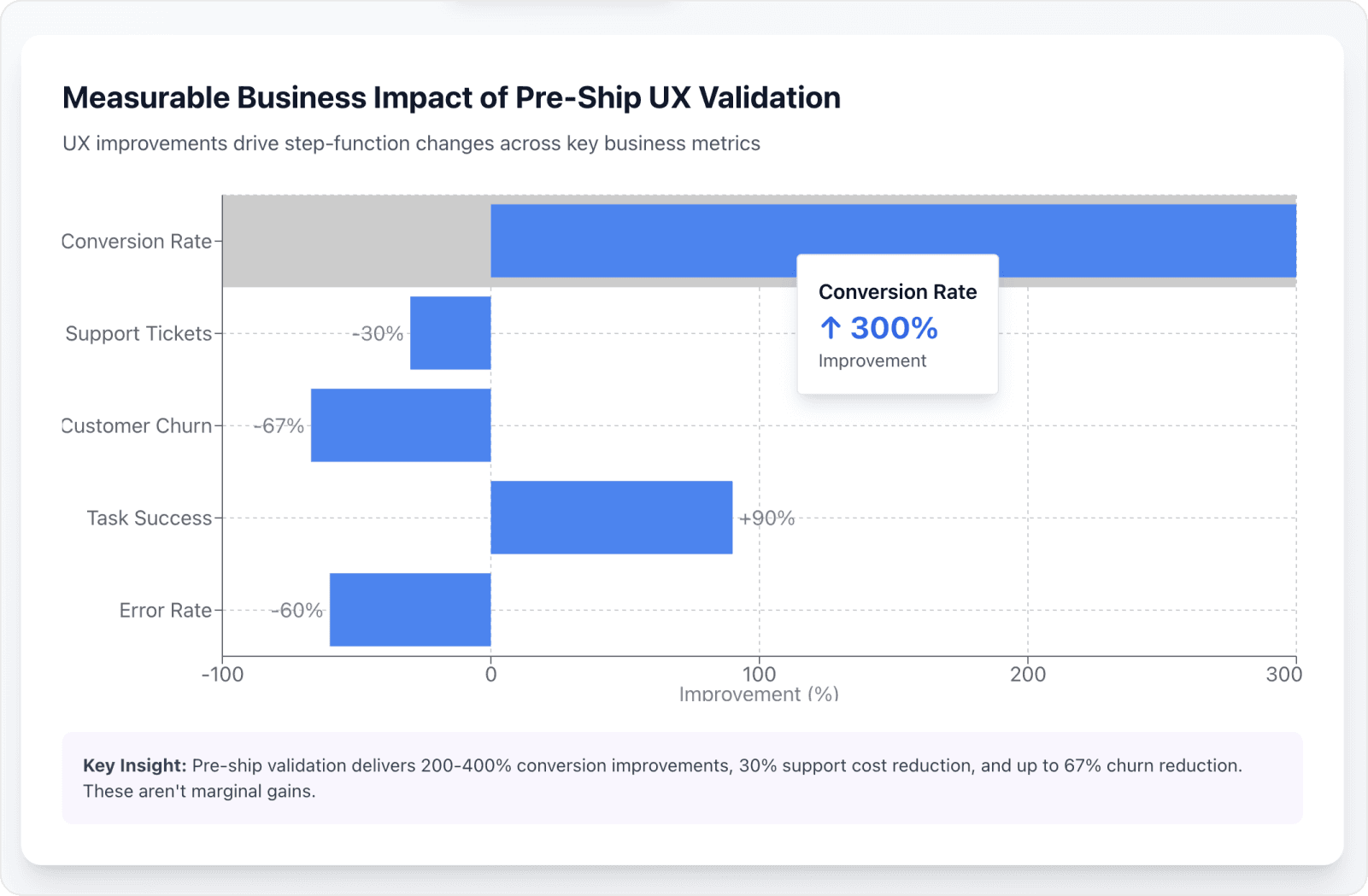
Companies investing in pre-ship UX validation report transformative business outcomes that extend across multiple operational metrics and financial indicators.
Conversion increases of 200% to 400% from UX improvements are documented across multiple industries, from e-commerce to enterprise software. These aren't marginal gains—they're step-function improvements in business performance.
Support Ticket Reduction
Support ticket volumes drop by as much as 30% when interfaces align better with user mental models.
Users who understand how to complete tasks don't need to contact support, reducing operational costs while improving user satisfaction.
Task Success Rates
Task success rates for critical workflows reach 90% or higher when tested and refined before launch. This represents the difference between a product that works in theory and one that works in practice.
Error Rate Decreases
Error rates decrease by 50% to 70% when designs account for human cognitive limitations and common mistake patterns.
Users make fewer mistakes, which means fewer support contacts, fewer refund requests, and higher overall satisfaction.
Expert Perspective on Measurable Impact
As product leaders at Atlassian have noted, "The measurable business impact of UX isn't subtle—it shows up in conversion rates, support costs, and retention curves immediately after improvement implementation."
Section Summary: Functional vs. Usable Products
70% of cart abandonment stems from UX issues, not technical failures. Poor onboarding creates silent churn with each setup step reducing completion by 20-30%. Pre-ship validation delivers 200-400% conversion improvements, 30% support ticket reduction, 90%+ task success rates, and 50-70% fewer user errors.
7. Implementation Framework: The Pre-Ship UX Validation Stack
Phase 1: Heuristic Evaluation (Week 1-2)
When to Conduct Heuristic Evaluation
The first phase involves expert evaluation using established usability principles, typically conducted during the design or early development stage.
Investment and Coverage
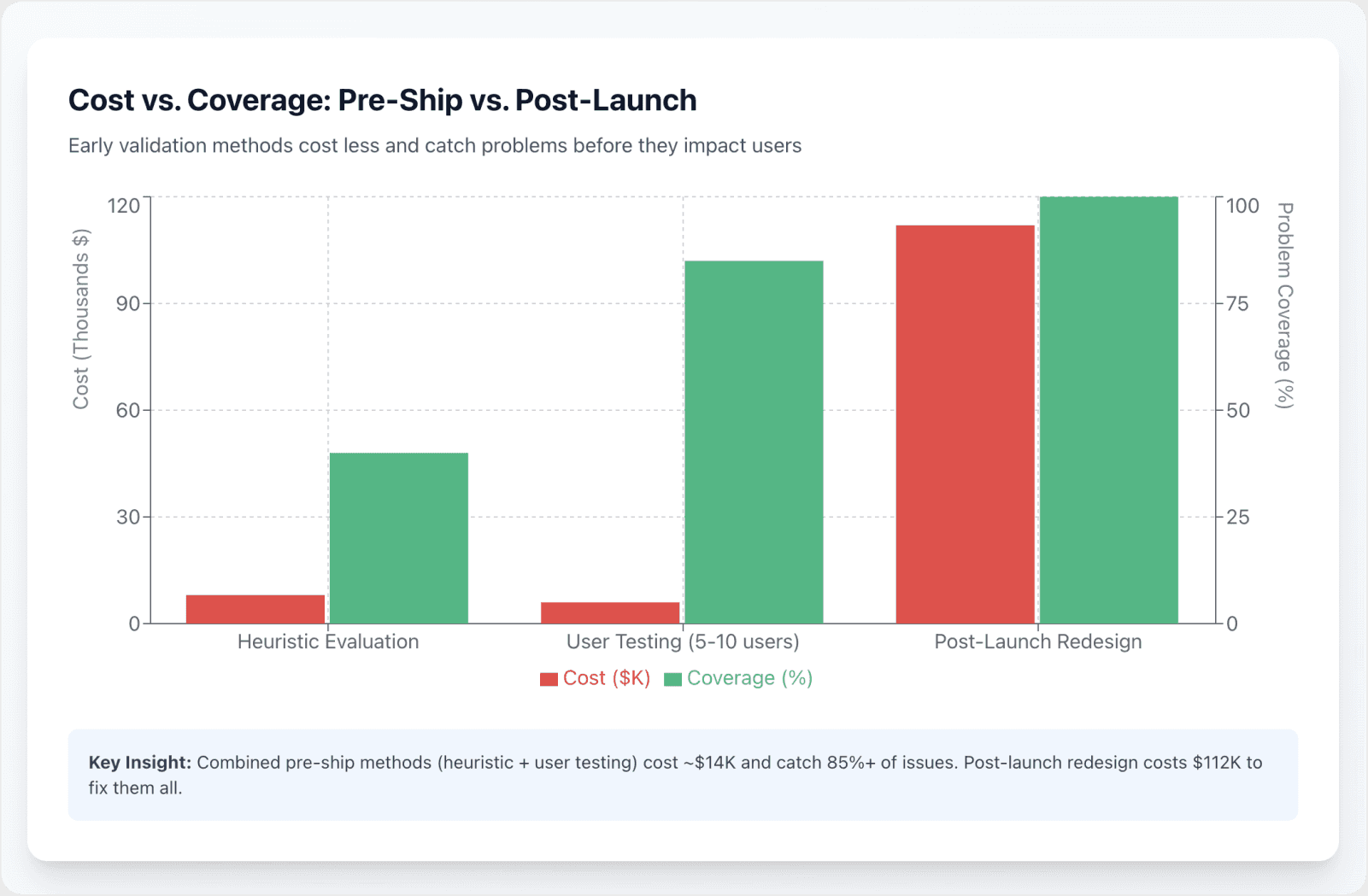
Investment ranges from $2,400 to $12,000 depending on the number of evaluators and the complexity of your product. This typically covers 30% to 50% of usability problems.
What You Receive
The deliverable is a prioritized issue list with severity ratings that guide development priorities.
High-severity issues that will affect most users get addressed first, while lower-severity issues might be deferred to later sprints.
What You're Preventing
This investment prevents between **$50,000and $150,000** in post-launch redesign costs. You're catching the most predictable failures early, when making changes requires minimal technical rework and no user communication.
Expert Perspective on Timing
As UX strategy consultants at Nielsen Norman Group have noted, "Heuristic evaluation delivers the highest ROI per research hour because expert evaluators can surface critical issues without any user recruitment, making it ideal for early validation."
Recommended Timing
We recommend conducting heuristic evaluation before investing heavily in visual design or advanced development. This allows you to fix information architecture and interaction design issues while they're still easy to change.
Phase 2: Small-Scale User Testing (Week 3-4)
When to Conduct User Testing
The second phase shifts from expert review to empirical testing with representative users, typically conducted once you have a functional prototype or MVP.
Investment Range and Sample Size
Investment ranges from $3,000 to $8,000 for five to ten carefully recruited participants.
Cost Breakdown
The cost breakdown includes:
Screening and recruiting participants who match your target segments
Incentive payments that compensate for their time
Facilitation time including test protocol development and moderation
Analysis effort to identify patterns and prioritize findings
Problem Detection Rate
This phase uncovers 85% to 95% of segment-specific problems that might not surface in expert evaluation. You're validating that real users with diverse backgrounds and expectations can succeed with your design decisions.
Deliverables Provided
The deliverables include:
Task success rates that quantify usability
Error pattern documentation that reveals systematic problems
Qualitative insights about user mental models that explain why certain approaches work or fail
Business Impact
This phase directly addresses the 67% of churn drivers rooted in UX friction. It enables the 200% to 400% conversion improvements documented in multiple economic impact studies.
Expert Perspective on Empirical Validation
As user research leaders at Meta have observed, "Small-scale testing with real users validates assumptions that expert review can only hypothesize about, making it essential for catching segment-specific friction before launch."
Phase 3: Iterative Validation (Ongoing)
Embedding Validation into Development
The final phase embeds UX validation into regular development cadence, treating it as an ongoing investment rather than a one-time project.
Ongoing Budget Allocation
This approach consumes between 5% and 15% of total redesign budget on a continuing basis.
Teams conduct validation before each major feature release, treating UX testing as a standard pre-launch checklist item.
Key Metrics to Track
The metrics tracked include:
Friction scores that quantify interaction cost
Net Promoter Score that captures satisfaction trends
Task completion rates that validate usability across critical workflows
Documented Business Impact
The business impact of this ongoing practice includes:
415% ROI over three years
Payback periods under six months
These results come from comprehensive Total Economic Impact studies of companies implementing systematic validation processes.
Expert Perspective on Continuous Validation
As product development experts at Intercom have noted, "The companies that win on UX aren't those that do one big research project—they're the ones that embed small, frequent validation into their regular development rhythm, catching problems while they're still easy to fix."
Section Summary: Three-Phase Validation Framework
Phase 1 (weeks 1-2): Heuristic evaluation costs $2,400-$12,000, catches 30-50% of problems, prevents $50,000-$150,000 in post-launch fixes. Phase 2 (weeks 3-4): User testing with 5-10 participants costs $3,000-$8,000, uncovers 85-95% of issues, enables 200-400% conversion gains. Phase 3 (ongoing): Continuous validation at 5-15% of budget delivers 415% ROI with <6 month payback.
Conclusion
The data systematically refutes the "I'll know it when I see it" assumption with quantified financial risk that no evidence-based founder should ignore or discount.
Pre-ship UX evaluation isn't a design luxury reserved for companies with generous budgets. It's not a nice-to-have refinement that you defer until product-market fit.
It's a business-critical risk management function that delivers measurable returns.
The Four Foundational Pillars
The case is built on multiple reinforcing pillars:
Cost Prevention: UX validation prevents 100x cost escalation by catching issues during design, when changes require minimal technical rework
Revenue Generation: It delivers 9,900% ROI through conversion and retention gains that compound over customer lifecycles
Churn Reduction: It reduces 67% of churn drivers that silently erode revenue while teams focus on feature development
Efficient Problem Detection: It achieves 85% problem detection with just five users per segment—a remarkably efficient information return
The Real Cost of Skipping Validation
Founders who skip structured UX validation aren't saving money or moving faster toward their goals. They're making a $75,000 to $250,000 bet that their intuition outperforms empirical data and established methodology.
That bet might occasionally pay off, but the odds are quantifiably against you.
The Predictable Path Forward
In a landscape where 70% of design issues surface post-launch—precisely when they're most expensive to address—systematic heuristic evaluation and small-scale user testing represent the only predictable path from "technically functional" to "demonstrably user-friendly."
Reframing the Choice
The choice isn't between perfection and speed. It's between structured pre-ship validation that costs thousands and unstructured post-launch firefighting that costs hundreds of thousands.
The evidence is unambiguous, the economics are compelling, and the methodology is accessible to teams of any size.
The Evidence-Based Decision
We can either invest in knowing what works before we ship, or we can pay exponentially more to fix what fails after users encounter it.
The data tells us unequivocally which path delivers better outcomes, lower costs, and more sustainable growth.
Research Institutions and Methodologies
Nielsen Norman Group (usability heuristics and evaluation methodology)
Stanford Human-Computer Interaction Group (user research and mental model analysis)
IBM Systems Sciences Institute (software development cost analysis)
Carnegie Mellon Human-Computer Interaction Institute (statistical validation of testing methods)
Business and Strategy Research
Forrester Research (UX ROI and economic impact studies)
McKinsey & Company (design-led business performance analysis)
Gartner (customer acquisition and retention economics)
Harvard Business Review (design business value documentation)
Bain & Company (customer retention and loyalty research)
Industry Analysis and Data
Baymard Institute (e-commerce usability research and cart abandonment analysis)
Interaction Design Foundation (UX education and research synthesis)
Reforge (product growth and retention frameworks)
Gainsight (customer success and churn analysis)
Product and Design Leadership
IDEO (design thinking and business impact)
Meta (user research at scale)
Google (product usability standards)
Atlassian (product development best practices)
Intercom (product-led growth and UX)
UX Thought Leaders
Jakob Nielsen (usability testing methodology and sample size research)
Don Norman (human-centered design principles)
Rolf Molich (heuristic evaluation research)
Luke Wroblewski (form and interaction design)
Laura Faulkner (statistical validation of usability testing)